A chart shows that the Baltic Dry Index has stabilized and rebounded, with freight rates for large vessels rising.
2026-11-18 22:54:30
The latest data shows that on November 18, 2026, the Baltic Dry Index (BDI) was 2914 points, up 0.73% from the previous day, marking the largest increase in four days. Looking at the short-term charts, the BDI saw positive growth 8 times, negative growth 3 times, and zero growth 0 times in the last 11 BDI data points. Specifically, the Panamax Freight Index (BPI) was 2129 points, up 0.33% from the previous day; the Capesize Freight Index (BCI) was 4549 points, up 1.40%; and the Supramax Freight Index (BSI) was 1817 points, down 0.55%. For detailed charts of the latest 720-day and 10-year trends of the Baltic Dry Index and its three main sub-indices, please refer to the charts specially created by FX678. 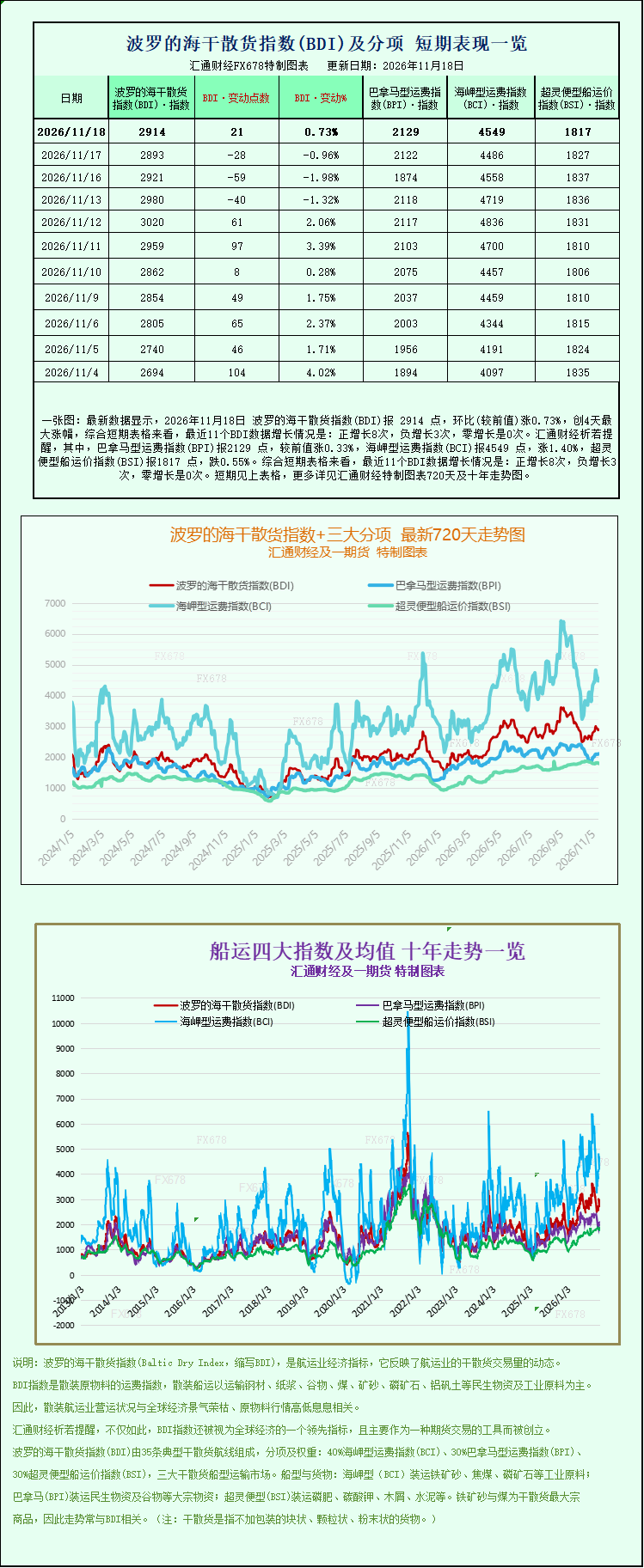 On Wednesday, the Baltic Dry Index (BDI), the core shipping index of the Baltic Dry Exchange, saw a slight increase. This index reflects global dry bulk shipping rates, and the rise was mainly driven by a moderate increase in freight rates for Capesize and Panamax vessels. There was a clear divergence in market conditions between different vessel types, with smaller vessel rates experiencing a slight decline. The Baltic Dry Index (BDI), representing the combined performance of freight rates for Capesize, Panamax, and Supramax vessels, rose 21 points, or 0.7%, to close at 2914 points. By vessel type, the Capesize index rose 63 points, or 1.4%, to 4549 points, which was the core force driving the overall index upward. Capesize vessels are the largest and most dominant vessel type in the dry bulk shipping market, with a typical deadweight tonnage of 150,000 tons. They primarily handle the long-distance transoceanic transport of bulk raw materials such as iron ore and thermal coal, with routes mainly concentrated on Australian and Brazilian iron ore shipments to East Asian steel-producing countries, as well as inter-regional coal trade routes. Along with the index's rise, the average daily earnings of these vessels increased by $569 to $37,753. Iron ore futures also closed higher, providing fundamental support for the Capesize vessel market: domestic core steel mills maintained relatively high pig iron production, coupled with rising market expectations for winter raw material restocking, leading to increased willingness among traders to actively inquire and stock up, resulting in a marginal recovery in demand for transoceanic iron ore transport. However, it should be noted that the current demand recovery is largely seasonally driven; the overall profit margin of the downstream steel industry remains weak, limiting the incentive for steel mills to continuously stockpile large quantities, making it difficult to support a trend of explosive growth in freight rates. The Panamax index rose slightly by 7 points to close at 2129 points. Panamax vessels, with a deadweight range of 60,000 to 70,000 tons, are adapted to the traditional Panama Canal navigation restrictions. They primarily transport coal and grain, with routes covering multiple main lines in the Atlantic and Pacific Oceans. They are not only the main vessel type for global energy coal transportation but also an important carrier for North and South American grain exports and Southeast Asian grain trade. The average daily earnings for this vessel type increased by $60 to $19,161. The seasonal rhythm of energy trade and agricultural product exports influences the Panamax vessel market: after the Northern Hemisphere enters winter, demand for coal for thermal power generation in some overseas regions increases, driving the release of seaborne thermal coal orders; at the same time, the South American and North American grain harvest and export window remains open, and demand for grain chartering supports freight rates. However, supply-side constraints are not strong, and the pressure of new vessel deliveries continues, suppressing the upward potential of freight rates, which only show a slow and moderate upward trend. Another aspect of the market divergence is reflected in the Supramax vessel sector. The Supramax vessel index, corresponding to small dry bulk carriers, fell 10 points, a decrease of 0.6%, closing at 1817 points. Supramax vessels, with their smaller tonnage and greater flexibility in port calls, are suitable for short-haul, feeder, and small-to-medium-sized port bulk cargo transportation. They handle a wide range of goods, including building materials, small-batch grains, and bulk fertilizers, primarily serving regional and near-sea trade. The weakening freight rates for this type of vessel reflect relatively sluggish near-sea feeder cargo, insufficient activity in regional industrial raw materials and building materials trade, more intense competition in short-haul shipping, and weaker bargaining power for shipowners, contrasting sharply with the recovery in the market for large ocean-going vessels. Overall, the dry bulk market this week exhibited a structural trend of "strong large vessels, weak small vessels." The composite index rose slightly, but this was not due to a simultaneous surge in demand across the market. Instead, it was driven by seasonal restocking of long-distance bulk commodities like iron ore and coal, which benefited very large ocean-going vessels. Near-sea and feeder bulk cargo demand remained weak, dragging down freight rates for smaller vessels. From a market sentiment perspective, most participants are currently adopting a wait-and-see approach. Charterers are unlikely to lock in long-term capacity at high prices, and shipowners are only raising prices based on short-term cargo, without a unified expectation of further price increases. Looking ahead, the core variables for market trends remain focused on the pace of raw material procurement in the East Asian steel industry, the realization of winter coal consumption, and the progress of grain export shipments. If steel mill pig iron production remains stable and winter restocking orders continue to materialize, the resilience of Cape-class freight rates is expected to persist. However, if end-user steel consumption falls short of expectations and steel mills quickly halt raw material restocking, seaborne iron ore demand will cool rapidly, and large vessel freight rates will face the risk of correction. Meanwhile, the long-term pressure from new global dry bulk vessel capacity deployments persists, continuously limiting the ceiling for this round of freight rate increases. For Supramax vessels to reverse their downward trend, they need to wait for a recovery in demand from regional manufacturing and building materials trade, leading to a large release of near-sea cargoes. In the short term, the dry bulk market is likely to continue this structurally differentiated pattern, with different vessel types potentially continuing to diverge in their price movements.
- Risk Warning and Disclaimer
- The market involves risk, and trading may not be suitable for all investors. This article is for reference only and does not constitute personal investment advice, nor does it take into account certain users’ specific investment objectives, financial situation, or other needs. Any investment decisions made based on this information are at your own risk.