Gold rebounded sharply from oversold levels and rose above 3600, awaiting a test of resistance.
2026-11-23 09:56:31
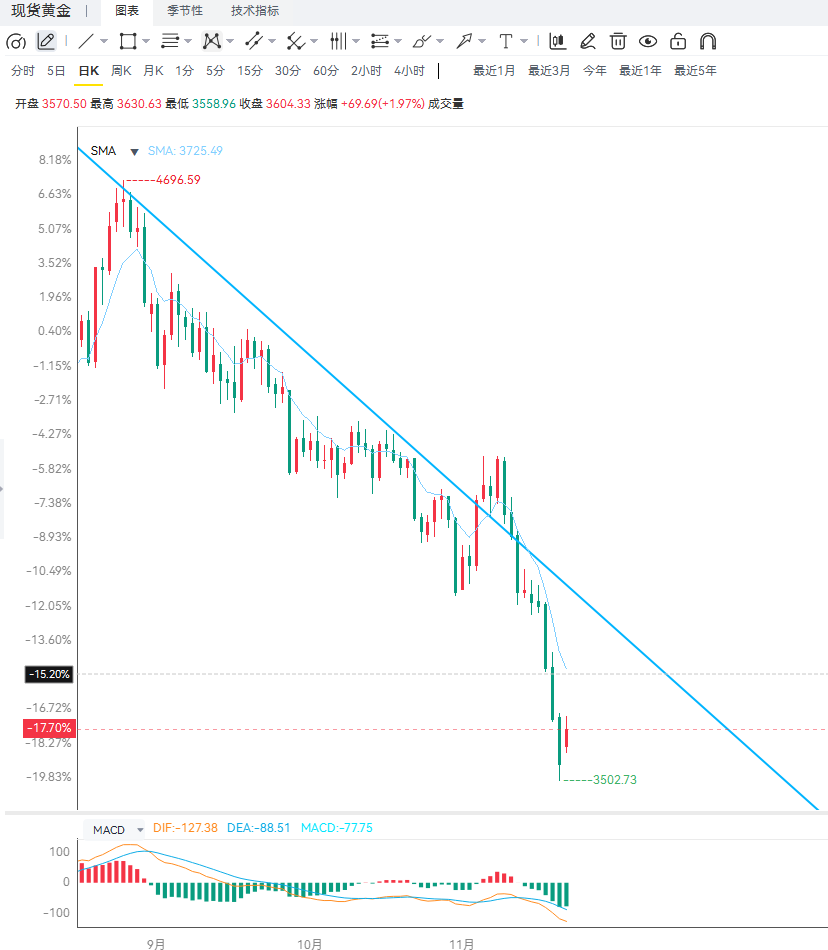
Gold extended its rebound on Monday, rising above $3,600 and ending a five-day losing streak. This rally was fueled by concerns surrounding AI trading, which pressured risk assets and prompted investors to seek safe-haven assets. It's important to clarify that this upward movement should be characterized as an oversold bounce – there are no clear reversal signals on the daily chart, the price remains well below the Bollinger Band middle line and the 100-day simple moving average, the trend structure has not been repaired, and only the downward momentum has shown signs of temporary exhaustion.  U.S. Treasury yields fell significantly due to concerns related to AI trading. The 10-year Treasury yield fell below 5.0% , while the 2-year yield is on track for its biggest weekly drop since September 2024. Lower yields reduce the opportunity cost of holding gold, which doesn't pay interest, and are the most direct driver of this rebound. However, the Federal Reserve's hawkish interest rate expectations may put selling pressure on gold prices. Philadelphia Fed President Anna Paulson warned of inflation risks, suggesting that further rate hikes may be needed, reinforcing expectations that U.S. borrowing costs will continue to rise. Meanwhile, Governor Christopher Waller said last week that a 50-basis-point rate hike in December should be considered. According to the CME FedWatch tool, the market currently sees a 93.2% probability of a 25-basis-point rate hike in December. "Higher interest rates, a stronger dollar, and the prospect of continued high inflation—which will prompt the Fed to continue raising rates—all of these factors we've been seeing are negatively impacting gold," said analyst Meger. Deutsche Bank strategists point out that the latest wave of risk aversion is spreading across markets, with a "risk-averse tone" suppressing various assets. Federal Reserve Governor Cook has sent a significantly more hawkish signal, with his FXS speech tracking score reaching 8.6/10 , significantly higher than the historical average of 7.7/10 , clearly pointing to a tighter policy stance. His assessment that the current position "does not provide the necessary restraint" and that a September rate hike is "not sufficient" indicates an openness to further rate hikes, especially against the backdrop of strong growth, a healthy labor market, and inflation described as "extremely worrying." The emphasis on embedded inflation risks and "overly accommodative" financial conditions strengthens the upside risk for the dollar as the market prices a path of sustained high interest rates for a longer period. The FXS Fed Sentiment Index rose 1.58 points to 152.14 , deepening its already clearly hawkish stance and well above the neutral level of 100. This change confirms that Cook's remarks have been interpreted as a substantial hawkish shift in the Fed's communication tone. From a technical perspective, gold continues its bearish trend on the daily chart. The spot price is far below the middle Bollinger Band (20) and the 100-day simple moving average, so the current movement should be characterized as an oversold rebound rather than a trend reversal. However, the rebound has made substantial progress: the current price of 3600 is about $30 higher than the lower Bollinger Band of 3570 , and the lower band has been recovered and turned into support ; the 14-day Relative Strength Index (RSI) of about 28 is still in the oversold zone, but the rebound from the low of 3545 last Friday has recovered about 29% of the previous drop of about $190, and has crossed the 23.6% retracement level (about 3590). The next level is the 38.2% retracement at about 3618 and the 50% retracement at about 3640 , which together constitute a series of thresholds that need to be broken one by one for the rebound to continue. Regarding volatility, the Bollinger Bands are expanding rapidly—on November 19th, the range was 4180 to 3770, with a width of approximately $410; on November 20th, it expanded to 4210 to 3705, with a width of approximately $505; and this time it has further expanded to 4255 to 3570, with a width of approximately $685 , a widening of about 67% in two days. This confirms the judgment that volatility has increased significantly . The coexistence of rising volatility and oversold rebounds means that the probability of false breakouts and rapid pullbacks during the rebound process is increasing simultaneously, which is why waiting for stress tests should be the main observation method. On the 4-hour chart, the price has recovered the lower Bollinger Band at 3570 and the psychological level of 3600 from the low of 3545 last Friday, and the short-term momentum has turned from weak to stable, but it has not yet crossed 3630, so the pattern is still a correction rather than a breakout. Since no clear reversal signal has yet appeared on the daily chart, the sustainability of the bullish recovery depends on two conditions: first, holding the support zone of 3550 to 3570; and second, not giving back most of the gains during the resistance test at 3800. If it encounters resistance at 3800 and falls back quickly, this rebound is more likely to be characterized as a technical correction within a downtrend; if it can hold above 3800, the recovery could be upgraded.
 Editor's Summary: This rebound was driven by safe-haven flows into US Treasuries, pushing down yields , rather than a shift in monetary policy expectations. On the contrary, policy is still tightening: a 25 basis point rate hike in December has been priced in by 93.2%, Waller suggested considering 50 basis points, Paulson warned of inflation risks, Cook's speech received a rating of 8.6/10, far exceeding historical averages, and he stated bluntly that the current stance "does not provide the necessary restraint," with the sentiment index rising to a historically hawkish high of 152.14 . Therefore, gold has only benefited from half of the "declining yields" positive impact, while bearing the full pressure of "rising real interest rate expectations." This is the fundamental reason why the rebound has only recovered about 29% of the previous decline and has failed to return to the middle band area. In the medium term, if concerns about AI trading continue to suppress equity assets and yields, gold may get a temporary respite; however, if policy turns further hawkish or liquidity tightening intensifies, the oversold rebound is likely to fail.
U.S. Treasury yields fell significantly due to concerns related to AI trading. The 10-year Treasury yield fell below 5.0% , while the 2-year yield is on track for its biggest weekly drop since September 2024. Lower yields reduce the opportunity cost of holding gold, which doesn't pay interest, and are the most direct driver of this rebound. However, the Federal Reserve's hawkish interest rate expectations may put selling pressure on gold prices. Philadelphia Fed President Anna Paulson warned of inflation risks, suggesting that further rate hikes may be needed, reinforcing expectations that U.S. borrowing costs will continue to rise. Meanwhile, Governor Christopher Waller said last week that a 50-basis-point rate hike in December should be considered. According to the CME FedWatch tool, the market currently sees a 93.2% probability of a 25-basis-point rate hike in December. "Higher interest rates, a stronger dollar, and the prospect of continued high inflation—which will prompt the Fed to continue raising rates—all of these factors we've been seeing are negatively impacting gold," said analyst Meger. Deutsche Bank strategists point out that the latest wave of risk aversion is spreading across markets, with a "risk-averse tone" suppressing various assets. Federal Reserve Governor Cook has sent a significantly more hawkish signal, with his FXS speech tracking score reaching 8.6/10 , significantly higher than the historical average of 7.7/10 , clearly pointing to a tighter policy stance. His assessment that the current position "does not provide the necessary restraint" and that a September rate hike is "not sufficient" indicates an openness to further rate hikes, especially against the backdrop of strong growth, a healthy labor market, and inflation described as "extremely worrying." The emphasis on embedded inflation risks and "overly accommodative" financial conditions strengthens the upside risk for the dollar as the market prices a path of sustained high interest rates for a longer period. The FXS Fed Sentiment Index rose 1.58 points to 152.14 , deepening its already clearly hawkish stance and well above the neutral level of 100. This change confirms that Cook's remarks have been interpreted as a substantial hawkish shift in the Fed's communication tone. From a technical perspective, gold continues its bearish trend on the daily chart. The spot price is far below the middle Bollinger Band (20) and the 100-day simple moving average, so the current movement should be characterized as an oversold rebound rather than a trend reversal. However, the rebound has made substantial progress: the current price of 3600 is about $30 higher than the lower Bollinger Band of 3570 , and the lower band has been recovered and turned into support ; the 14-day Relative Strength Index (RSI) of about 28 is still in the oversold zone, but the rebound from the low of 3545 last Friday has recovered about 29% of the previous drop of about $190, and has crossed the 23.6% retracement level (about 3590). The next level is the 38.2% retracement at about 3618 and the 50% retracement at about 3640 , which together constitute a series of thresholds that need to be broken one by one for the rebound to continue. Regarding volatility, the Bollinger Bands are expanding rapidly—on November 19th, the range was 4180 to 3770, with a width of approximately $410; on November 20th, it expanded to 4210 to 3705, with a width of approximately $505; and this time it has further expanded to 4255 to 3570, with a width of approximately $685 , a widening of about 67% in two days. This confirms the judgment that volatility has increased significantly . The coexistence of rising volatility and oversold rebounds means that the probability of false breakouts and rapid pullbacks during the rebound process is increasing simultaneously, which is why waiting for stress tests should be the main observation method. On the 4-hour chart, the price has recovered the lower Bollinger Band at 3570 and the psychological level of 3600 from the low of 3545 last Friday, and the short-term momentum has turned from weak to stable, but it has not yet crossed 3630, so the pattern is still a correction rather than a breakout. Since no clear reversal signal has yet appeared on the daily chart, the sustainability of the bullish recovery depends on two conditions: first, holding the support zone of 3550 to 3570; and second, not giving back most of the gains during the resistance test at 3800. If it encounters resistance at 3800 and falls back quickly, this rebound is more likely to be characterized as a technical correction within a downtrend; if it can hold above 3800, the recovery could be upgraded. Editor's Summary: This rebound was driven by safe-haven flows into US Treasuries, pushing down yields , rather than a shift in monetary policy expectations. On the contrary, policy is still tightening: a 25 basis point rate hike in December has been priced in by 93.2%, Waller suggested considering 50 basis points, Paulson warned of inflation risks, Cook's speech received a rating of 8.6/10, far exceeding historical averages, and he stated bluntly that the current stance "does not provide the necessary restraint," with the sentiment index rising to a historically hawkish high of 152.14 . Therefore, gold has only benefited from half of the "declining yields" positive impact, while bearing the full pressure of "rising real interest rate expectations." This is the fundamental reason why the rebound has only recovered about 29% of the previous decline and has failed to return to the middle band area. In the medium term, if concerns about AI trading continue to suppress equity assets and yields, gold may get a temporary respite; however, if policy turns further hawkish or liquidity tightening intensifies, the oversold rebound is likely to fail.- Risk Warning and Disclaimer
- The market involves risk, and trading may not be suitable for all investors. This article is for reference only and does not constitute personal investment advice, nor does it take into account certain users’ specific investment objectives, financial situation, or other needs. Any investment decisions made based on this information are at your own risk.