There is currently no upward pressure on wages in the Eurozone, which may allow the European Central Bank to ease pressures.
2026-11-23 21:36:34
Eurozone inflation is driven by energy, but wage growth remains moderate. Analysts suggest there is currently no risk of a wage-price spiral, potentially allowing the European Central Bank (ECB) to slow its rate hike pace. Influenced by the rebound in energy prices, the ECB has already implemented two rate hikes this year, and the market widely expects a third next month. Eurozone inflation reached 4% in October, double the central bank's 2% target and a three-year high. On the surface, upward pressure on prices is significant, but the current inflationary drivers are highly concentrated in the energy sector. There are currently no clear signals that price increases have spread and evolved into widespread, endogenous, and persistent inflation. 
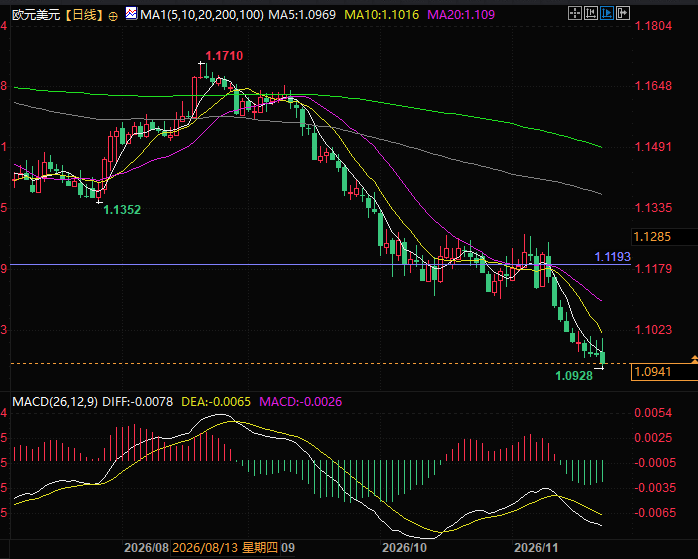 (Euro/USD daily chart, source: FX678) At 21:33 Beijing time, the euro/dollar exchange rate is currently 1.0941/42.
Central Bank's Core Concern: Beware of a Repeat of the 2022 Wage-Price Spiral
The risk that the European Central Bank is most wary of right now is a repeat of the inflationary situation of 2022. Back then, oil, gas, and electricity prices soared across the board, and the inflationary shock quickly spread to all categories of goods, creating a typical second-round inflation effect. Rising prices further pushed up wages, ultimately creating an unstoppable wage-price spiral, which is the scenario that policymakers are focusing on preventing.Wage data signals easing: a second round of inflation transmission has not yet occurred.
However, the latest wage data has temporarily alleviated this concern. The European Central Bank's (ECB) contractual wage indicator, a key indicator for assessing the risk of a wage-price spiral, shows that, so far, there are no signs of a second round of inflation transmission in the Eurozone's wage sector. Contractual wage growth in the third quarter only slightly increased from 2.5% to 2.6%, with wage growth remaining stable below 3%. According to the ECB's own assessment framework, under the assumptions of 2% inflation and 1% productivity growth, wage growth below 3% is consistent with the price stability target.A cooling labor market and accelerated wage increases lack a solid foundation.
The state of the labor market is fundamentally different from that of the 2022 inflation cycle. Although the unemployment rate has only risen moderately from a historical low of 6.2% in October 2024 to 6.5%, many leading indicators have weakened significantly, and the labor shortage reported by companies has dropped sharply. Wage growth and the hiring gap have historically been strongly correlated, and the current decline in the tightness of hiring by companies suggests that there is no solid foundation for accelerated wage growth.Overall assessment: The one-off energy shock provides a buffer for monetary policy.
Compared to the previous inflation cycle, the Eurozone labor market is currently experiencing a significant cooling, with workers' bargaining power weakening. Faced with cost pressures, companies are prioritizing controlling wage increases. Overall, this round of inflation is considered a one-off shock driven by energy prices, rather than persistent inflation fueled by overheated demand and continuously rising wages. Even if the market has already priced in a December rate hike, the moderate wage data will provide significant support for the ECB to slow the pace of rate hikes or even pause tightening earlier. (Euro/USD daily chart, source: FX678) At 21:33 Beijing time, the euro/dollar exchange rate is currently 1.0941/42.
- Risk Warning and Disclaimer
- The market involves risk, and trading may not be suitable for all investors. This article is for reference only and does not constitute personal investment advice, nor does it take into account certain users’ specific investment objectives, financial situation, or other needs. Any investment decisions made based on this information are at your own risk.