Gold Trading Alert: Gold prices have rebounded strongly from a more than one-year low, with bargain hunters flocking in after the AI sector turmoil, and a fierce battle between bulls and bears raging on the eve of the PCE.
2026-11-24 07:50:32
On Monday (November 23), the international gold market witnessed a dramatic rebound. After a sharp drop of over 9% last week, spot gold finally recovered strongly from its more than one-year low, surging as much as 4% to $3689.71 per ounce during the session, ultimately closing up 2.7% at around $3635.89. US gold futures performed even stronger, rising 4% to $3653.70. Jensen Huang's return to the fold triggered a 31.5% surge in Nvidia shares, and the rebound in US stocks attracted bargain hunters. However, the dollar hit a 19-month high, and the market is still betting on a Fed rate hike in December, causing gold prices to give back some of their gains towards the end of the session. The market is awaiting the release of the October Personal Consumption Expenditures (PCE) price index on Wednesday to further confirm the inflation trajectory and the Fed's next move. On Tuesday (November 24) in early Asian trading, spot gold fluctuated slightly lower, currently trading at $3628 per ounce, down about 0.2%. 
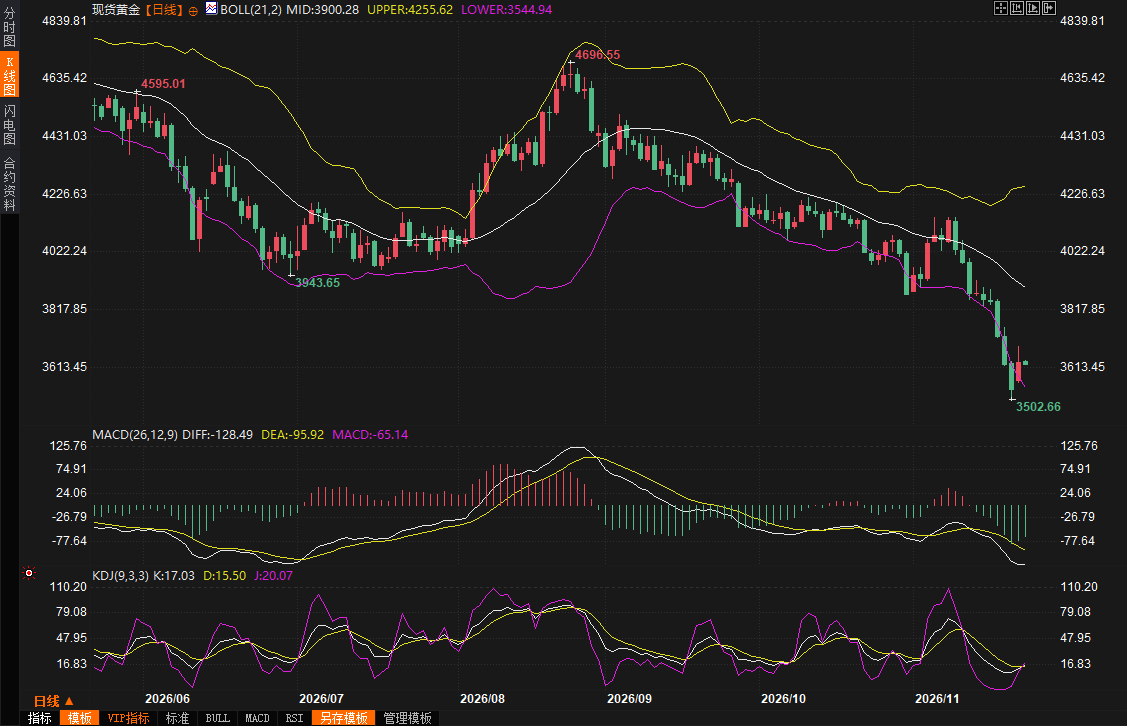 (Spot gold daily chart, source: FX678) At 07:45 Beijing time, spot gold is currently trading at $3627.74 per ounce.
The aftershocks of last week's plunge and Monday's bargain hunting
The gold market suffered a severe blow last week, falling by more than 9%, directly caused by a sharp sell-off in artificial intelligence-related stocks. Investors were forced to sell assets, including gold, to raise cash and meet margin requirements, causing gold prices to fall to their lowest level since September 2025. On Monday, market expectations that the Federal Reserve would maintain interest rates in December attracted bargain hunters, helping gold prices rebound above $3,600. Nvidia's dramatic announcement of the immediate reinstatement of Jensen Huang as CEO further fueled market sentiment. Nvidia's stock price surged 31.5% in a single day, marking its largest single-day gain since 2003, while the Nasdaq index soared by more than 6%, and the S&P 500 and Dow Jones Industrial Average rose by 4.73% and 3.01%, respectively. The strong stock market rebound alleviated the pressure from previous gold sell-offs to meet margin requirements, and some funds flowed back into the precious metals market, creating significant bargain hunting. Jim Wyckoff, a market analyst at American Gold Exchange, pointed out that there is a view in the market that if stock indices continue to plummet, the Federal Reserve will find it difficult to continue raising interest rates. While he believes this possibility is unlikely, the expectation itself has already supported the rebound in precious metals earlier this week. He also cautioned that the next few trading days will largely determine whether the market has bottomed out or is merely a dead cat rally in a bear market.Subtle oscillations in Fed policy expectations and the pressure on the dollar
The rebound in gold prices was not without its challenges. As sentiment in the US stock market improved, market expectations for the Federal Reserve's December policy also shifted. According to the CME Group's FedWatch tool, traders still bet on a 25 basis point rate hike in December with a 96.1% probability, while the probability of a 50 basis point hike rose to 3.9%. The probability of a cumulative 25 basis point rate hike by January next year is 32.1%, while the probability of a cumulative 50 basis point hike is as high as 65.3%. The expectation of "keeping interest rates unchanged," which had previously surged due to the stock market crash, quickly faded. This change in expectations directly boosted the US dollar. The dollar index once refreshed a 19-month high to 104.53, significantly suppressing gold prices, which were denominated in dollars. This caused gold prices to give back some of their gains after reaching around $3689, ultimately closing at around $3635. The negative correlation between the dollar and gold was fully reflected on Monday: the stock market rebound boosted risk appetite, but also reinforced the logic that the Fed might continue to tighten, thus constraining gold prices through the dollar channel. New York Fed President Williams' remarks on Monday further heightened market caution regarding the policy path. He explicitly stated that inflation was "too high" and that the Fed "still has work to do," and must ensure that inflation falls back to the 2% target in a timely and sustained manner. He expects inflation to remain around 3.5% by the end of this year, slowing to slightly above 2% next year, and not truly returning to the target level until 2028, with inflation risks still skewed to the upside. These comments corroborated the market's high expectations for a December rate hike, limiting the upside potential for gold.The complex interplay between falling oil prices and geopolitical factors
In contrast to gold, international oil prices continued to weaken. Brent crude fell 3.46% to $89.37 a barrel on Monday, while U.S. crude fell 3.88% to $80.17, both hitting three-month lows. The reopening of the Sharara pipeline in Libya, coupled with expectations of increased supply in the Middle East, was the main reason for the downward pressure on oil prices. JPMorgan Chase even predicts that, due to oversupply, crude oil futures prices may fall to around $70 a barrel in the first half of 2027. The decline in oil prices has alleviated inflation concerns to some extent, theoretically providing support for gold. However, geopolitical risks have not truly subsided. The Houthi rebels claimed to have attacked Saudi oil refineries, multiple attacks on ships occurred in the Persian Gulf and near the Strait of Hormuz, Iran launched missile and drone attacks on U.S. military sites in Bahrain, and Ukraine continued to strike Russian oil refining and transportation facilities. These events remind the market that the risk of supply disruptions still exists, only temporarily masked by news of increased supply. Goldman Sachs analysts noted in a report that the downward pressure on gold is expected to eventually reverse, but the reversal may be slow towards the end of the year. Some hedge funds may be reluctant to increase their risk exposure before the end of the year, and the Federal Reserve's expected rate hike in December provides them with another reason to postpone rebuilding their long gold positions, even though speculative positions have already declined significantly.Market sentiment and key turning points
In summary, Monday's gold rebound was more of a technical correction after last week's oversold condition and a return of liquidity due to a sudden shift in sentiment in the AI sector, rather than a fundamental change in fundamentals. The repricing of Fed policy expectations, the strength of the dollar, and year-end caution in the money market all constrained gold prices. Meanwhile, expectations of easing inflation due to falling oil prices and potential geopolitical risks provided some downside support for gold. Wednesday's upcoming October PCE data will be a key short-term catalyst. As the Fed's most valued inflation indicator, the PCE result will directly impact the market's reassessment of the December and next year's rate hike path. If the data continues to show strong inflation stickiness, the dollar and US Treasury yields may strengthen further, limiting the upside potential for gold; conversely, if inflation falls more than expected, it could open a larger upside window for gold. In conclusion, the gold market is currently in a sensitive phase of intertwined bullish and bearish forces. Last week's plunge exposed the reality that gold, as a liquid asset, can also be sold off during periods of sharp volatility in risk assets; Monday's rebound proves that once stock market sentiment stabilizes, bargain hunters will quickly emerge. The performance in the next few trading days will determine whether this rebound is a genuine confirmation of a short-term bottom or merely a brief respite in a downtrend. Investors need to closely monitor PCE data, subsequent statements from Federal Reserve officials, and developments in the geopolitical situation to seek more certain trading opportunities amidst the volatility. (Spot gold daily chart, source: FX678) At 07:45 Beijing time, spot gold is currently trading at $3627.74 per ounce.
- Risk Warning and Disclaimer
- The market involves risk, and trading may not be suitable for all investors. This article is for reference only and does not constitute personal investment advice, nor does it take into account certain users’ specific investment objectives, financial situation, or other needs. Any investment decisions made based on this information are at your own risk.