Falling oil prices coupled with expectations of three more Federal Reserve rate hikes sent the US dollar to a 19-month high against the Canadian dollar.
2026-11-24 15:20:36
The US dollar traded at 1.4359 against the Canadian dollar in Asian trading on Tuesday, nearing the 19-month high of 1.4385 reached in the previous session. The Canadian dollar's weakness was not due to its own internal factors, but rather a passive consequence of the broad-based strengthening of the US dollar – during the Asian trading session, the Canadian dollar faced widespread pressure against the US dollar. 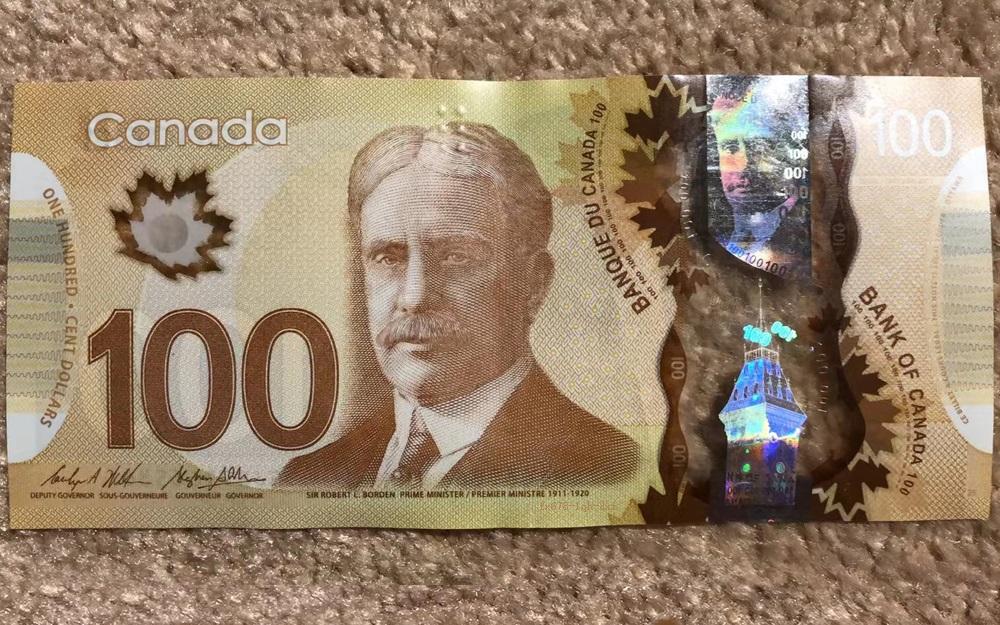 The core factor supporting this pattern is the renewed escalation of expectations for Federal Reserve rate hikes . Economists at TD Securities have upgraded their assessment of the policy outlook, now anticipating three consecutive rate hikes starting in December . Their argument is quite comprehensive: "Inflation remains above target and is heading in the wrong direction," and "The labor market has stabilized and shown some signs of strengthening, with activity data also robust." Based on this, the bank concludes that "the economy can withstand more constraints, and the Fed is likely to impose those constraints," but emphasizes that "the evolution of inflation data will determine the magnitude and pace of subsequent rate hikes in this cycle." It should be noted that this expectation represents a significant upgrade from the previous market consensus—the mainstream pricing previously favored two consecutive rate hikes in December and January , while TD Securities' "three consecutive hikes" implies a further extension of the tightening cycle's duration. The change from two to three rate hikes affects not only the magnitude but also the expectation of a "further destination," which provides sustained support for the US dollar rather than a one-off shock. The independent variable for the Canadian dollar lies in monetary policy. Bank of Canada Governor John Macklem will speak later today at the Economic Club of Canada in Toronto, Ontario, and financial markets will be closely watching his comments on the outlook for Canadian interest rates . Given the Canadian dollar's recent dependence on the US dollar, a hawkish tone from Macklem would provide much-needed support for the currency; conversely, a dovish tone or expressions of concern about the economic outlook would further confirm the strength of the USD/CAD pair . Technically, the USD/CAD pair is trading at 1.4359 on the daily chart, continuing its bullish trend , holding above the 9-period exponential moving average (EMA) at 1.4308 . The pair has trended higher throughout November , and while the 14-day Relative Strength Index (RSI) of around 71 suggests overbought conditions , momentum still points upward in the short term . On the downside, immediate support lies in the 1.4308 area defined by the short-term EMA , while the current price area of 1.4359 forms a near-term pivot point , which needs to give way to signal a deeper corrective pullback . As long as the support zone at 1.4308 holds, buyers are likely to remain dominant, despite the stretched momentum readings . On the 4-hour chart, the price is consolidating at high levels after reaching a 19-month high, with short-term momentum still biased upwards but showing signs of weakening. Two levels need to be observed: first, whether the 19-month high of 1.4385 can be retested and broken, which is a criterion for whether the upward trend can continue; second, whether the support zone at 1.4308 can hold. If this level is breached, it would mean the first substantial gap in the upward structure that has been consolidating since November.
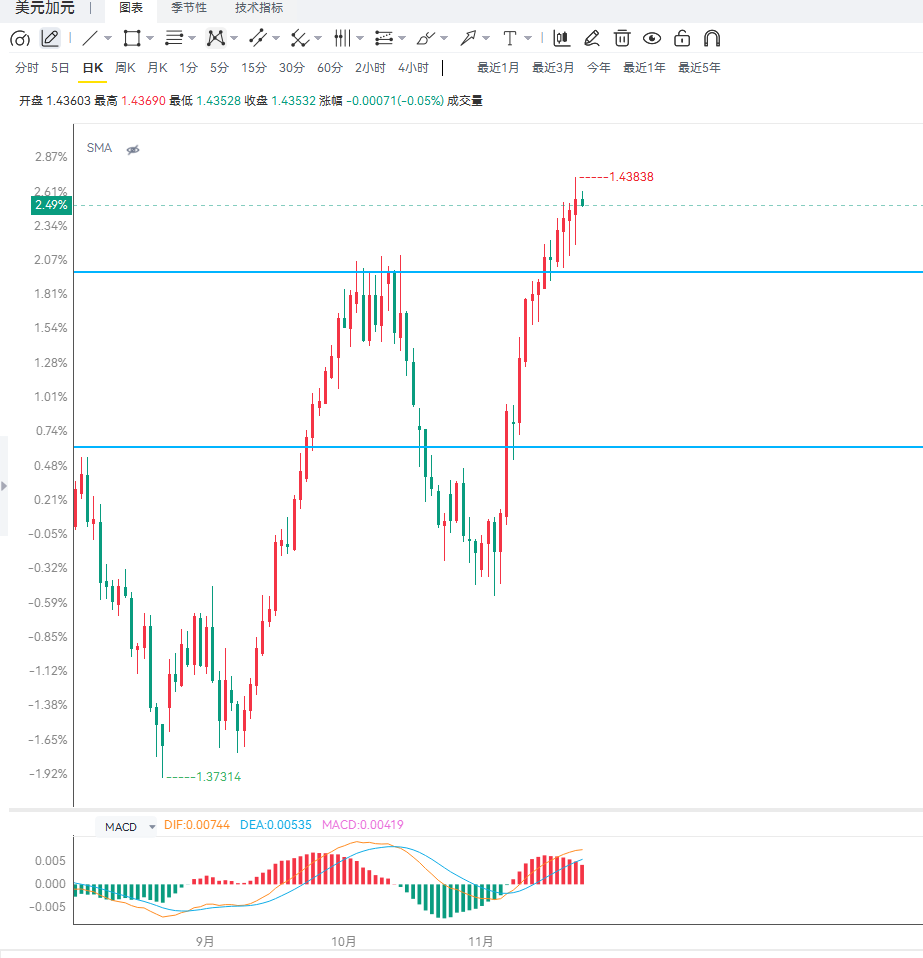 Editor's Summary: The USD/CAD pair reaching a 19-month high is a product of the convergence of two main themes: falling oil prices and a strengthening US dollar. Looking at the Canadian dollar, it broke through 1.43 on November 18th. Currently, with oil prices falling below $80 and hitting a three-month low, the Canadian dollar has lost its last external anchor. This chain of events proves that the weakness of the Canadian dollar is an inevitable consequence of its commodity currency nature, rather than a result of monetary policy—the approximately 11% drop in crude oil prices from above $90 to below $80 will inevitably be transmitted to the Canadian dollar through terms of trade. In the short term, key attention should be paid to Wednesday's actual PCE reading, the tone of Macklem's speech, the actual battle between 1.4385 and 1.4308, and the direction of oil prices below $80.
The core factor supporting this pattern is the renewed escalation of expectations for Federal Reserve rate hikes . Economists at TD Securities have upgraded their assessment of the policy outlook, now anticipating three consecutive rate hikes starting in December . Their argument is quite comprehensive: "Inflation remains above target and is heading in the wrong direction," and "The labor market has stabilized and shown some signs of strengthening, with activity data also robust." Based on this, the bank concludes that "the economy can withstand more constraints, and the Fed is likely to impose those constraints," but emphasizes that "the evolution of inflation data will determine the magnitude and pace of subsequent rate hikes in this cycle." It should be noted that this expectation represents a significant upgrade from the previous market consensus—the mainstream pricing previously favored two consecutive rate hikes in December and January , while TD Securities' "three consecutive hikes" implies a further extension of the tightening cycle's duration. The change from two to three rate hikes affects not only the magnitude but also the expectation of a "further destination," which provides sustained support for the US dollar rather than a one-off shock. The independent variable for the Canadian dollar lies in monetary policy. Bank of Canada Governor John Macklem will speak later today at the Economic Club of Canada in Toronto, Ontario, and financial markets will be closely watching his comments on the outlook for Canadian interest rates . Given the Canadian dollar's recent dependence on the US dollar, a hawkish tone from Macklem would provide much-needed support for the currency; conversely, a dovish tone or expressions of concern about the economic outlook would further confirm the strength of the USD/CAD pair . Technically, the USD/CAD pair is trading at 1.4359 on the daily chart, continuing its bullish trend , holding above the 9-period exponential moving average (EMA) at 1.4308 . The pair has trended higher throughout November , and while the 14-day Relative Strength Index (RSI) of around 71 suggests overbought conditions , momentum still points upward in the short term . On the downside, immediate support lies in the 1.4308 area defined by the short-term EMA , while the current price area of 1.4359 forms a near-term pivot point , which needs to give way to signal a deeper corrective pullback . As long as the support zone at 1.4308 holds, buyers are likely to remain dominant, despite the stretched momentum readings . On the 4-hour chart, the price is consolidating at high levels after reaching a 19-month high, with short-term momentum still biased upwards but showing signs of weakening. Two levels need to be observed: first, whether the 19-month high of 1.4385 can be retested and broken, which is a criterion for whether the upward trend can continue; second, whether the support zone at 1.4308 can hold. If this level is breached, it would mean the first substantial gap in the upward structure that has been consolidating since November. Editor's Summary: The USD/CAD pair reaching a 19-month high is a product of the convergence of two main themes: falling oil prices and a strengthening US dollar. Looking at the Canadian dollar, it broke through 1.43 on November 18th. Currently, with oil prices falling below $80 and hitting a three-month low, the Canadian dollar has lost its last external anchor. This chain of events proves that the weakness of the Canadian dollar is an inevitable consequence of its commodity currency nature, rather than a result of monetary policy—the approximately 11% drop in crude oil prices from above $90 to below $80 will inevitably be transmitted to the Canadian dollar through terms of trade. In the short term, key attention should be paid to Wednesday's actual PCE reading, the tone of Macklem's speech, the actual battle between 1.4385 and 1.4308, and the direction of oil prices below $80.- Risk Warning and Disclaimer
- The market involves risk, and trading may not be suitable for all investors. This article is for reference only and does not constitute personal investment advice, nor does it take into account certain users’ specific investment objectives, financial situation, or other needs. Any investment decisions made based on this information are at your own risk.