Gold Trading Alert: Gold Prices Plunge 2%! Fed's Hawkish Moves Tear Apart Bullish Defenses; Focus on US PCE Data
2026-11-25 07:42:32
Spot gold prices plunged more than 2% on Tuesday (November 24), closing at $3,555.83 per ounce, after hitting a low of $3,546.65 during the session. Just the previous trading day, gold had recorded a strong gain of nearly 4%. This rollercoaster-like volatility has left market participants in a state of extreme confusion and anxiety: gold prices had just touched a more than one-year low of $3,502.73 last Friday, and in just a few trading days, gold seems to be repeatedly torn apart by two diametrically opposed forces. US gold futures also fell 2.6% to $3,557.80, and the close correlation between futures and spot prices confirms that this is a systemic sell-off, rather than an isolated event involving individual contracts. Hawkish signals from the Federal Reserve and the near-complete pricing in a December rate hike were the main drivers, while a sell-off in AI stocks triggered margin calls, further dragging down gold prices. The Hormuz attack, while pushing up oil prices, failed to provide effective support. A decline in the US dollar index and a slight drop in US Treasury yields provided limited cushioning. PCE data will be key in the short term. On Wednesday (November 25) in early Asian trading, spot gold traded in a narrow range, currently hovering around $3,560 per ounce. 
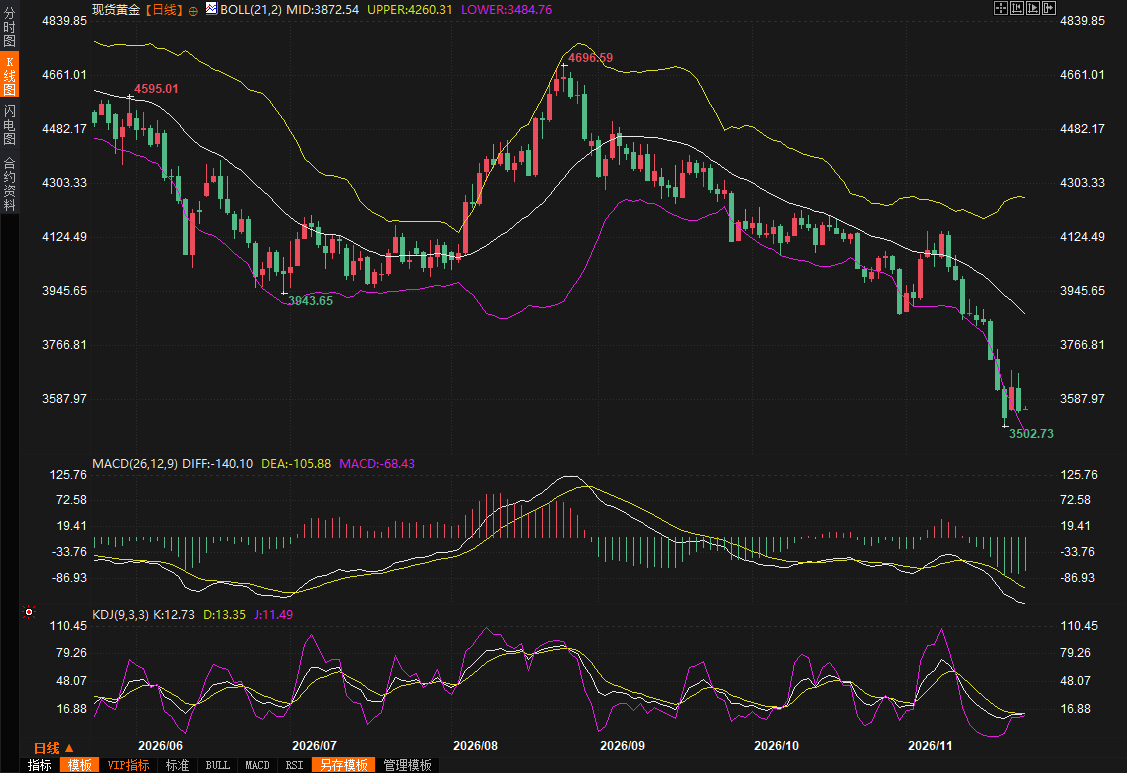 (Spot gold daily chart, source: FX678) At 07:36 Beijing time, spot gold is currently trading at $3562.08 per ounce.
I. The Federal Reserve's Hawkish Stance: Rate Hike Expectations Fully Locked in, Gold Holding Costs Soar
The most fundamental driver of this round of gold price decline stems from the market's repricing of the Federal Reserve's monetary policy path. According to the CME Group's FedWatch tool, traders have fully priced in a 25-basis-point rate hike in December. While the probability of a 50-basis-point hike is only 2%, the very existence of this probability is enough to keep the market highly vigilant. More importantly, federal funds rate futures traders currently expect a 97% probability of a December rate hike and a 66% probability of another rate hike in January. This means the market is pricing in a sustained tightening cycle, rather than a one-off policy adjustment. New York Fed President Williams clearly stated on Monday that persistently high inflation continues to prompt the Fed to adopt a tighter monetary policy. Although he emphasized that the pace of future rate hikes will depend on subsequent economic data, this statement was still interpreted by the market as a confirmation of a hawkish signal. Forex market analyst Fawad Razaqzada pointed out that gold is struggling to find strong support because the hawkish stance adopted by central banks, led by the Fed, is putting continuous pressure on gold prices. As a non-interest-bearing asset, the cost of holding gold is highly negatively correlated with the real interest rate. When rising expectations of interest rate hikes drive up nominal interest rates, the attractiveness of gold diminishes.II. The Chain Reaction of the Stock Market Liquidation Wave: Margin Calls Force Gold to "Take the Blame"
If the Federal Reserve's hawkish stance was a "slow poison" that crushed gold prices, then the wave of margin calls triggered by the decline in US stocks was an "acute catalyst" that ignited the crash. Razaqzada further added that the margin calls from the stock market exacerbated the pressure on the precious metals market, forcing investors to release margin by closing out their gold and silver positions. This mechanism was demonstrated again in Tuesday's trading: the Nasdaq fell 1.48%, the S&P 500 fell 0.50%, with technology stocks leading the decline across the S&P 500 sectors, falling 2.8%, and the semiconductor index plunging 7.9%. Nvidia's stock price fell 5.9% after surging 31.5% on Monday, as investors remained concerned about the political and governance risks associated with Jensen Huang's return to the CEO position. Anthropic's stock price closed down 6.5% and fell below its IPO price of $83. The collective retreat of AI concept stocks quickly dissipated the market optimism that had been built up by artificial intelligence trading. Gene Goldman, Chief Investment Officer of Cetera Financial Group, admitted that some profit-taking was expected after the biggest rally in months, and ultimately, a single news story cannot truly resolve investors' doubts about AI trading. When losses in the stock market force leveraged investors to add margin, the most liquid assets are often the first to be sold off, with gold and silver becoming "cash cows" due to their deep market depth. Meanwhile, investors are preparing for potential new tariffs. Sources indicate that the Trump administration is about to release the results of an investigation aimed at addressing overcapacity in the industries of 16 major trading partners, which is expected to impose new import tariffs on a wide range of goods. Goldman Sachs stated that the new tariffs will bring uncertainty to the market, and investors are also cautious ahead of Wednesday's release of the personal consumption expenditure price index. This combination of uncertainties has caused gold to suffer a double blow in the short term from both rising interest rate expectations and a liquidity crunch, making it difficult for its price to remain unaffected.III. The Double-Edged Sword of Consumer Confidence and Inflation Expectations: Weakening Economic Resilience and Demand for Safe-Haven Investment
The surge in U.S. consumer confidence in November is a double-edged sword for gold. Data released by the Conference Board shows that the consumer confidence index jumped to 103.3 from a slightly revised 91.9 in October, the highest level since January 2025. This improvement in confidence spanned all age groups and generations, with high-income households showing the largest increase. This data is consistent with the improving trend shown in the University of Michigan's consumer confidence survey, indicating that Americans' views on the job market and the overall economic outlook are warming. Economists believe that the surge in consumer confidence is a positive sign for the holiday shopping season. Although the correlation between consumer spending and confidence is not strong, consumer spending has maintained strong growth for two consecutive quarters even with prolonged low consumer confidence. Christopher Rupkey, chief economist at FWDBONDS, stated that the headwinds and uncertainties brought about by the midterm elections no longer pose a risk to the economic outlook. This economic resilience fundamentally weakens gold's appeal as a safe-haven asset—when investors are optimistic about the economic outlook, they are more inclined to allocate funds to risk assets rather than gold. Meanwhile, the US unemployment rate has fallen from 4.5% in November to 4.1% in October. While this decline is partly due to increased retirements and a shrinking labor force caused by the White House's crackdown on immigration, signs of a strengthening job market may pave the way for the Federal Reserve to continue tightening policy after the widely anticipated December rate hike. Fergus McCormick, senior economist at World Enterprise Research, noted that while written feedback from respondents in November remained negative, it was an improvement over previous months. Regarding inflation expectations, the median one-year inflation expectation fell to 4.5%, alleviating some concerns, but it remains well above the Fed's 2% target, meaning there is still room for real interest rates to rise. The headwinds on gold in the interest rate environment are unlikely to dissipate in the short term. Nancy Vanden Houten, chief US economist at Oxford Economics, predicts that year-on-year house price growth will slow to below 2% in the fourth quarter and remain there until early 2028. High mortgage rates leading to weak demand will put pressure on house prices, but mortgage rates above 7% will also cause sellers to remain on the sidelines, thus limiting housing supply. Overall, the strong economic data and the slow decline in inflation paint a picture of "the Federal Reserve having room to continue raising interest rates," which is exactly the scenario that gold bulls least want to face.IV. Cross-verification between the oil and currency markets: The weakening dollar failed to save gold prices, indicating heavy selling pressure.
Of particular note is the weakness of the US dollar against a basket of currencies on Tuesday, with the dollar index falling 0.46% to 103.82. Typically, a weaker dollar provides support for dollar-denominated gold, but this conventional logic failed completely in Tuesday's trading—gold prices still plummeted by over 2% despite the dollar's decline. This anomaly precisely illustrates the heavy selling pressure facing gold. Haddad, global head of market strategy at Brown Brothers Harriman, pointed out that the US economic growth advantage relative to the Eurozone, the UK, and Japan narrowed further in November, which could put pressure on the dollar. Data showing that German business confidence rose for the seventh consecutive month in November also boosted the euro. However, even though the dollar gave back most of Monday's gains, gold failed to gain any respite, indicating that the core variable currently driving gold prices is not exchange rates, but rather interest rate expectations and liquidity conditions. In the oil market, Brent crude futures rose 2.27% to $91.40 a barrel on Tuesday, while West Texas Intermediate crude futures closed up $1.88, or 2.35%, at $82.05 a barrel, influenced by news of further attacks on ships in the Strait of Hormuz and surrounding waters. However, Deutsche Bank stated that global observed liquid fuel inventories rose in October, implying a daily oversupply of 1.7 million barrels, with mounting evidence suggesting the global market is rebalancing and shifting towards a supply surplus. The oversupply expectation in the oil market and the selling pressure in the gold market subtly echo each other, both pointing to a macro theme: with the Federal Reserve's tightening cycle not yet over, commodities as a whole face a dual test of their financial and commodity attributes.V. Key Signals from the Bond Market: Flattening Yield Curve Reflects Market Doubts About Economic Growth Prospects
The movement in the US Treasury market provides another important dimension for understanding the decline in gold prices. On Tuesday, Treasury yields were largely unchanged, with the 10-year Treasury yield falling 1.6 basis points to 4.906%, the 30-year yield falling 0.5 basis points to 5.29%, and the two-year Treasury yield, most sensitive to Federal Reserve interest rate expectations, rising 1.9 basis points to 4.685%. The spread between the two-year and 10-year Treasury yields was 21.9 basis points, having previously narrowed to 21.6 basis points, the flattest level since November 12. Al-Bahari, chief investment officer at LNW in Philadelphia, stated that Monday was a risk-on trading day for the stock market, but a risk-averse day for the bond market. The yield curve flattened, and the bond market's message at the time was that despite the huge popularity of the AI sector, the bond market did not believe it would bring significant economic growth. He further pointed out that Tuesday's market movement was more like a normal reaction after yesterday's market action. Investors are beginning to realize that it is almost impossible for companies to maintain a 20% to 30% growth rate in quarterly profits, so the market is reassessing the valuation of the AI sector. The break-even yield on five-year US Treasury Inflation-Protected Securities (TIPS) was 2.133%, the lowest closing level since November 2024, while the break-even yield on 10-year TIPS was 2.11%, indicating that the market expects an average annual inflation rate of about 2.1% over the next 10 years. Although this inflation expectation reading is close to the Fed's target, given that the current actual inflation level is still far above 2%, the decline in the break-even yield reflects more of the market's concerns about the long-term economic growth outlook than full confidence in a decline in inflation. For gold, a flattening yield curve and declining inflation expectations should have been a positive factor, but in a market environment dominated by the Fed's short-term hawkish stance, this positive factor has been completely overshadowed. Analysts were divided on the results of the $70 billion five-year U.S. Treasury auction. The bid-to-cover ratio was 2.37 times, above the average, and the winning yield was 4.719%, slightly higher than the secondary market yield at the time of the bidding deadline. The U.S. Treasury will also auction $44 billion in seven-year U.S. Treasury notes on Wednesday. The calm in the bond market contrasts sharply with the volatility in the gold market, suggesting that the current decline in gold is more a result of fund flows and sentiment than a fundamental deterioration.Summary: Short-term headwinds persist, but long-term prospects remain bright – a battle between bulls and bears around $3560.
In summary, Tuesday's plunge in the gold market was the result of a confluence of negative factors. The complete lock-in of the Fed's December rate hike expectations formed the core logic suppressing gold prices, while the margin call triggered by the decline in US stocks acted as a catalyst for accelerating the fall. Furthermore, the economic resilience demonstrated by the surge in US consumer confidence to a near two-year high further weakened gold's safe-haven appeal. The unusual phenomenon that a weaker dollar failed to prevent the decline in gold prices precisely confirms the current heavy selling pressure. However, behind the fog of short-term pessimism, the factors supporting gold in the long term have not disappeared. JPMorgan Chase predicts that gold prices will rebound to $4,500 per ounce by the end of 2027, while Commerzbank predicts that gold prices will reach $4,100 per ounce in the same period. These forecasts from these two institutions imply an upside potential of more than 15% to 26% compared to the current price of $3,560. From a technical perspective, the more than one-year low of $3502.73 reached by gold prices last Friday has formed a significant support level, while Tuesday's intraday low of $3546.65 is just a step away from this support. Looking ahead, the October personal income, personal spending, and personal consumption expenditure price index data to be released on Wednesday will be a key indicator for the market to judge the Fed's policy path. The US market being closed on Thursday for Thanksgiving could exacerbate volatility on Wednesday's trading day. For investors, gold is currently in a tug-of-war between short-term hawkish expectations and long-term value support. Whether this is a good opportunity to buy the dip or a continuation of the downtrend depends on whether the inflation data can mark the end of the Fed's tightening pace. Until the answer is revealed, remaining cautious, controlling positions, and waiting for clear signals may be the best strategy to cope with the current highly volatile environment. (Spot gold daily chart, source: FX678) At 07:36 Beijing time, spot gold is currently trading at $3562.08 per ounce.
- Risk Warning and Disclaimer
- The market involves risk, and trading may not be suitable for all investors. This article is for reference only and does not constitute personal investment advice, nor does it take into account certain users’ specific investment objectives, financial situation, or other needs. Any investment decisions made based on this information are at your own risk.