US crude oil futures fell more than 1% after a tanker caught fire in the Hormuz, and API inventories rose slightly.
2026-11-25 10:54:33
On Wednesday (November 25) during Asian trading hours, US crude oil futures opened about 0.6% lower and continued to decline, currently trading below $81, down about 1.5%. Traders are assessing the ongoing real threats to Middle Eastern energy shipping while weighing the prospect of a global crude oil oversupply. 
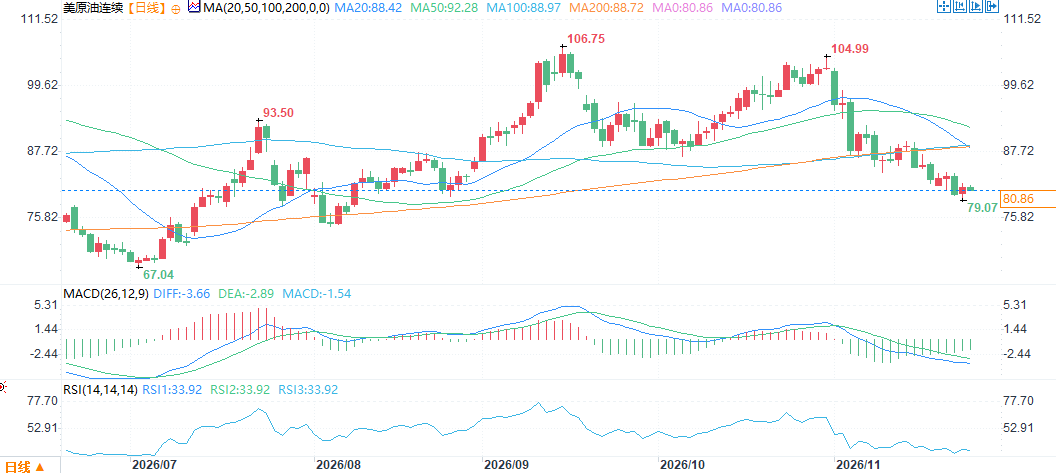 (US crude oil futures daily chart, source: FX678) At 10:52 Beijing time, US crude oil futures were trading at $80.78 per barrel.
Shipping conflicts have resurfaced in the Taiwan Strait, and tensions are rising simultaneously in the Red Sea.
Geopolitical risks escalated again this week, directly focusing on the world's most important oil shipping route. According to Iranian sources, the Iranian Revolutionary Guard claimed that three oil tankers struck mines and caught fire in the Strait of Hormuz, quickly raising concerns about the safety of passage through the strait. Simultaneously, the US intensified sanctions against Iran, aiming to cut off its financial channels and further compress its capital and trade space. The Iranian Revolutionary Guard subsequently repeatedly warned merchant ships, clearly stating that only the northern route was permitted passage, and vessels choosing alternative routes near Oman would face direct attacks and threats. This "selective passage" statement effectively structured the shipping risks in the Strait of Hormuz, increasing costs and uncertainty for shipowners and insurance companies. The conflict also spread towards the Red Sea. The Saudi-led coalition launched an attack on the port of Hodeidah in Yemen on Tuesday, after issuing a port evacuation notice, indicating that the military action was pre-announced and prepared. The Houthi rebels immediately responded strongly, threatening that if Saudi Arabia carried out the attack on Hodeidah, Jeddah and all Saudi ports along the Red Sea coast would become targets of retaliation. The Red Sea route, already partially disrupted by previous conflicts, has escalated again, potentially forcing more oil tankers to detour around the Cape of Good Hope, lengthening transit times and driving up freight rates. The simultaneous pressure on two key waterways significantly increases the real threat to energy shipping, providing potential geopolitical premium support for oil prices.API inventories rose slightly, with supply-side factors putting downward pressure on oil prices.
Supply-side data continued to weigh on oil prices. Data released by the American Petroleum Institute (API) showed that crude oil inventories increased by 126,000 barrels in the week ending November 20. While the increase was significantly smaller than the 5.3 million barrels increase in the previous week, indicating a marked slowdown in inventory accumulation, the positive growth still reflected a relatively tight supply of crude oil in the United States. The continuous increase in inventories suggests that the domestic supply-demand balance has not yet shifted to a significant shortage, and refinery processing demand and export pace have not fully absorbed the new supply. This result weakened market expectations of a "rapid tightening of supply" in the short term, and also left bulls without strong evidence from the inventory level to push prices higher. Meanwhile, exports from some oil-producing countries around the world remained resilient, coupled with previous market concerns about oversupply, making it difficult for oil prices to rise sharply even with escalating geopolitical risks. The discrepancy between API data and official EIA data is closely watched by traders. If subsequent official data confirms continued inventory accumulation, it will further reinforce the narrative of a loose supply side, limiting the upside potential of oil prices.Analyst Interpretation: Negotiations weaken geopolitical premium, but the situation remains fragile.
Institutional perspectives provide a clear framework for the current volatile market. ING strategists point out that the core driver of the drop in US crude oil futures below $80 on Tuesday was the expectation of negotiations between the US and Iran, which quickly squeezed out some of the geopolitical risk premium. Monday's nearly 4% drop in oil prices was a direct result of the market focusing on the prospect of diplomatic easing. The emergence of negotiation expectations has reduced the pricing of the probability of the conflict spiraling out of control in the short term, allowing oil prices to find a temporary balance between risk aversion and supply concerns. Although Persian Gulf crude oil exports are currently showing some resilience, with no complete disruption to ship traffic and loading activities, the differences between the US and Iran on core issues remain significant, and the foundation for negotiations is not solid. Once the negotiation process stalls, both sides harden their positions, or new geopolitical risks arise in other parts of the world, crude oil prices are highly likely to rebound rapidly. Currently, the forces of bulls and bears are offsetting each other, and oil prices are temporarily stabilizing above $81, reflecting this market situation of "negotiation hopes" and "situational fragility." Going forward, close attention needs to be paid to the actual progress of negotiations and the subsequent evolution of shipping events; any shift in the wind direction could break the current sideways pattern. (US crude oil futures daily chart, source: FX678) At 10:52 Beijing time, US crude oil futures were trading at $80.78 per barrel.
- Risk Warning and Disclaimer
- The market involves risk, and trading may not be suitable for all investors. This article is for reference only and does not constitute personal investment advice, nor does it take into account certain users’ specific investment objectives, financial situation, or other needs. Any investment decisions made based on this information are at your own risk.