One chart: The Baltic Dry Index rose across the board, reaching a near two-month high, with freight rates for all vessel types recovering in tandem.
2026-11-25 22:54:32
The latest data shows that the Baltic Dry Index (BDI) reached 3107 points on November 25, 2026, a new high since October 2, 2026, up 1.27% month-on-month, marking the third consecutive day of increase (including zero growth). Looking at the short-term charts, the recent 11 BDI data points show: 6 positive increases, 5 negative increases, and 0 zero increases. Specifically, the Panamax Freight Index (BPI) was 2223 points, up 2.02% from the previous value; the Capesize Freight Index (BCI) was 5014 points, up 1.46%; and the Supramax Freight Index (BSI) was 1814 points, up 0.17%. For detailed 720-day and 10-year trend charts of the Baltic Dry Index and its three main sub-indices, please refer to the charts specially created by FX678. 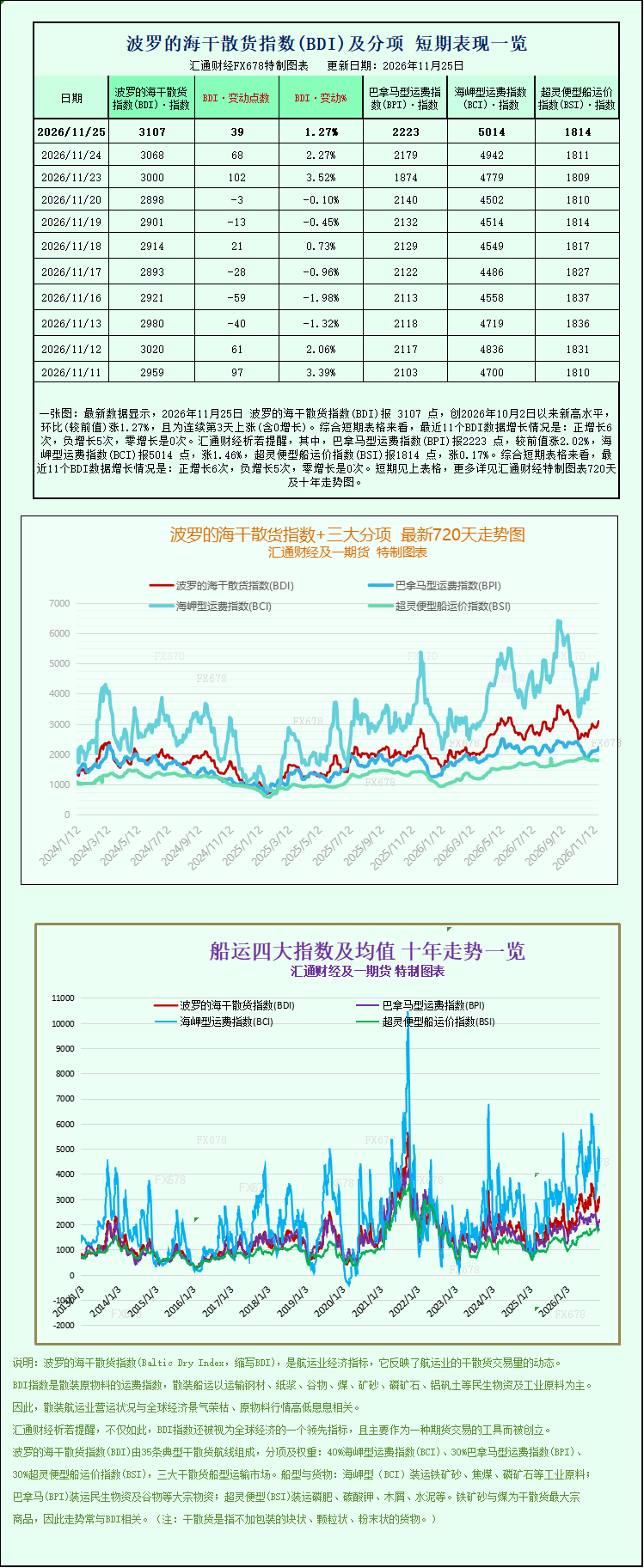 The Baltic Dry Index (BDI), the core dry bulk shipping index, saw a significant rise on Wednesday, reaching its highest point in nearly two months. This round of price increases was unusually broad-based, with freight rates for the three major dry bulk vessel types—Capesize, Panamax, and Supramax—all strengthening simultaneously, driving up the overall index and reflecting a clear recovery in short-term sentiment in the global dry bulk shipping market and a rebound in chartering demand for ocean-going bulk cargo transportation. The Baltic Dry Index (BDI), the market's most closely watched indicator, integrates charter rates for dry bulk vessels of different tonnages. It rose 39 points, or 1.27%, to close at 3107 points, a new high since October 2nd. The BDI itself does not directly reflect ship prices but rather summarizes daily charter rate quotes from the spot charter market, serving as a core reference indicator for global commodity traders, shipping traders, mines, power plants, and grain traders to assess shipping costs. The rise in the index signifies increased freight costs for cargo owners chartering vessels, resulting in higher daily operating profits for shipowners. It also reflects a faster pace of dry bulk cargo deployment globally. In this round of price increases, Capesize vessels, the largest segment of the cargo market, are the core driver of the index's rise. The Capesize index rose 72 points, or 1.46%, to close at 5014 points, returning to its highest level since October 2nd. Capesize vessels typically have a deadweight tonnage of around 150,000 tons and are the mainstay for long-distance trade of large-tonnage cargoes such as iron ore and thermal coal. Their routes are concentrated on long-haul routes from Brazil and Australia to East Asia, and from South Africa and Western Australia to China. Supporting data shows that the average daily earnings for Capesize vessels increased by $656, reaching $41,970 per day. Compared to the relatively low charter rates a month ago, current earnings have significantly improved, alleviating cash flow pressure for many shipowners. The underlying logic supporting Capesize freight rates is closely related to the competitive landscape of the iron ore market. After surging to a one-week high in the previous trading day, iron ore prices failed to continue their upward trend and instead entered a range-bound trading pattern. Two opposing forces are at play in the market: on the one hand, there is buying interest on dips, with steel mills replenishing their inventories at suitable prices, absorbing some of the circulating supply; on the other hand, the continued release of increased supply, coupled with generally weak end-user demand in China, the world's largest iron ore consumer market, is suppressing the potential for further price increases. This volatile pattern indirectly impacts the shipping sector: steel mills' phased restocking has led to an increase in ocean-going iron ore shipments, pushing up Cape-of-Goods charter rates; however, the lack of a sustained strong recovery in downstream steel demand limits further significant increases in freight rates, resulting in a relatively moderate pace of price increases. Panamax vessels also performed strongly. The Panamax index rose 44 points to close at 2223, a new high since October 20, 2026. Panamax vessels, mostly with a deadweight range of 60,000 to 70,000 tons, are suitable for cargoes such as coal, grain, and bauxite. They offer more diverse route options, handling both trans-Pacific coal transport and grain exports from North and South America, the Black Sea, and Southeast Asia. Their market structure is more diversified compared to Capesize vessels. Average daily charter rates for Panamax vessels rose by $398 to $20,009 per day. Seasonal grain shipments and coal replenishment demand from power plants in the Asia-Pacific region are supporting freight rates in this sector. Unlike Capesize vessels, Panamax prices are more susceptible to global grain export rhythms, energy import policies, and regional weather disturbances, making their fluctuations more complex. The smaller Supramax vessels saw relatively stable price movements, with the Supramax index rising only 3 points, a mere 0.2%, closing at 1814 points. These smaller vessels offer greater flexibility, handling a wide range of short-haul, small-volume bulk cargoes, including sand, cement clinker, small-volume grains, and fertilizers. They also account for a higher proportion of intra-regional and near-sea trade. Amidst this broad-based market rally, smaller vessels significantly lagged behind larger vessels, indicating that the current shipping recovery is primarily driven by long-distance trunk cargoes, while demand recovery for short-haul near-sea cargoes remains weak, highlighting the continued structural differentiation within the market. From an overall perspective, this across-the-board rise is a rare instance of synchronized growth in the dry bulk market over the past two months. Previously, the market frequently exhibited a divergence where one type of vessel rose while another fell: large vessels strengthened due to disruptions in coal and mineral shipments, while demand for smaller vessels weakened; or the peak grain season boosted Panamax vessels, while Capesize vessels faced pressure. This time, however, the simultaneous rise of all three vessel types sends a positive signal: the overall turnover activity in global dry bulk trade has rebounded. However, market participants remain cautious, as fundamental factors still constrain the market. The slow pace of demand recovery in China's manufacturing and steel industries remains a long-term drag; simultaneously, the continued deployment of new dry bulk fleet capacity will limit the sustained bullish trend in freight rates in the medium to long term. In the short term, key factors to watch for future market trends include iron ore shipments from Australia and Brazil, the pace of winter coal stockpiling in the Northern Hemisphere, South American grain export plans, and the restocking intentions of downstream industries in China. If cargo volumes continue to increase, the index is expected to remain high; however, once the restocking phase ends and cargo volumes decline, freight rates are likely to see another correction.
- Risk Warning and Disclaimer
- The market involves risk, and trading may not be suitable for all investors. This article is for reference only and does not constitute personal investment advice, nor does it take into account certain users’ specific investment objectives, financial situation, or other needs. Any investment decisions made based on this information are at your own risk.