Gold Trading Alert: US inflation fuels gold price plunge over 3% before rebounding by over $150 – has it bottomed out?
2026-11-26 07:56:32
Wednesday (November 25th) witnessed a dramatic rollercoaster ride in the global gold market. Spot gold plunged more than 3% at one point, hitting a new low of $3426.71 per ounce, a more than one-year low, almost completely shattering market sentiment. However, just as bearish sentiment was spreading, bargain hunting and pre-Thanksgiving position adjustments suddenly came into play, pushing gold prices up by more than $150 from the bottom, ultimately closing at $3588.40 per ounce, a reversal and a 0.92% increase for the day. This dramatic fluctuation from the abyss to the recovery not only exposed the fragility of the current gold market but also reflected the intense interplay of multiple forces, including persistent inflation, rising expectations of a Federal Reserve rate hike, sharp fluctuations in risk assets, and geopolitical undercurrents. On Thursday (November 26) in early Asian trading, spot gold fluctuated narrowly, currently trading around $3,580 per ounce. Today's trading day coincides with Thanksgiving in the United States, and the US stock market is closed. The gold market will also close early, and trading during the European and American sessions is expected to be limited. 
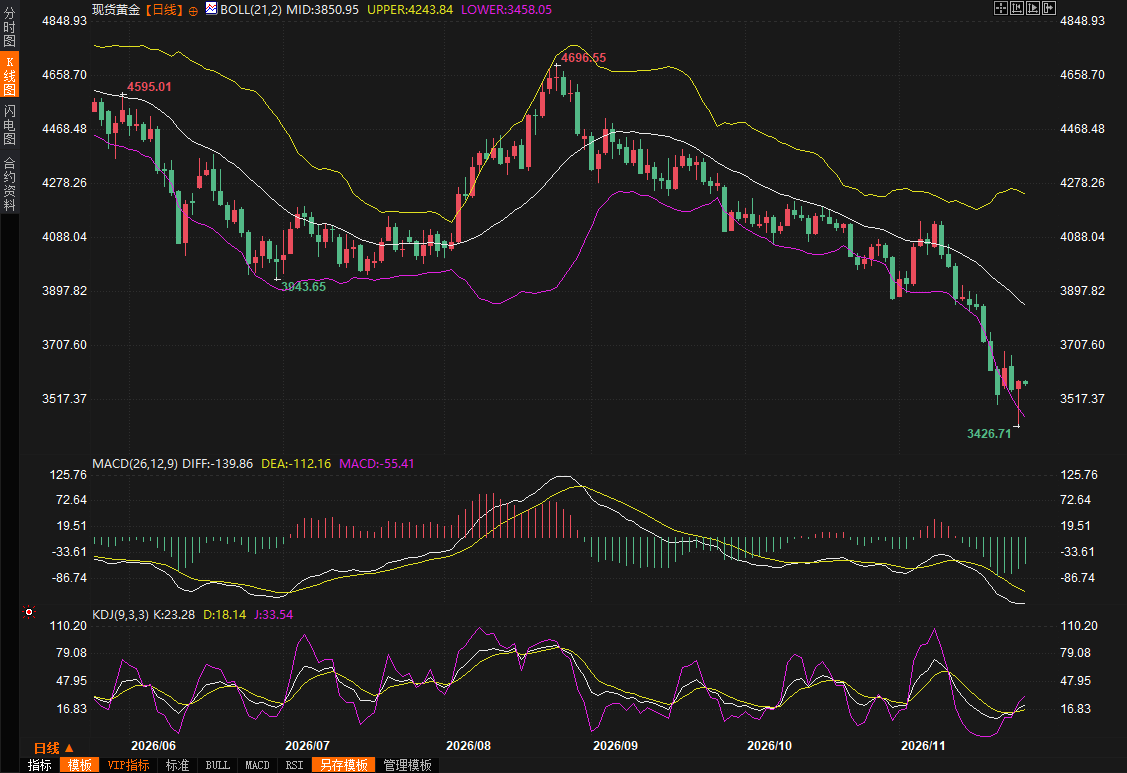 (Spot gold daily chart, source: EasyTrade) At 07:52 Beijing time, spot gold is currently trading at $3580.39 per ounce.
Inflation data adds further pressure, and the shadow of interest rate hikes continues to loom over the gold market.
The core catalyst driving the sharp drop in gold prices in early trading was the latest inflation data released by the U.S. Bureau of Economic Analysis. The Personal Consumption Expenditures (PCE) price index rose 0.3% month-over-month in October, lower than the unrevised 0.5% increase in September, but still well above the Federal Reserve's long-term target of 2%. More importantly, the core PCE, excluding food and energy, also rose 0.3% month-over-month, with a year-over-year increase of 3.3%, the highest level in three years. This result completely shattered market illusions that inflation was rapidly declining. David Meger, director of precious metals trading at High Ridge Futures, pointed out incisively that inflationary pressures remain far above the Fed's target, and the possibility of further interest rate hikes remains, which is the main long-term headwind facing the gold market. The CME FedWatch tool shows that the market has almost fully priced in the Fed's expectation of an interest rate hike at its December policy meeting. Since hitting a record high earlier this year, spot gold prices have plummeted by about 37%, driven by repeated upward revisions to interest rate path expectations and the continued pressure of rising real interest rates on non-interest-bearing assets. The Federal Reserve's Beige Book, released on the same day, further reinforced this narrative. The report showed that the U.S. economy continued to grow at a slight to moderate pace in most regions, with some job gains, but inflation remained remarkably sticky. Respondents from multiple industries cited continued cost increases in energy, transportation, healthcare, insurance, and tariff-related expenses. While businesses attempted to pass on these costs, they faced profit margin pressures due to increased competition and rising consumer price sensitivity. The report explicitly stated that respondents expected both costs and selling prices to continue rising in the coming months. This feedback from the front lines of the real economy, corroborated by the PCE data, deepened market concerns about a "higher and longer" interest rate environment.The stock market volatility and tariff shocks caused risk appetite to plummet.
Alongside gold prices, US stocks also experienced significant volatility. The Nasdaq, heavily weighted with tech stocks, fell more than 4% in early trading, and the Nasdaq 100 even dropped about 20% from its all-time closing high, briefly teetering on the edge of a technical bear market. Nvidia fell 3.9%, Amazon fell 3.1%, and the semiconductor sector as a whole was under pressure. Market doubts about whether the artificial intelligence boom could generate sufficient returns continued to fester, coupled with news that the Trump administration had proposed new tariffs on major trading partners, including China, further dampening risk sentiment. The Trump administration's new round of tariff proposals, announced on Wednesday, targets 14 major trading partners, including Japan and the EU, proposing tariff caps of 20% to 40% on so-called "industrial overcapacity." Although lower caps have been set for economies that have already reached agreements, and the tariffs still need to undergo hearings before they take effect, this move has reignited global trade tensions. Analysts point out that despite the Republican Party's loss in the midterm elections, Trump's determination to push forward with protectionist policies has not weakened. Although the stock market narrowed its losses in late trading due to bargain hunting and pre-holiday position adjustments, with the Dow Jones even closing slightly higher, the rapid shift in overall risk appetite still provided some safe-haven cushion for gold. Meanwhile, US Treasury yields initially fell during the stock market plunge, with the 10-year yield touching a low of 4.8% intraday, but subsequently rebounded with the stock market recovery, ultimately closing lower but still above its intraday low. The bond market's performance indicates that against the backdrop of strong economic data (second-quarter GDP revised upward to an annualized rate of 4.3%) and persistent inflation, the room for significant yield declines is limited. This combination of "economic resilience + inflation stickiness" means that gold cannot fully benefit from the influx of safe-haven funds while continuing to be suppressed by high real interest rates.Geopolitical disturbances and oil prices moved in tandem, causing the US dollar to weaken slightly, giving gold a short-term respite.
Unusual activity in the crude oil market also provided additional support for gold prices. News of attacks by Yemen's Houthi rebels on Saudi Arabia's largest oil refinery, Rastanura, and Riyadh's financial district quickly pushed up oil prices. Brent crude rose 3.5% to $94.61 per barrel, while U.S. crude rose 2% to $83.68 per barrel. The rising geopolitical risk premium, coupled with market uncertainty regarding the upcoming OPEC+ meeting to discuss 2027 production policy, exacerbated energy price volatility. Rising oil prices further reinforced the narrative of sticky inflation through cost-push inflation, while also increasing gold's relative appeal as a safe-haven asset. The US dollar fell slightly during the day's volatile trading, while safe-haven currencies like the Swiss franc and the Japanese yen strengthened. The US dollar index closed at 103.70, down 0.11%. Against the backdrop of sharp fluctuations in risk assets, the US dollar did not exhibit sustained safe-haven buying, creating a relatively loose monetary environment for gold's rebound.The short-term rebound cannot mask the medium-term pressure; the key variable remains the interest rate path.
In summary, Wednesday's strong rally in gold prices from a more than one-year low was driven by a confluence of short-term factors: inflation data, while stronger than expected, did not significantly exceed expectations; a late-day stock market rebound mitigated extreme risk aversion; pre-Thanksgiving holiday positioning provided technical buying; and the Houthi attack briefly boosted geopolitical premiums. However, these factors are more of a "stop-loss" than a "trend reversal." Looking at the longer term, the gold market still faces severe challenges. The probability of a Fed rate hike in December is nearly fully priced in, and discussions about further rate hikes in early 2027 are intensifying. Inflation has been above target for more than five consecutive years and has recently shown signs of accelerating again, pushing back the timing of a policy shift. Meanwhile, the Trump administration's tariff policies may further exacerbate inflationary pressures by increasing import costs, while valuation corrections in AI-related assets could affect overall risk appetite through the wealth effect. In this environment, gold is unlikely to receive sustained support from expectations of rate cuts, nor can it completely escape the pressure of real interest rates. Looking ahead, the market will closely watch the Fed's dot plot and policy statement at the December meeting. If inflation data continues to show stickiness and economic resilience is maintained, gold prices may fluctuate around current levels, or even retest lower levels. Only when inflation shows clear signs of decline, or geopolitical risks escalate significantly and trigger systemic safe-haven demand, will gold be able to truly break free from its current downtrend. While the short-term rebound has boosted bullish sentiment, the true bottom for gold prices still needs more time to be confirmed before there is a substantial change in the interest rate path. (Spot gold daily chart, source: EasyTrade) At 07:52 Beijing time, spot gold is currently trading at $3580.39 per ounce.
- Risk Warning and Disclaimer
- The market involves risk, and trading may not be suitable for all investors. This article is for reference only and does not constitute personal investment advice, nor does it take into account certain users’ specific investment objectives, financial situation, or other needs. Any investment decisions made based on this information are at your own risk.