With inflation and wages continuing to rise, can the yen recover thanks to expectations of interest rate hikes?
2026-11-26 10:20:35
On Thursday (November 26) during the Asian session, the USD/JPY pair fluctuated narrowly, currently trading around 159.10, down 0.02%. Despite the relatively small price movement, tightening signals from within the Bank of Japan (BOJ) continue to influence market pricing of yen interest rates. Naoki Tamura, a hawkish figure within the BOJ, stated that the current policy rate of 1.25% still corresponds to a loose financial environment and is significantly far from the neutral rate. This view remains unchanged since his June assessment of a 2% neutral rate. Based on this target, the BOJ would need approximately three more 25bp rate hikes to reach the neutral range, higher than the market's mainstream expectation of a 1.75%-2% final range. He also acknowledged that the neutral rate cannot be precisely locked in advance and can only be confirmed gradually through rate hikes and observation of economic responses. 
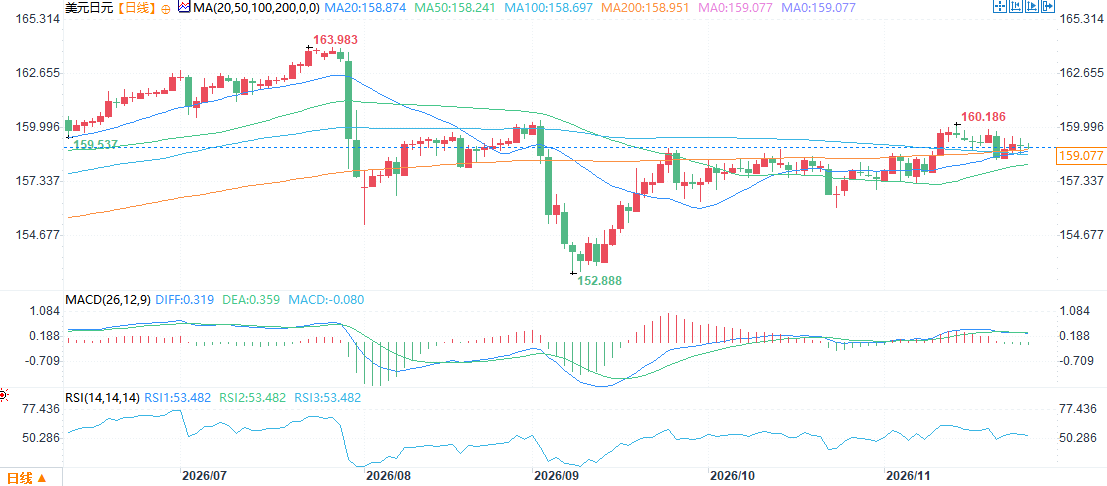 (USD/JPY daily chart, source: FX678) At 10:16 Beijing time, USD/JPY was trading at 159.11/12.
Policy stance: Seeking progress while maintaining stability, retaining the option of accelerating interest rate hikes.
Tamura summarized the policy approach as "seeking progress while maintaining stability." This statement accurately reflects the unique stage the Bank of Japan is currently in: it does not want to repeat the mistakes of excessive easing in the past, which led to a prolonged period of low inflation expectations, nor does it want to trigger a hard landing of the economy due to excessively rapid interest rate hikes, as has happened with central banks in Europe and the United States. The Bank of Japan can assess the impact of each round of interest rate hikes on the real economy within a few months, without being overly hesitant, but it will never be blindly aggressive. Unlike Europe and the United States, Japan's inflation expectations have only recently risen from a long-term low, and the foundation is not yet solid; the anchoring of inflation expectations for households and businesses remains relatively fragile. Once inflation continues to exceed the target, the central bank needs to have the ability to respond more quickly and strongly, retaining policy space to accelerate interest rate hikes. Most companies report that the impact of interest rate hikes at this stage is generally limited, and rising financing costs have not yet become a widespread operational pressure. However, some interest rate-sensitive companies have clearly warned that high borrowing costs will gradually suppress equipment investment and long-term capital expenditures. Tamura's statement is actually sending a clear signal to the market: the policy path is not linear and fixed, but highly dependent on data feedback. If wage growth and service prices form a virtuous cycle, the central bank will be more confident in raising interest rates; conversely, it may slow the pace. This "steady progress with the option of acceleration" approach provides the market with a certain degree of certainty while preserving policy flexibility, and is the core of the Bank of Japan's current communication strategy.Multiple risks to inflation, with the AI boom pushing up prices in the short term.
Tamura cited several inflation warning signs, demonstrating his high level of vigilance regarding upside risks. Japan's PPI rose 7.1% year-on-year in October, while the core CPI, excluding temporary policy factors, remained around 3.5%, significantly higher than the 2% target. Price increases were evident in commodities such as plastic products, laptops, and electronic components, reflecting the accumulating pressure of upstream costs being passed down downstream. Fluctuations in oil prices, a temporary weakening of the yen, and the reconfiguration of global supply chains collectively pushed up import and production costs. More noteworthy is the additional inflationary pressure from the explosive demand in the AI industry chain. Tamura pointed out that the breadth of AI's benefits across Japanese industries exceeded previous expectations, with data center construction, power equipment, HVAC systems, and related infrastructure companies all significantly benefiting, experiencing simultaneous increases in orders and capacity utilization. In the long term, AI is expected to significantly boost productivity and lower overall price levels—this is one aspect of its deflationary nature; however, in the short term, large-scale capital expenditures and a surge in demand for electricity and raw materials will instead push up costs and prices. This structural characteristic of "long-term benefits, short-term pressure" makes the Bank of Japan face greater uncertainty when assessing the sustainability of inflation. Tamura's reminder is essentially emphasizing that we cannot simply use the deflationary experience of the past thirty years to judge the current situation, and that the multifaceted inflation risks require a more proactive policy response framework.Impact on the yen: Unlikely to change December pricing, but will raise expectations of the end of interest rate hikes.
This statement reflects Tamura's consistent hawkish stance and is unlikely to significantly alter the market's mainstream pricing for the December policy meeting—the market still widely expects the Bank of Japan to maintain a cautious pace. However, its core significance lies in significantly raising expectations for the medium- to long-term interest rate endpoint. If more members of the central bank agree with the assessment that "the neutral interest rate is close to 2% and about three more rate hikes are needed," short-term yields on Japanese government bonds will receive upward support, thus providing a medium-term boost to the yen. Currently, the USD/JPY exchange rate is hovering around 159, approaching a historically sensitive intervention range, and yen short sellers are still testing the bottom line of the central bank and the Ministry of Finance. Any signal regarding an upward revision of the rate hike path could trigger short covering and adjustments by speculative positions. Subsequent data on Tokyo CPI, the results of spring wage negotiations, and corporate pricing behavior will be key variables in verifying the pace of rate hikes and triggering currency market volatility. If subsequent data continues to confirm that inflation is sticky and wage growth momentum continues, the market's pricing of the final interest rate may be further raised, and the yen is expected to receive phased support; conversely, it may continue to be under pressure. While Tamura's statement did not immediately change the trading logic for December, it did implant a higher interest rate anchor expectation for the medium-term yen pricing, which deserves continued attention from the foreign exchange market. (USD/JPY daily chart, source: FX678) At 10:16 Beijing time, USD/JPY was trading at 159.11/12.
- Risk Warning and Disclaimer
- The market involves risk, and trading may not be suitable for all investors. This article is for reference only and does not constitute personal investment advice, nor does it take into account certain users’ specific investment objectives, financial situation, or other needs. Any investment decisions made based on this information are at your own risk.