Dalio's key takeaway: A 10% to 15% allocation to gold is standard and irreplaceable.
2026-11-26 11:12:32
In a recent interview, Bridgewater Associates founder Ray Dalio reiterated that gold is an irreplaceable diversification tool in a portfolio, and that allocating 10% to 15% of an asset to gold is a reasonable choice regardless of the investment cycle. He also shared his overall asset allocation strategy, comparing gold with other assets and explaining the debt and geopolitical logic behind central banks' increased gold holdings.
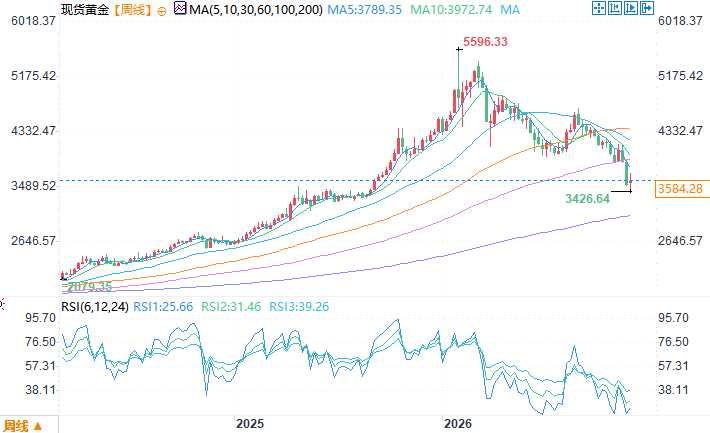 Spot gold weekly chart source: FX678. As of 11:04 AM Beijing time on November 26th, spot gold was trading at $3584.28 per ounce.
First establish a solid safety baseline, then assume investment risks.
Dalio believes the primary prerequisite for investors to make asset allocation decisions is to first clearly calculate the funds needed to maintain a stable lifestyle, and then lock in this purchasing power through stable and diversified investments. He states that when evaluating assets, the focus should be on the actual return after deducting inflation, as the essence of investing is preserving purchasing power. He advises investors to conduct scenario calculations, assuming that inflation erodes asset value by an average of about 3% per year, while also preparing for extreme contingency plans for a maximum drawdown of 50%. Only after confirming that family funds remain sufficient after inflation erosion and significant drawdowns can one afford to pursue higher returns. Maintaining a safety net is the foundation for inner peace, and only on this basis should one take on risks; this is the starting point of his asset philosophy.The Holy Grail of Investing: Diversifying Risk with Low-Correlation Assets
Dalio proposed what he calls the "holy grail" of investing: portfolio diversification that reduces risk without compromising returns. He explained that combining two assets with similar expected returns and low correlation in price movements maintains the same level of return while offsetting each other's overall volatility risk. His core experience is that selecting 10 to 15 high-quality, low-correlation assets can reduce portfolio risk by nearly five times, achieving the same return with one-fifth of the original risk. He concluded that investors should identify their capital safety line, complete bottom-line positioning, ensure sufficient diversification, and remain humble.Gold's unique defensive value cannot be replaced by other assets.
Within this diversification framework, gold occupies a special position. Dalio states that when the conventional credit system operates smoothly, most financial assets perform well; however, once debt levels rise and the credit system experiences a crisis, gold plays an excellent hedging role. Therefore, gold should be included in the portfolio as a diversification tool in the long term, with an allocation range of 10% to 15%. He also discusses the limitations of other assets, arguing that they do not possess the underlying reliability of gold. Central banks can safely hold physical gold, which is not dependent on counterparty fulfillment; in his view, gold is difficult to substitute.Debt and geopolitical risks are forcing sovereign capital to turn to gold.
At the World Economic Forum in Davos, Dalio discussed the intertwined landscape of debt, capital flows, internal politics, and geopolitical risks. As debt levels and repayment pressures continue to rise, they squeeze other spending and fuel financial risks. Debt is essentially one party's liability and another's asset; if bond supply continues to increase, buyers' willingness to absorb it becomes a problem. Coupled with increasing geopolitical friction, the market begins to see risks of capital speculation. Sovereign wealth funds holding dollar-denominated bonds worry about supply pressures or the risk of sanctions. Against this backdrop, central banks and sovereign wealth funds around the world are continuously reducing their holdings of US Treasury bonds and increasing their holdings of gold. Gold has now become the second-largest reserve currency, which is the core driver of the continued rise in gold prices. He remarked that such historical cycles repeat themselves repeatedly, and the market should not be surprised by this.Conclusion
Ray Dalio's overall asset allocation logic prioritizes safety, diversifies risk through low-correlation assets, and uses gold as a crisis hedging tool, with a 10% to 15% allocation range suitable for most cycles. The ongoing global debt crisis and geopolitical changes, along with the trend of sovereign capital shifting towards hard currencies, will continue to support gold's long-term investment value. Spot gold weekly chart source: FX678. As of 11:04 AM Beijing time on November 26th, spot gold was trading at $3584.28 per ounce.
- Risk Warning and Disclaimer
- The market involves risk, and trading may not be suitable for all investors. This article is for reference only and does not constitute personal investment advice, nor does it take into account certain users’ specific investment objectives, financial situation, or other needs. Any investment decisions made based on this information are at your own risk.