Will Swiss inflation rising to 1.5% change the relative trend of the Swiss franc?
2026-11-26 19:04:34
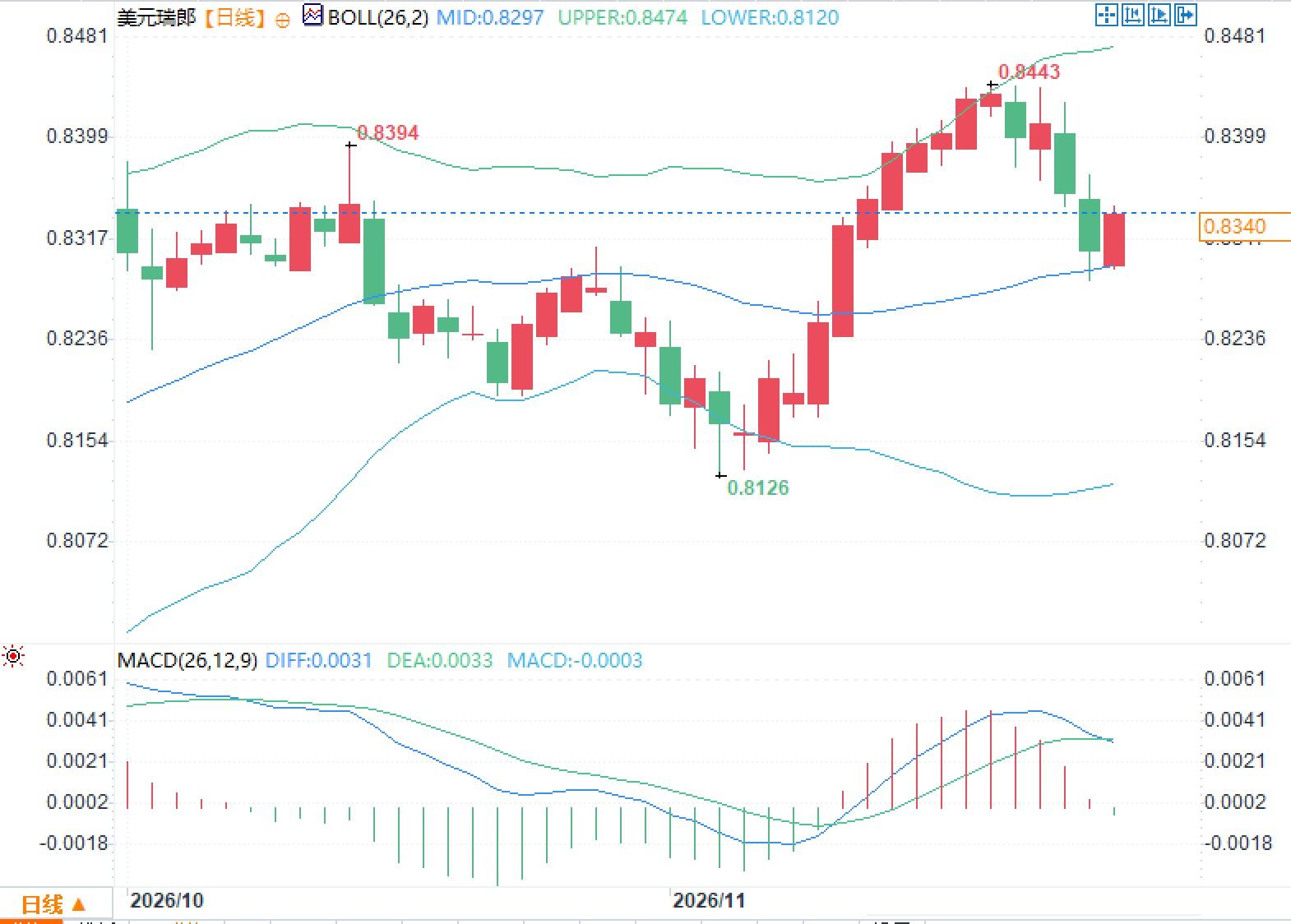
On Thursday, November 26, the USD/CHF pair regained positive momentum after two consecutive days of decline, rebounding further from a recent two-week low near 0.8285 and currently trading around 0.8330, up approximately 0.35% on the day. This move occurred after a pullback this week from the March 2025 highs, with US macroeconomic data pointing to persistent inflation and resilient economic expansion, coupled with escalating conflict in the Middle East, providing support for the dollar. The US Thanksgiving holiday resulted in relatively thin liquidity, limiting market trading activity. 
Market Background for the Rebound of the US Dollar Against the Swiss Franc
US macroeconomic data released Wednesday showed that inflation remained high and economic expansion showed some resilience, a combination that reinforced market expectations for further tightening by the Federal Reserve. Meanwhile, conflict in the Middle East escalated again, with the Houthi rebels claiming responsibility for attacks on Saudi Arabia's Rastanaura oil refinery and Riyadh's King Abdullah financial district. Safe-haven demand thus provided some support for the US dollar, pushing it to maintain its intraday gains against the Swiss franc in the first half of the European session. The Thanksgiving holiday resulted in thinner liquidity and lower trading activity in the US market, potentially amplifying or delaying price reactions to news.Federal Reserve Policy Path and Interest Rate Spread Changes
The U.S. Personal Consumption Expenditures (PCE) price index showed that year-on-year inflation rose to 3.8% in October, with the core index reaching 3.3%, a relatively high level in nearly three years. This reading remains above the Federal Reserve's 2% target, prompting the market to adjust its expectations for policy rates. The Fed's current target range for the federal funds rate remains at 3.75% to 4.00%, and futures pricing indicates a high probability of a 25 basis point rate hike at the December 9th meeting, with the market also pricing in a possible further upward adjustment in early 2027. Fed Chairman Kevin Warsh recently emphasized the persistence of inflationary pressures, and some officials are open to accelerating tightening. In stark contrast to the Swiss policy rate, the USD/CHF interest rate differential has widened further. Widening interest rate differentials typically influence exchange rate pricing through capital flows, resulting in relative support for the dollar in the USD/CHF cross-currency pair. However, persistently high inflation data also implies uncertainty about the policy path, and market pricing may adjust based on subsequent data.Risk aversion transmission in the escalation of Middle East conflict
The conflict in the Middle East escalated again this week. The conflict involves energy facilities and financial centers, potentially disrupting global energy supply chains and regional stability. Under traditional safe-haven logic, the US dollar, as one of the major reserve currencies, often attracts capital inflows when geopolitical risks rise. This mechanism has provided additional support for the USD/CHF exchange rate in this round of conflict, especially in the relatively illiquid holiday environment, where news shocks may be reflected in prices more quickly. However, the duration and pace of the conflict remain uncertain, and its impact on exchange rates depends on subsequent developments and actual changes in market risk appetite, rather than a linear transmission of a single event.Swiss National Bank policy relative performance to the Swiss franc
The Swiss National Bank's (SNB) policy rate has remained at 0.00% since mid-2025, a level significantly lower than that of other major economies. This low-interest-rate environment provides room for so-called carry trades, and the tendency for funds to flow from low-yielding currencies to high-yielding currencies somewhat suppresses the relative performance of the Swiss franc. Swiss inflation rose to 1.5% in October, a significant rebound from 1.0% in September, but still within the SNB's 0% to 2% price stability range. SNB Vice President Antoine Martin recently noted that inflation has continued to rise since the September policy assessment, and the central bank is closely monitoring potential second-round effects. The rise in inflation has led to adjustments in market expectations regarding the SNB's subsequent interest rate path, with some institutions shifting the timing of rate hikes to around mid-2027. This change may limit further weakness in the Swiss franc, especially against the backdrop of persistent global inflationary pressures. In its September assessment, the SNB maintained its interest rate unchanged and indicated its willingness to take action in the foreign exchange market if necessary to maintain appropriate monetary conditions. Under the current policy framework, the Swiss franc's trajectory depends more on the combined effects of interest rate dynamics, inflation evolution, and external risk appetite.Observations on Liquidity Environment and Market Structure
The US Thanksgiving holiday resulted in relatively thin market liquidity, and decreased trading volume could amplify the price's reaction to news. In a illiquid environment, order book depth decreases, making it easier for large-scale fund flows to push prices away from their recent averages. The USD/CHF pair rebounded this week after falling from its highs, with technical indicators showing prices fluctuating around the Bollinger Band's middle line and the MACD indicator consolidating near the zero line. These structural features reflect a short-term balance between bullish and bearish forces, rather than a clear signal of trend continuation. Market structure is also influenced by the cross-influence of the USD/CHF interest rate differential, developments in the Middle East conflict, and Swiss inflation data. Subsequent price movements will depend on actual changes in these factors, rather than the dominance of a single variable. Once liquidity recovers, the trading environment normalizes, and the price's pricing efficiency towards fundamentals typically improves.
- Risk Warning and Disclaimer
- The market involves risk, and trading may not be suitable for all investors. This article is for reference only and does not constitute personal investment advice, nor does it take into account certain users’ specific investment objectives, financial situation, or other needs. Any investment decisions made based on this information are at your own risk.