Oil prices at a critical juncture: OPEC+ meeting on Sunday may extend quotas to January.
2026-11-26 20:52:33
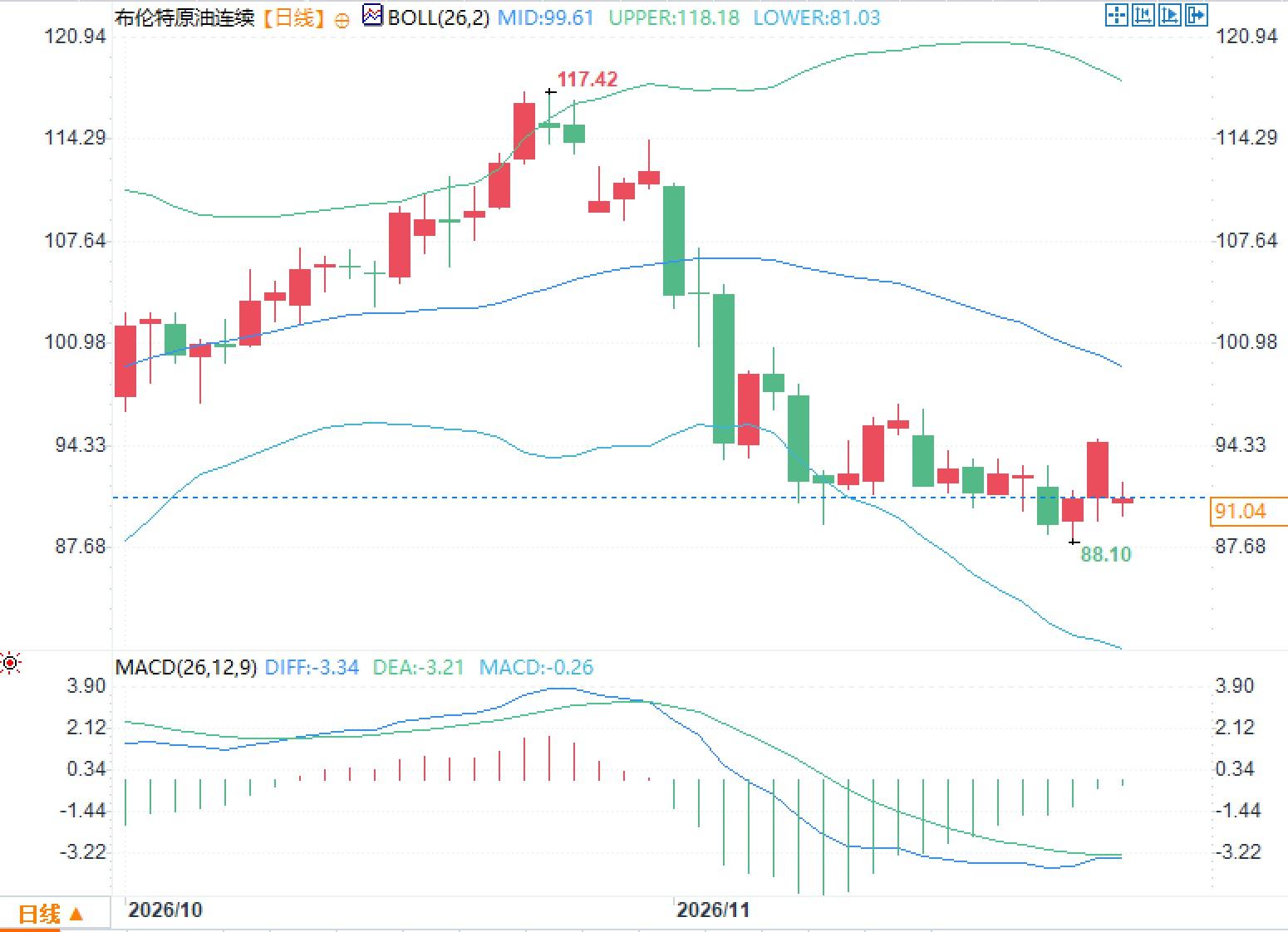
On Thursday, November 26, Brent crude oil was fluctuating around $91 per barrel, a significant drop from its October high of $117.42 per barrel. The market is simultaneously digesting the pace of recovery in Gulf exports and expectations of potential oversupply. OPEC and its allies are scheduled to hold an online meeting on November 29 to discuss the possibility of extending current production quotas into January and to review external capacity assessments in preparation for the 2027 quota framework. 
OPEC and its allies are considering extending current quotas until January.
The Saudi-led coalition is assessing a plan to roll over existing production quotas directly to January 2027. Sources familiar with the matter indicated this move aims to address the ongoing uncertainty surrounding exports and infrastructure caused by the conflict with Iran. The coalition has not yet finalized its full-year targets for 2027. Originally, it planned to incorporate capacity assessments from external advisory bodies into quota allocation, but Iraq's objections to the assessments complicated the process. Over the past year and a half, the core G7 countries (Saudi Arabia, Russia, Iraq, Kuwait, Kazakhstan, Algeria, and Oman) have officially resumed the two rounds of production cuts suspended in 2023 and have gradually increased their targets. However, the conflict has led to actual output in the Gulf states repeatedly falling below their paper quotas, making the targets more of a benchmark. Recently, the November and December quotas remained at the September levels, with the G7 countries collectively requiring approximately 31.01 million barrels per day (bpd), including 10.478 million bpd for Saudi Arabia, 9.949 million bpd for Russia, and 4.431 million bpd for Iraq. The online meeting will include discussions between the Joint Ministerial Monitoring Committee and a wider range of members, with a focus on assessing market conditions and progress on capacity reviews.Capacity assessment controversy and internal tensions within the alliance
The independent assessment of maximum sustainable production capacity, led by De Golier and McNaughton, has been largely completed, with a final meeting held on November 16th, described as a historic milestone. The assessment aimed to provide a unified benchmark for 2027 quotas, but Iraq rejected the initial estimate of approximately 4.9 million barrels per day (bpd), with its oil minister stating that it could reach 5.2 million bpd and seeking higher recognition. Kazakhstan also requested an upward revision of its capacity estimate. Russian Deputy Prime Minister Alexander Novak stated this week that the coalition plans to complete its capacity review by the end of the year and review progress at Sunday's meeting. The UAE withdrew from the organization and its coalition in May due to long-standing dissatisfaction with the mismatch between quota restrictions and the return on investment in production capacity. These disagreements make the 2027 quota negotiations more sensitive, as higher recognized capacity directly corresponds to a higher production benchmark, and the coalition still needs to strike a balance between internal coordination and market stability. The gap between actual production and quotas widened during the conflict, with some members experiencing blocked export routes, causing a disconnect between paper targets and actual supply.Gulf logistics constraints and actual supply reality
Amrita Sen, founder and director of an energy company, pointed out that extending quotas into next year would not make a substantial difference from a purely balancing perspective, because "all parties are producing what they can, but are constrained by restrictions on shipping crude oil out of the Gulf." Constraints on Gulf logistics and export routes have meant that many paper adjustments over the past year and a half have not fully translated into additional physical supply. Even though the core G7 targets have gradually recovered, actual output was significantly lower than required levels at the height of the conflict, subsequently rebounding as exports partially recovered, but remains significantly below pre-conflict levels. Data from the International Energy Agency and other sources also show that the pace of recovery in Gulf-related production is affected by infrastructure and transportation factors. If exports further normalize, the existing quota framework could still increase physical output into the market; conversely, quota extensions would primarily serve to stabilize expectations. Analysts expect that, given the damage to infrastructure and the uncertainty surrounding the duration of the conflict, ministers are more likely to maintain existing targets and postpone major quota decisions until 2027.Frequently Asked Questions
Question 1: Why did OPEC and its allies consider extending the current quotas to January instead of immediately setting a full-year target for 2027? Answer: Primarily due to the uncertainty caused by the conflict in Iran on Gulf exports and infrastructure, and the ongoing disagreements over external capacity assessments. The alliance chose to roll out the existing framework first to buy time to complete the review and observe the pace of export recovery. Question 2: What is the core reason for Iraq's objection to the capacity assessment? Answer: Iraq does not accept the assessment conclusion of approximately 4.9 million barrels per day, arguing that its sustainable capacity after investment is higher and hoping to obtain a correspondingly higher 2027 quota benchmark, which differs from its current quota of 4.431 million barrels per day.- Risk Warning and Disclaimer
- The market involves risk, and trading may not be suitable for all investors. This article is for reference only and does not constitute personal investment advice, nor does it take into account certain users’ specific investment objectives, financial situation, or other needs. Any investment decisions made based on this information are at your own risk.