One chart: The Baltic Dry Index continues to rise, with freight rates increasing across all vessel types.
2026-11-26 23:02:33
Latest data shows that the Baltic Dry Index (BDI) reached 3152 points on November 26, 2026, a new high since September 29, 2026, up 1.45% month-on-month, the largest increase since November 24, 2026, and the fourth consecutive day of increase (including zero growth). Looking at the short-term charts, the recent 11 BDI data points show: 6 positive increases, 5 negative increases, and 0 zero increases. Specifically, the Panamax Freight Index (BPI) was 2273 points, up 2.25% from the previous value; the Capesize Freight Index (BCI) was 5100 points, up 1.72%; and the Supramax Freight Index (BSI) was 1816 points, up 0.11%. For detailed 720-day and 10-year trend charts of the Baltic Dry Index and its three sub-indices, please refer to the charts specially prepared by FX678. 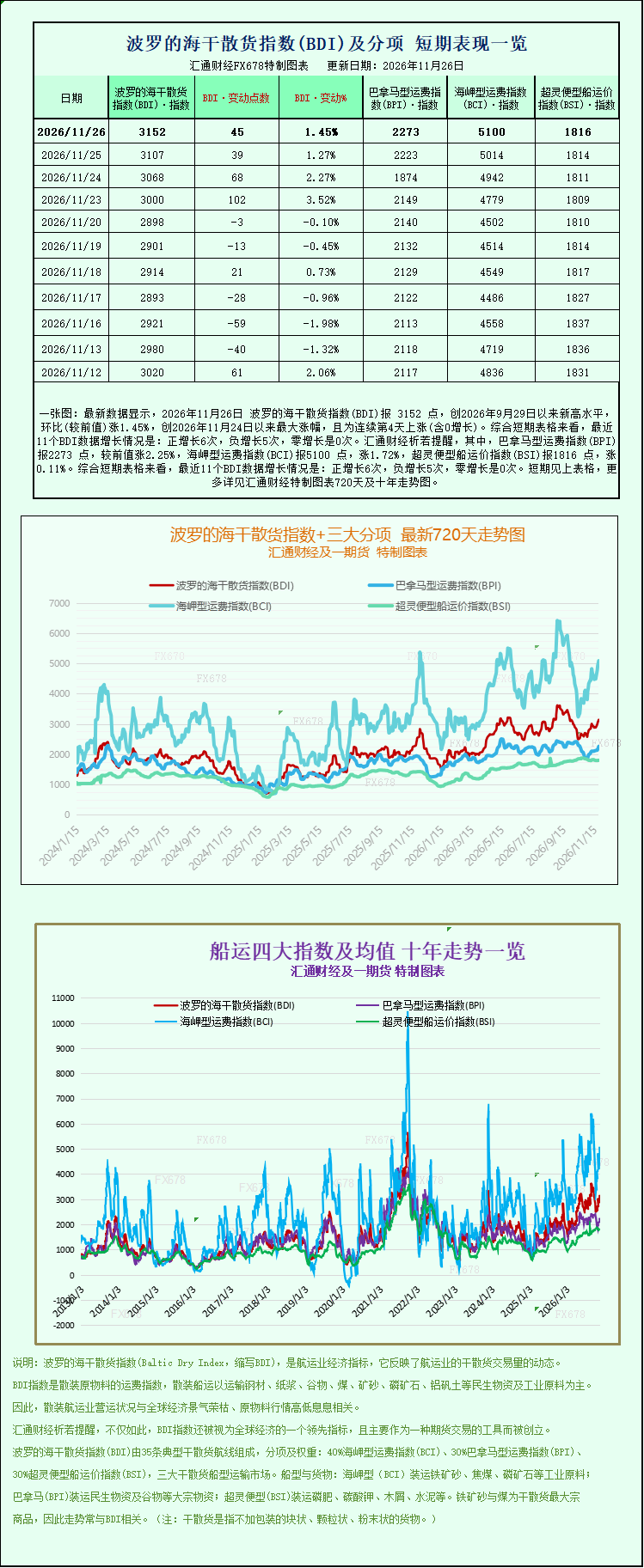 On November 26, the Baltic Dry Index (BDI), the core dry bulk freight index on the Baltic Exchange, continued its upward trend on Thursday, reaching a new high in nearly two months. The dry bulk market is showing signs of recovery, with shipping rates across the board rising. Capesize, Panamax, and Supramax vessel rates all strengthened, driving up overall market sentiment. The Baltic Dry Index, which aggregates spot charter rates for Capesize, Panamax, and Supramax vessels, is a key indicator of global commodity shipping conditions. On the day, the index rose 45 points, or 1.45%, to close at 3152 points, a new high since September 29. This rebound was not driven by a single vessel type, but rather by a coordinated strengthening of rates across all vessel types, reflecting a comprehensive recovery in global dry bulk trade demand. The foundation for the shipping market recovery is more solid than in previous periods. Looking at individual vessel types, Capesize vessels, the largest in size, performed the best. The Capesize index surged 86 points, or 1.72%, to close at 5100, also reaching its highest level since September 29. Capesize vessels, primarily carrying 150,000-ton bulk cargoes such as iron ore and thermal coal, are the mainstay of industrial raw material shipping, and their charter rates are highly correlated with the steel industry chain and energy demand. Data shows that the average daily earnings of Capesize vessels increased by $777 to $42,747. The core support for this round of strong Capesize vessel charter rates comes from optimistic expectations in the iron ore market. Market participants generally expect that as the world's largest iron ore consumer, Chinese steel mills will begin their raw material restocking cycle in December, releasing downstream demand and driving up iron ore shipping orders. The simultaneous rise in iron ore spot prices further boosted shipowners' pricing confidence, charterers' willingness to purchase cargo rebounded, and market activity significantly increased. For a long time, the Capesize sector has been a major driver of BDI index fluctuations, and the strong rise in this vessel type is the core pillar of this round of index breakthrough. Panamax vessels followed suit, with their market also showing a recovery trend. The Panamax index rose 50 points to close at 2273, a new high since October 19, 2026. Panamax vessels, with a deadweight tonnage mostly between 60,000 and 70,000 tons, primarily transport cargoes such as coal and grain, covering both energy and agricultural trade. Their routes cover multiple major Atlantic and Pacific routes, resulting in a more diversified trade structure. The average daily earnings of Panamax vessels increased by $447 to $20,456. This sector's rise is supported by multiple factors: firstly, global energy trade remains resilient, with power plants in some regions continuing to release winter coal storage demand, keeping transoceanic coal transportation demand stable; secondly, international grain trade has not been interrupted, with South American grain exports and Southeast Asian grain shipments generating continuous chartering demand. Compared to Capesize vessels, which are highly tied to the iron ore and steel industries, Panamax vessels have more diversified demand and relatively milder fluctuations. The recent steady rise reflects support from agricultural shipping demand in addition to industrial raw materials, resulting in a more balanced upward trend in the dry bulk market. Smaller Supramax vessels maintained a slight upward trend. The Supramax index rose 2 points, or 0.2%, to 1816 points. Supramax vessels offer greater flexibility and are suitable for short-haul, small-volume cargo. Their routes cover feeder lines across the globe, handling small batches of ore, building materials, fertilizers, and grains, with intra-regional trade being their primary demand. The increase in this vessel type was significantly smaller than the other two larger vessel types, indicating that the current market momentum is concentrated in long-distance, ocean-going bulk cargo transportation, while the recovery in short-haul regional bulk trade is relatively slow. However, the index still closed in positive territory, meaning that the spot market has not shown signs of weakening or divergence, and charter rates for small and medium-sized vessel owners remain firm, without any sector-wide divergence. Looking back at the market cycle, the BDI entered a period of consolidation after the end of September. Previously, weak iron ore prices, high steel mill raw material inventories, and a temporary slowdown in chartering demand suppressed freight rate upside. However, market expectations shifted in late November. Trading funds preemptively anticipated the year-end restocking window for domestic steel mills, and traders locked in shipping capacity in advance, pushing up spot charter rates. Simultaneously, seasonal demand from global coal trade and grain exports further supported freight rates across various vessel types. However, industry insiders maintain a rational perspective, noting that this round of price increases is largely driven by seasonal restocking and remains uncertain. Continued monitoring of domestic steel mill procurement is crucial: if end-user steel consumption remains weak and mill restocking falls short of expectations, there is a risk of a rapid decline in seaborne iron ore demand. Furthermore, the pace of vessel deployment, fluctuations in international commodity prices, and the shipping schedules of exporting countries will all influence freight rates. The current rebound in freight rates has improved the profit expectations of dry bulk shipping companies, but whether this trend can be sustained depends on the actual cargo volume in December. As a leading indicator of global trade, the Baltic Dry Index's broad-based gains in this round signal to the market that global dry bulk cargo flows are marginally improving and commodity shipping activity is picking up. Going forward, as the year-end peak trade season progresses, the supply-demand dynamics in the shipping market will continue, and freight rates for various vessel types will continue to be influenced by China's raw material procurement and the pace of global energy and agricultural exports.
- Risk Warning and Disclaimer
- The market involves risk, and trading may not be suitable for all investors. This article is for reference only and does not constitute personal investment advice, nor does it take into account certain users’ specific investment objectives, financial situation, or other needs. Any investment decisions made based on this information are at your own risk.