Can the euro stabilize after its sharp drop against the dollar? ING: There are conditions for recovery, but it's unlikely to break through 1.10.
2026-11-27 10:34:38
On Friday (November 27) in early Asian trading, the euro briefly dipped to around 1.0960 against the US dollar, after hitting a new low since April 2025 earlier this week, before rebounding to trade around 1.0975. Due to the US Thanksgiving holiday, overall market trading volume remained low, and volatility was relatively mild. The resilience of the US economy, coupled with strong inflation stickiness, has led the market to continue pricing in further interest rate hikes by the Federal Reserve in December and early 2027. This perpetuates the dollar's interest rate advantage, exerting medium- to long-term downward pressure on the euro. Sim Moh Siong, a foreign exchange strategist at OCBC Bank in Singapore, commented: The dollar is simultaneously pulled by both safe-haven buying and concerns about a slowdown in the AI economy. The risk-reward ratio for chasing the dollar higher has decreased, but hawkish expectations from the Federal Reserve will still provide a floor for the dollar. 
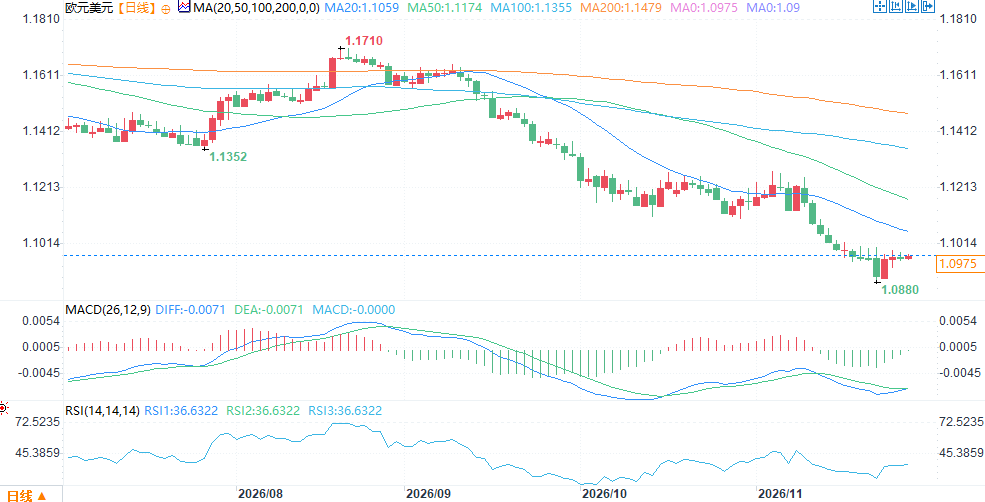 (Euro/USD daily chart, source: FX678) At 10:29 Beijing time, the euro was trading at 1.0974/75 against the US dollar.
Major personnel announcement: Decos is expected to succeed as the next ECB president.
According to the latest media reports, Pablo Hernández de Cos, a Spanish national, is expected to become the president of the European Central Bank (ECB) next year. The Netherlands has explicitly abandoned its candidate, Klaas Knot, in support of de Cos, a shift that clears a major political obstacle in the nomination process. De Cos, currently the governor of the Bank of Spain, is known within the ECB Governing Council for his relatively cautious and data-dependent stance. His formal appointment will mark the beginning of a new cycle in the ECB leadership. After the new leadership is finalized, the market will reassess the Eurozone's medium-term monetary policy path, particularly its preference for balancing inflation stickiness with economic growth. If de Cos continues his hawkish or neutral-hawkish policy style, it may strengthen market expectations that the ECB will maintain higher interest rates for a longer period; conversely, if his statements focus more on growth risks, it may create room for speculation about a period of policy easing for the euro. While the personnel confirmation itself is not an immediate strong catalyst, it will potentially impact the medium-term trend of the euro against the US dollar by altering the expectation gap between European and American monetary policies, and is also an important clue for medium-term funding pricing.ING: The euro held key support, presenting a chance for stabilization and recovery, but the 1.10 resistance level remains difficult to break.
ING Group offers a cautiously optimistic assessment. ING points out that the euro successfully held the key support level of 1.0880 against the dollar this week; if it can close above 1.0975 by Friday, it may signal a reversal after the first week of declines since the 7% drop at the end of August. Historically, the dollar tends to weaken in December; the euro's previous decline has significantly exceeded what short-term interest rate differentials can explain, leaving room for technical oversold correction. Furthermore, lower energy prices this month have improved the eurozone's terms of trade, theoretically benefiting the euro, but this fundamental positive has not yet been fully priced into the exchange rate, representing a potential support. However, ING also cautions that the current rebound is more of a correction after overselling than a trend reversal. The short-term market is likely to remain range-bound, with no clear catalysts currently in sight to push the exchange rate above 1.10. The Fed's continued hawkish expectations and the dollar's interest rate advantage remain key resistance levels; for the euro to effectively break through this crucial resistance, stronger data or policy signals are needed.Kocher sends hawkish signal: Rising inflation risks limit euro rebound.
ECB Governing Council member Kocher emphasized that monetary policy must not lag behind the inflation curve, and the December inflation forecast will likely need to be revised upwards. Therefore, policy must adopt a cautious and tightening stance. He pointed out that the second-wave inflation effect will not be clearer until the first half of 2027; while the Eurozone economy is resilient, it remains fragile. The market's pricing in the Eurozone interest rate path is largely reasonable, but the risk is skewed towards inflation continuing to exceed the target, and a rapid shift to a dovish stance is unlikely in the short term. This statement reinforced expectations that the ECB will maintain a restrictive policy, and the synchronized hawkish stance of the European and US central banks has limited the euro's upside potential. Although the euro has recovered slightly from support, the ECB's reluctance to cut rates and the persistently high expectations of a Fed rate hike limit the rebound's strength. Against the backdrop of low trading volume during the US Thanksgiving holiday, the market lacks new funds to drive a one-sided market trend. Kocher's hawkish remarks have dampened the willingness of bulls to chase higher prices. Investors need to continue to monitor subsequent statements from other ECB Governing Council members to confirm the consistency of policy stance. (Euro/USD daily chart, source: FX678) At 10:29 Beijing time, the euro was trading at 1.0974/75 against the US dollar.
- Risk Warning and Disclaimer
- The market involves risk, and trading may not be suitable for all investors. This article is for reference only and does not constitute personal investment advice, nor does it take into account certain users’ specific investment objectives, financial situation, or other needs. Any investment decisions made based on this information are at your own risk.