Institutions: The dollar's rise may be nearing its end, gold's downside is limited, and it's expected to reach $3700 by the end of the year.
2026-11-27 11:46:33
Gold prices rose more than 1.5% in early Asian trading on Friday (November 27), currently trading around $3,625 per ounce. Gold had previously dipped to its lowest level since August 2025. 
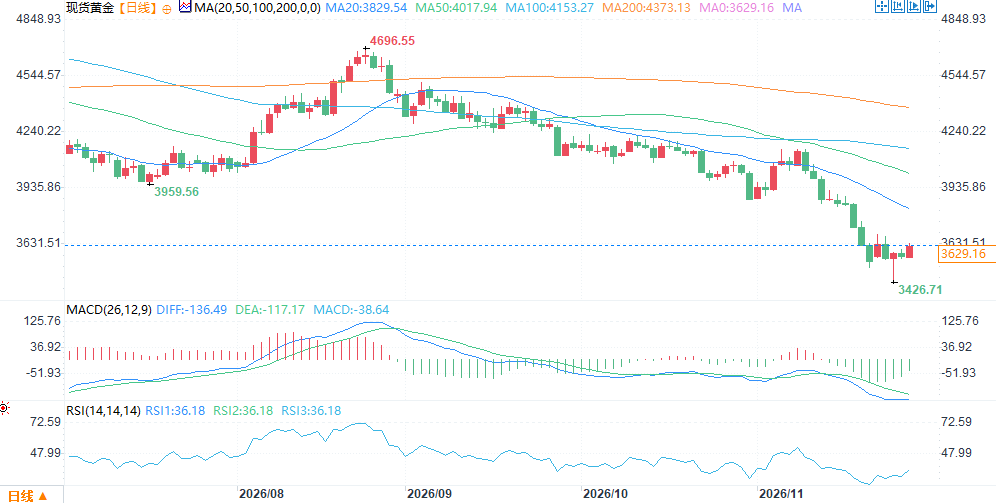 (Spot gold daily chart, source: FX678) At 11:42 Beijing time, spot gold was trading at $3,629.70 per ounce.
Driving Logic Shift: Gold Moves Away from Safe-Haven Dominance and Returns to the Framework of the US Dollar and Real Yields
Commonwealth Bank of Australia (CBA) analysts believe that the core pricing logic of the current gold market is changing. Previously, safe-haven trading driven by declining confidence in US assets, a long-term depreciation of the US dollar, and rising global geopolitical risks was a significant force propelling gold prices. However, as the "sell US assets" trend subsided, the US dollar did not weaken as previously expected, but instead showed considerable resilience. The macroeconomic narrative that gold previously relied on is also changing. Against this backdrop, gold is returning to the traditional macroeconomic pricing framework: the inverse relationship between the US dollar index and US real interest rates. Since gold itself does not generate interest, when US real yields rise, the opportunity cost for investors to hold gold increases, making it easier for funds to flow into dollar assets, thus suppressing gold prices. Conversely, if real yields fall, gold's attractiveness as an asset allocation typically improves. This means that future gold price movements may no longer solely depend on safe-haven news such as geopolitical conflicts and political uncertainty, but will more sensitively reflect changes in US monetary policy expectations, the dollar's trajectory, and real yields on US Treasury bonds. For traders, it is necessary to readjust the focus of observation, taking the US dollar index and the US 10-year real yield as important indicators for judging the direction of gold prices, while risk aversion sentiment should be used more as a secondary variable.The US dollar is nearing its expected peak, providing a floor for gold prices.
CBA believes that the recent rise in the US dollar has exceeded previous expectations in both magnitude and speed, and the current dollar exchange rate is very close to the cyclical peak predicted by the bank in mid-2027. This assessment is significant for the gold market, as a stronger dollar has been one of the core factors suppressing gold prices recently. A stronger dollar not only increases the cost of gold for non-dollar investors but also enhances the attractiveness of dollar assets to international funds, thereby weakening the relative allocation value of gold. However, if the dollar has already absorbed most of the upward momentum in this round, then the main macroeconomic headwinds facing gold may be gradually approaching their limit. In other words, even if the dollar remains strong in the short term, as long as the space and momentum for further increases begin to weaken, the pressure on gold is expected to decrease accordingly. This is also an important basis for CBA's belief that the space for further significant declines in gold prices is limited. From the perspective of the exchange rate market, the movements of USD/JPY and EUR/USD are also worth noting. If the upward momentum of USD/JPY weakens, or EUR/USD gradually stabilizes and rebounds, it may mean that the dollar index is approaching a temporary peak. At that time, gold is expected to gain new upward momentum. Based on this assessment, CBA has set a year-end gold price target range of $3,500-$3,700 per ounce. However, this forecast does not imply an immediate one-sided upward trend in gold prices. Whether the dollar has truly peaked still requires further verification from subsequent economic data and Federal Reserve policy signals.The December Fed decision: the most important test in the short term.
With the dollar's trajectory still uncertain, the December Federal Reserve meeting will be a crucial turning point for gold's short-term direction. The market is currently focused not only on how the Fed ultimately adjusts interest rates, but also on its policy statement, economic forecasts, and officials' statements regarding the future path of monetary policy. While the interest rate decision itself is important for gold, what truly influences market pricing is whether the policy signals released by the Fed exceed investors' previous expectations. If the Fed ultimately implements the 25 basis point rate hike already priced in by the market, without releasing further hawkish signals, the market may interpret this as the current tightening policy nearing its end. As expectations for additional rate hikes cool, the pressure on US Treasury real yields to rise further is expected to ease, and the dollar may gradually lose its upward momentum. In this scenario, gold will have the opportunity to gradually stabilize above $3,500 and rebound towards the $3,700 range. However, another scenario cannot be ignored. If the Fed believes that inflationary pressures remain persistent and hints at the possibility of further rate hikes, then market expectations for persistently high US interest rates may reignite. This would not only push up the dollar but could also drive real yields further upward, putting new selling pressure on gold. Once the market begins to repric the path to a stronger tightening, $3,500 could become a significant technical and psychological support level. Therefore, the December meeting is actually a crucial window to test whether the dollar is nearing its peak and whether gold has weathered its most difficult phase.Institutional opinions are sharply divided, with the risk also stemming from an unexpectedly strong US dollar.
While the CBA (China's financial regulator) holds a relatively constructive view on the future of gold, significant disagreements remain among market institutions, reflecting a current phase of rebalancing between bullish and bearish forces. Those bullish believe the dollar's upside potential is gradually narrowing, and expectations of Fed tightening may be nearing a temporary peak, potentially easing the macroeconomic pressures previously faced by gold. With reduced selling pressure, gold prices may bottom out at key support levels and resume upward movement. However, more cautious institutions do not believe gold has definitively bottomed out. HSBC warns that if global stock markets continue to weaken, market liquidity pressures and investor demand for passive profit-taking could further increase, potentially putting gold below $3400. This means that even with long-term investment value, gold may not be entirely immune to the impact of financial market volatility in the short term. Especially when investors need to replenish cash or reduce overall risk exposure, gold may be included in the selling pressure. In contrast, Saxo Bank is more concerned about whether selling pressure in the gold market has weakened. If gold prices can effectively hold above $3590, it indicates strengthening market support, and short-term bearish pressure may gradually ease, potentially leading to a rebound towards $3700. However, CBA's optimistic assessment also rests on certain conditions: the dollar must gradually confirm its peak, and the Federal Reserve cannot release hawkish signals beyond market expectations. If the dollar continues to strengthen beyond expectations, or if US real yields rise further, gold may still face significant downward pressure. Therefore, the core disagreement in the current market is not whether gold can rebound, but rather how much room there is left in the dollar's strong cycle. Only when this question is clearly answered will the direction of gold in the next stage become clearer. (Spot gold daily chart, source: FX678) At 11:42 Beijing time, spot gold was trading at $3,629.70 per ounce.
- Risk Warning and Disclaimer
- The market involves risk, and trading may not be suitable for all investors. This article is for reference only and does not constitute personal investment advice, nor does it take into account certain users’ specific investment objectives, financial situation, or other needs. Any investment decisions made based on this information are at your own risk.