Expectations of a new Federal Reserve chairman triggered a further decline in the US dollar index, which is expected to fluctuate downwards in the short term.
2025-12-03 13:18:12
The U.S. dollar index (DXY) continued to be under pressure in early Asian trading, trading around 99.20, down about 0.1% on the day, highlighting the market's urgent need to repric the outlook for U.S. monetary policy.
The core driver of this decline stems from renewed market focus on the succession of the Federal Reserve Chair. With the Fed Chair's term expiring next May, discussions about whether the White House will push for a policy shift have intensified significantly.
There are signs that the voices of White House economic advisor Kevin Hassett are rapidly gaining traction. His rare mention during interactions among high-ranking U.S. officials has been quickly interpreted by the market as an indication of potential policy direction.
Given that this candidate has long aligned with the economic philosophy of the U.S. administration, the market generally believes that if he takes office, the policy stance may lean towards lower interest rates and a greater emphasis on economic stimulus.
Market experts generally believe that if the new chairman's policy stance aligns with that of the executive branch, the Fed's independence may be questioned by the market, thereby increasing dollar volatility. From an economic indicator perspective, investors are also closely watching the upcoming ADP employment data and ISM services index.
Current market forecasts suggest that ADP private sector job growth may be only 10,000, significantly lower than last month's 42,000. Meanwhile, the ISM Services PMI is expected to fall to 52.1, a slight decline from last month's 52.4.
If data confirms weakening economic momentum, it could strengthen bets on a December rate cut, putting further downward pressure on the dollar. Overall, policy uncertainty coupled with potential economic weakness significantly limits the current upside potential of the dollar index, and short-term volatility triggered by the convergence of multiple macroeconomic factors should be closely monitored.
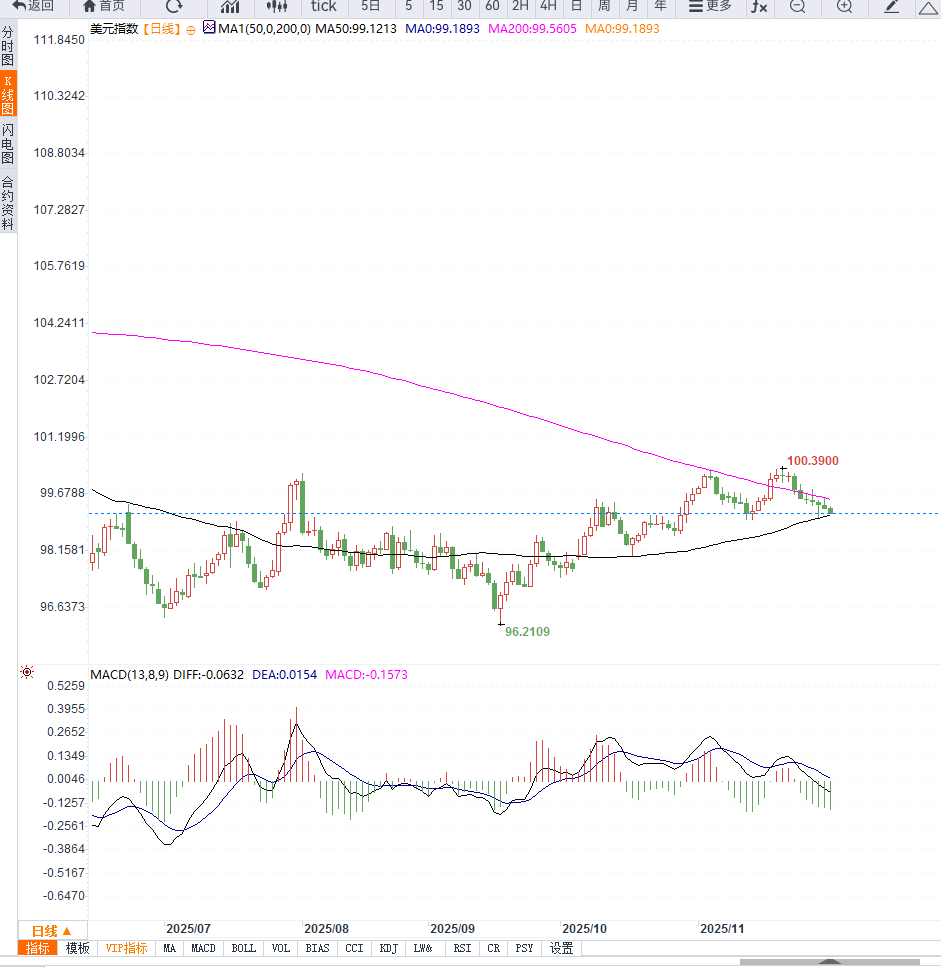
Observing the DXY daily chart, the US dollar index recently faced pressure and fell back after approaching the 100 mark, with short-term moving averages showing a weak alignment. The candlestick pattern indicates a downward trend with high-level fluctuations, the MACD histogram continues to weaken near the zero axis, and the RSI has gradually fallen from the neutral zone to about 48, indicating insufficient upward momentum.
Technical resistance is located near the 100 level, while support levels are in the 98.80 and 98.50 area. If the index fails to hold above 100, it may still retest the support range in the short term, and the overall technical picture leans towards a weak consolidation pattern.
Editor's Note:
From an overall perspective, the adjustment in the US dollar index reflects both the market's repricing of policy prospects and its anticipation of concerns about economic fundamentals. If subsequent data remains weak, it could drive the market to shift its bets towards earlier easing by the Federal Reserve.
Against this backdrop, the US dollar index may struggle to gain sustained upward momentum in the short term. The focus will be on the feedback from key data releases in the coming week, and whether potential appointment signals gradually become clearer.
The core driver of this decline stems from renewed market focus on the succession of the Federal Reserve Chair. With the Fed Chair's term expiring next May, discussions about whether the White House will push for a policy shift have intensified significantly.
There are signs that the voices of White House economic advisor Kevin Hassett are rapidly gaining traction. His rare mention during interactions among high-ranking U.S. officials has been quickly interpreted by the market as an indication of potential policy direction.
Given that this candidate has long aligned with the economic philosophy of the U.S. administration, the market generally believes that if he takes office, the policy stance may lean towards lower interest rates and a greater emphasis on economic stimulus.
Market experts generally believe that if the new chairman's policy stance aligns with that of the executive branch, the Fed's independence may be questioned by the market, thereby increasing dollar volatility. From an economic indicator perspective, investors are also closely watching the upcoming ADP employment data and ISM services index.
Current market forecasts suggest that ADP private sector job growth may be only 10,000, significantly lower than last month's 42,000. Meanwhile, the ISM Services PMI is expected to fall to 52.1, a slight decline from last month's 52.4.
If data confirms weakening economic momentum, it could strengthen bets on a December rate cut, putting further downward pressure on the dollar. Overall, policy uncertainty coupled with potential economic weakness significantly limits the current upside potential of the dollar index, and short-term volatility triggered by the convergence of multiple macroeconomic factors should be closely monitored.
Observing the DXY daily chart, the US dollar index recently faced pressure and fell back after approaching the 100 mark, with short-term moving averages showing a weak alignment. The candlestick pattern indicates a downward trend with high-level fluctuations, the MACD histogram continues to weaken near the zero axis, and the RSI has gradually fallen from the neutral zone to about 48, indicating insufficient upward momentum.
Technical resistance is located near the 100 level, while support levels are in the 98.80 and 98.50 area. If the index fails to hold above 100, it may still retest the support range in the short term, and the overall technical picture leans towards a weak consolidation pattern.
Editor's Note:
From an overall perspective, the adjustment in the US dollar index reflects both the market's repricing of policy prospects and its anticipation of concerns about economic fundamentals. If subsequent data remains weak, it could drive the market to shift its bets towards earlier easing by the Federal Reserve.
Against this backdrop, the US dollar index may struggle to gain sustained upward momentum in the short term. The focus will be on the feedback from key data releases in the coming week, and whether potential appointment signals gradually become clearer.
- Risk Warning and Disclaimer
- The market involves risk, and trading may not be suitable for all investors. This article is for reference only and does not constitute personal investment advice, nor does it take into account certain users’ specific investment objectives, financial situation, or other needs. Any investment decisions made based on this information are at your own risk.