The divergence between expectations of a Fed rate cut and signals of a Japanese rate hike has widened, leading to a continued correction in the USD/JPY exchange rate.
2025-12-03 13:07:59
During Wednesday's Asian trading session, the USD/JPY pair attempted to extend its rebound from the previous day's break above 156.00, but failed to hold the highs and retreated to around 155.65. Despite the pullback, there was a lack of significant follow-through selling, reflecting market caution ahead of important data releases.
The core factor driving the yen's strength comes from the Bank of Japan's latest policy hints. Bank of Japan Governor Kazuo Ueda spoke this week, mentioning that the central bank's economic and price outlook is gradually approaching its targets. This is seen as its clearest signal to date regarding interest rate hikes, implying that conditions for policy normalization are gradually forming, thus providing solid support for the yen.
 A Tokyo-based forex strategist said, "Ueda's remarks suggest that Japan may be entering the countdown to interest rate hikes, which provides structural support for the yen." This contrasts sharply with the continued weakness of the US dollar.
The market widely expects the Federal Reserve to cut interest rates at its meeting next week, which will directly weaken the dollar's interest rate advantage and make funds more inclined to flow to yen assets where future yields may rise.
A New York market observer noted, "The US-Japan interest rate differential is likely to narrow significantly in the coming months, making it more difficult for USD/JPY to rise." This contrasting policy expectations form the core logic behind the current bearish outlook for the exchange rate.
However, the overall robust performance of global risk assets limited safe-haven demand, thus weakening additional buying of the yen. Meanwhile, investors are awaiting several key US data releases this week to determine their next trading direction.
Wednesday's US economic agenda includes the ADP employment report and the ISM services PMI, which could influence short-term volatility. However, the market's primary focus remains on Friday's PCE price index, the Fed's most important inflation indicator, whose results could directly impact the magnitude and pace of interest rate cuts.
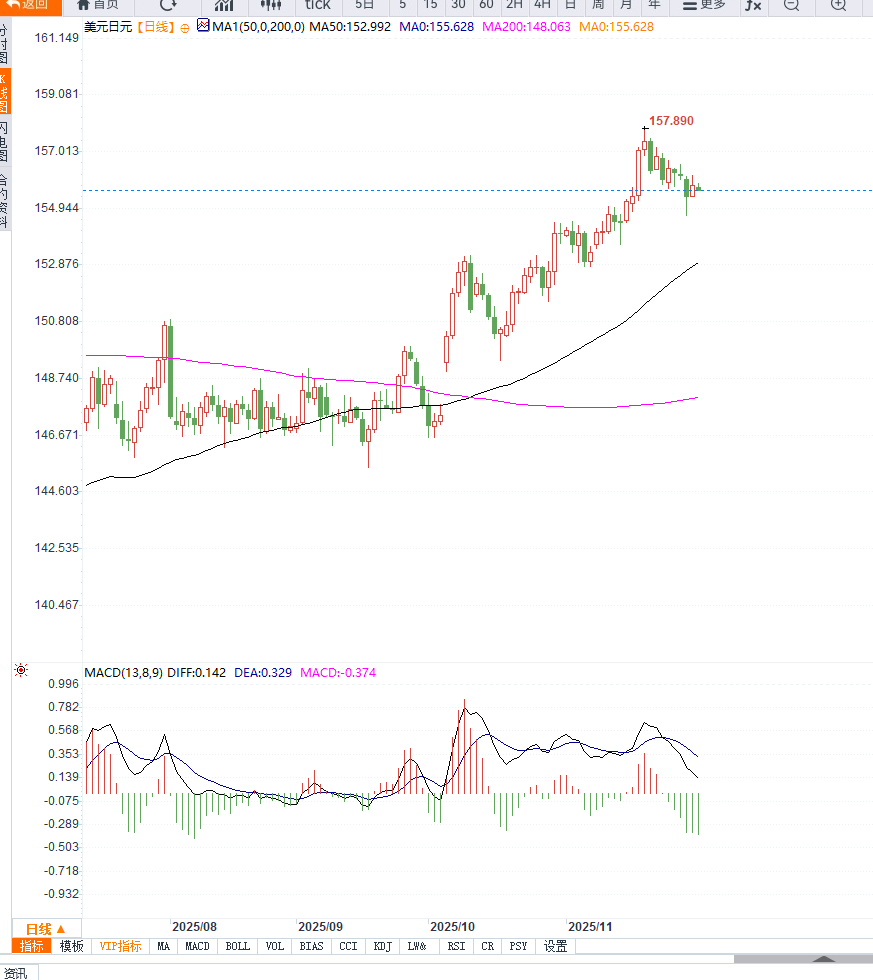
Looking at the USD/JPY daily chart, the exchange rate encountered resistance again after touching the 156 level, and has been blocked by short-term moving averages for several consecutive days, indicating that selling pressure remains significant. The current candlestick pattern shows signs of overbought conditions, the MACD histogram is gradually shrinking, indicating weakening upward momentum, and the RSI has fallen from overbought territory, further reflecting a slowdown in bullish strength.
If the exchange rate continues to remain below 156.00, it may test the key support levels of 155.00 and 154.50 in turn; conversely, if it breaks through and holds above the short-term moving average, a short-term corrective rebound may occur. The overall technical structure remains biased towards a weak consolidation pattern.
Editor's Note:
The current USD/JPY exchange rate movement is primarily driven by a significant divergence in policy expectations between the US and Japan. The Bank of Japan is gradually moving towards interest rate hikes, while the Federal Reserve may begin a rate-cutting cycle. This shift in the interest rate differential will be the main driver of the exchange rate's medium- to long-term trend.
The US PCE data in the coming days is crucial. If inflation continues to decline, expectations of interest rate cuts will strengthen further, and the exchange rate will likely test the 155.00 level or even lower. In the short term, both technical and fundamental factors point to a weak structure.
The core factor driving the yen's strength comes from the Bank of Japan's latest policy hints. Bank of Japan Governor Kazuo Ueda spoke this week, mentioning that the central bank's economic and price outlook is gradually approaching its targets. This is seen as its clearest signal to date regarding interest rate hikes, implying that conditions for policy normalization are gradually forming, thus providing solid support for the yen.
A Tokyo-based forex strategist said, "Ueda's remarks suggest that Japan may be entering the countdown to interest rate hikes, which provides structural support for the yen." This contrasts sharply with the continued weakness of the US dollar.The market widely expects the Federal Reserve to cut interest rates at its meeting next week, which will directly weaken the dollar's interest rate advantage and make funds more inclined to flow to yen assets where future yields may rise.
A New York market observer noted, "The US-Japan interest rate differential is likely to narrow significantly in the coming months, making it more difficult for USD/JPY to rise." This contrasting policy expectations form the core logic behind the current bearish outlook for the exchange rate.
However, the overall robust performance of global risk assets limited safe-haven demand, thus weakening additional buying of the yen. Meanwhile, investors are awaiting several key US data releases this week to determine their next trading direction.
Wednesday's US economic agenda includes the ADP employment report and the ISM services PMI, which could influence short-term volatility. However, the market's primary focus remains on Friday's PCE price index, the Fed's most important inflation indicator, whose results could directly impact the magnitude and pace of interest rate cuts.
Looking at the USD/JPY daily chart, the exchange rate encountered resistance again after touching the 156 level, and has been blocked by short-term moving averages for several consecutive days, indicating that selling pressure remains significant. The current candlestick pattern shows signs of overbought conditions, the MACD histogram is gradually shrinking, indicating weakening upward momentum, and the RSI has fallen from overbought territory, further reflecting a slowdown in bullish strength.
If the exchange rate continues to remain below 156.00, it may test the key support levels of 155.00 and 154.50 in turn; conversely, if it breaks through and holds above the short-term moving average, a short-term corrective rebound may occur. The overall technical structure remains biased towards a weak consolidation pattern.
Editor's Note:
The current USD/JPY exchange rate movement is primarily driven by a significant divergence in policy expectations between the US and Japan. The Bank of Japan is gradually moving towards interest rate hikes, while the Federal Reserve may begin a rate-cutting cycle. This shift in the interest rate differential will be the main driver of the exchange rate's medium- to long-term trend.
The US PCE data in the coming days is crucial. If inflation continues to decline, expectations of interest rate cuts will strengthen further, and the exchange rate will likely test the 155.00 level or even lower. In the short term, both technical and fundamental factors point to a weak structure.
- Risk Warning and Disclaimer
- The market involves risk, and trading may not be suitable for all investors. This article is for reference only and does not constitute personal investment advice, nor does it take into account certain users’ specific investment objectives, financial situation, or other needs. Any investment decisions made based on this information are at your own risk.