Suffocating volatility! The euro struggles sideways, a desperate gamble brewing in the market?
2025-12-19 10:15:24
The euro traded in a narrow range around 1.1720 against the dollar on Friday (December 19), as a flurry of economic data released from both sides of the Atlantic failed to provide a clear direction for the single currency.
With moderate US inflation data and the European Central Bank deciding to keep interest rates unchanged at its last meeting of the year, these factors had little impact on the directional guidance of the euro against the US dollar.

Delayed data released by the U.S. Bureau of Labor Statistics showed that both overall inflation and core inflation fell to their lowest levels since early 2021 in November. While this opens up room for further easing, the dual pressures of improved jobless claims last week, which exceeded economists' expectations, are looming.
In Brussels, across the Atlantic, the European Central Bank (ECB) kept interest rates unchanged as expected. Sources said the rate-cutting cycle was "highly likely over." ECB President Christine Lagarde stated that the decision was unanimously approved and that the ECB will continue to adhere to its policy of "making decisions at each meeting."
Following the data release and the European Central Bank's decision, the euro fell 0.16% against the dollar on Thursday, remaining within its familiar range.
Traders' focus has shifted to the Federal Reserve's preferred inflation gauge—the core personal consumption expenditures price index (PCE)—and the release of the final reading of the University of Michigan consumer sentiment index.
In Europe, markets will be closely watching speeches by European Central Bank officials Mario Cipolone and Martin Kocher, as well as the October current account data.
Data from the U.S. Bureau of Labor Statistics showed that inflation cooled further in November, with the Consumer Price Index rising 2.7% year-on-year, down from 3.0% in September and below market expectations of 3.1%. Core inflation, excluding food and energy, fell to 2.6% year-on-year from 3.0%, reinforcing the signal that the downward trend in inflation has resumed.
Meanwhile, data from the U.S. Department of Labor showed that the number of people filing for unemployment benefits declined. For the week ending December 13, initial jobless claims rose to 224,000, down from the revised previous week's figure of 237,000 and below the expected 225,000.
According to Capital Edge interest rate probability data, the market's expectation for a rate cut at the Federal Reserve's next meeting on January 28 remains unchanged at 24%. However, for the entire year, investors have already priced in a 60-basis-point rate cut, with the first cut expected in June.
Chicago Fed President Austan Goolsby said inflation data was "encouraging" and that a "clearer understanding of the downward trend in inflation" could prompt further interest rate cuts. However, he maintained a slightly hawkish stance, saying he was "uneasy about cutting rates too early."
The European Central Bank kept interest rates unchanged for the fourth consecutive meeting, with the deposit facility rate remaining at 2.00%, the main refinancing rate at 2.15%, and the marginal lending facility rate at 2.40%, in line with market expectations.
The euro/dollar pair traded sideways for the sixth consecutive session in the 1.1700-1.1800 range, with price action slowing as traders prepared for the Christmas holidays and liquidity gradually drying up.
The Relative Strength Index (RSI) indicates that momentum is still biased towards the bulls, but it has leveled off in low-volume trading.
On the upside, for the bullish trend to continue, the exchange rate needs to break through the 1.1750 resistance level and rise above the 1.1800 mark. Once the latter is broken, it could test 1.1850 and the year's high of 1.1918.
On the downside, if the euro/dollar weakens further and falls below 1.1700, it may test the 100-day simple moving average (SMA, 1.1652) and then the 1.1600 level.
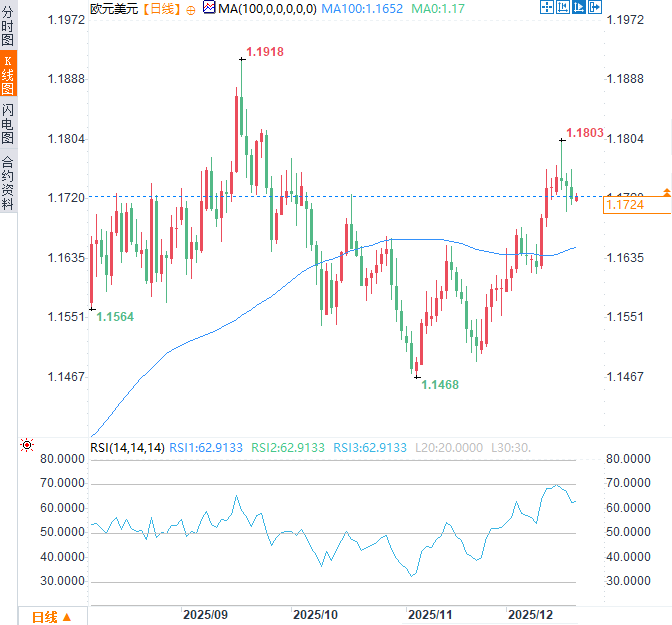
(Euro/USD daily chart, source: FX678)
At 10:15 Beijing time, the euro was trading at 1.1726/27 against the US dollar.
With moderate US inflation data and the European Central Bank deciding to keep interest rates unchanged at its last meeting of the year, these factors had little impact on the directional guidance of the euro against the US dollar.
Weak US inflation and the European Central Bank's prudent stance failed to ignite market momentum.
Delayed data released by the U.S. Bureau of Labor Statistics showed that both overall inflation and core inflation fell to their lowest levels since early 2021 in November. While this opens up room for further easing, the dual pressures of improved jobless claims last week, which exceeded economists' expectations, are looming.
In Brussels, across the Atlantic, the European Central Bank (ECB) kept interest rates unchanged as expected. Sources said the rate-cutting cycle was "highly likely over." ECB President Christine Lagarde stated that the decision was unanimously approved and that the ECB will continue to adhere to its policy of "making decisions at each meeting."
Following the data release and the European Central Bank's decision, the euro fell 0.16% against the dollar on Thursday, remaining within its familiar range.
Traders' focus has shifted to the Federal Reserve's preferred inflation gauge—the core personal consumption expenditures price index (PCE)—and the release of the final reading of the University of Michigan consumer sentiment index.
In Europe, markets will be closely watching speeches by European Central Bank officials Mario Cipolone and Martin Kocher, as well as the October current account data.
Thin liquidity caused the euro to stagnate.
Data from the U.S. Bureau of Labor Statistics showed that inflation cooled further in November, with the Consumer Price Index rising 2.7% year-on-year, down from 3.0% in September and below market expectations of 3.1%. Core inflation, excluding food and energy, fell to 2.6% year-on-year from 3.0%, reinforcing the signal that the downward trend in inflation has resumed.
Meanwhile, data from the U.S. Department of Labor showed that the number of people filing for unemployment benefits declined. For the week ending December 13, initial jobless claims rose to 224,000, down from the revised previous week's figure of 237,000 and below the expected 225,000.
According to Capital Edge interest rate probability data, the market's expectation for a rate cut at the Federal Reserve's next meeting on January 28 remains unchanged at 24%. However, for the entire year, investors have already priced in a 60-basis-point rate cut, with the first cut expected in June.
Chicago Fed President Austan Goolsby said inflation data was "encouraging" and that a "clearer understanding of the downward trend in inflation" could prompt further interest rate cuts. However, he maintained a slightly hawkish stance, saying he was "uneasy about cutting rates too early."
The European Central Bank kept interest rates unchanged for the fourth consecutive meeting, with the deposit facility rate remaining at 2.00%, the main refinancing rate at 2.15%, and the marginal lending facility rate at 2.40%, in line with market expectations.
Technical Outlook: EUR/USD remains range-bound despite maintaining an upward trend.
The euro/dollar pair traded sideways for the sixth consecutive session in the 1.1700-1.1800 range, with price action slowing as traders prepared for the Christmas holidays and liquidity gradually drying up.
The Relative Strength Index (RSI) indicates that momentum is still biased towards the bulls, but it has leveled off in low-volume trading.
On the upside, for the bullish trend to continue, the exchange rate needs to break through the 1.1750 resistance level and rise above the 1.1800 mark. Once the latter is broken, it could test 1.1850 and the year's high of 1.1918.
On the downside, if the euro/dollar weakens further and falls below 1.1700, it may test the 100-day simple moving average (SMA, 1.1652) and then the 1.1600 level.
(Euro/USD daily chart, source: FX678)
At 10:15 Beijing time, the euro was trading at 1.1726/27 against the US dollar.
- Risk Warning and Disclaimer
- The market involves risk, and trading may not be suitable for all investors. This article is for reference only and does not constitute personal investment advice, nor does it take into account certain users’ specific investment objectives, financial situation, or other needs. Any investment decisions made based on this information are at your own risk.