Crude oil trading alert: Geopolitical disturbances are unlikely to change the weak trend; US crude oil is fluctuating at low levels around $56.
2025-12-19 09:30:07
On Friday during Asian trading hours, US crude oil continued to fall, trading around $55.80 per barrel. The overall trend remained weak, with prices fluctuating around $56 per barrel for an extended period, not far from the year's low.
This performance reflects the market's hesitation between bullish and bearish factors: on the one hand, the geopolitical situation surrounding some oil-producing countries and the US's actions on energy and sanctions continue to inject risk premiums into oil prices;
On the other hand, the slow pace of global economic recovery has made the outlook for crude oil demand less convincing, limiting the sustainability of the bullish trend. From a fundamental perspective, recent support for oil prices comes more from expectations than from actual changes.

Market concerns exist that U.S. restrictions on crude oil transportation and exports could impact local supply in extreme cases, but there is currently no evidence of a substantial impact on the global supply structure.
At the same time, discussions about easing regional tensions have led some funds to cautiously exit the market at high levels, making it difficult for oil price rebounds to be sustained.
Some analysts point out that at the current stage, crude oil prices are more a reflection of the advance pricing of potential risks, rather than a fundamental reversal in the supply and demand structure.
Market information indicates that US restrictions on Venezuelan oil shipments and the progress of negotiations surrounding the Russia-Ukraine situation have become significant factors affecting oil prices.
Analysts believe that the psychological impact of sanctions is no less significant than actual supply and demand changes, and traders often price in potential risks in advance.
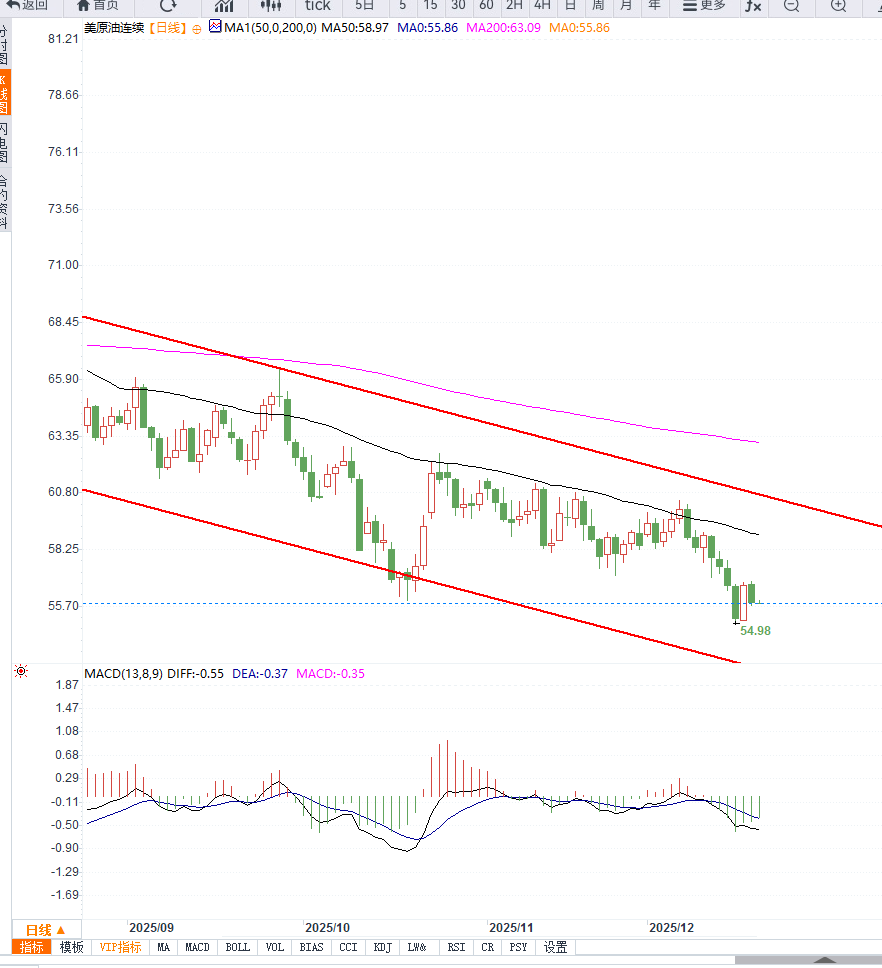
From the daily chart of US crude oil, the technical structure remains bearish. Prices are still trading within a medium-term downtrend channel, with multiple medium- and long-term moving averages trending downwards, significantly suppressing any potential rebound.
At key levels, the $55 to $55.50 area forms important support below, as this range coincides with previous lows. If this level is breached, oil prices risk falling again. On the other hand, the $57.50 to $58.50 range is where previous rebound highs and short-term moving averages overlap, becoming the core resistance limiting oil price increases.
In terms of momentum indicators, the RSI is in the low to mid range and has not yet shown a clear oversold signal, indicating that although the bearish momentum has weakened, the bullish force is still insufficient to drive a trend reversal.
Overall, the current rebound is more in line with the characteristics of a technical bounce within a downtrend, rather than the start of a new round of upward movement. Technical analysis suggests that only when oil prices effectively stabilize above key resistance levels, accompanied by a simultaneous improvement in trading volume and momentum, will the market be able to reassess its medium-term trend.
Editor's Note:
Based on both fundamental and technical analysis, US crude oil is unlikely to break out of its low-level consolidation pattern in the short term. While geopolitical factors continue to create volatility, their impact remains largely at the sentiment level until demand expectations improve significantly. Focus should be placed on the range-bound trading between the $55 support level and the $58 resistance level.
This performance reflects the market's hesitation between bullish and bearish factors: on the one hand, the geopolitical situation surrounding some oil-producing countries and the US's actions on energy and sanctions continue to inject risk premiums into oil prices;
On the other hand, the slow pace of global economic recovery has made the outlook for crude oil demand less convincing, limiting the sustainability of the bullish trend. From a fundamental perspective, recent support for oil prices comes more from expectations than from actual changes.
Market concerns exist that U.S. restrictions on crude oil transportation and exports could impact local supply in extreme cases, but there is currently no evidence of a substantial impact on the global supply structure.
At the same time, discussions about easing regional tensions have led some funds to cautiously exit the market at high levels, making it difficult for oil price rebounds to be sustained.
Some analysts point out that at the current stage, crude oil prices are more a reflection of the advance pricing of potential risks, rather than a fundamental reversal in the supply and demand structure.
Market information indicates that US restrictions on Venezuelan oil shipments and the progress of negotiations surrounding the Russia-Ukraine situation have become significant factors affecting oil prices.
Analysts believe that the psychological impact of sanctions is no less significant than actual supply and demand changes, and traders often price in potential risks in advance.
From the daily chart of US crude oil, the technical structure remains bearish. Prices are still trading within a medium-term downtrend channel, with multiple medium- and long-term moving averages trending downwards, significantly suppressing any potential rebound.
At key levels, the $55 to $55.50 area forms important support below, as this range coincides with previous lows. If this level is breached, oil prices risk falling again. On the other hand, the $57.50 to $58.50 range is where previous rebound highs and short-term moving averages overlap, becoming the core resistance limiting oil price increases.
In terms of momentum indicators, the RSI is in the low to mid range and has not yet shown a clear oversold signal, indicating that although the bearish momentum has weakened, the bullish force is still insufficient to drive a trend reversal.
Overall, the current rebound is more in line with the characteristics of a technical bounce within a downtrend, rather than the start of a new round of upward movement. Technical analysis suggests that only when oil prices effectively stabilize above key resistance levels, accompanied by a simultaneous improvement in trading volume and momentum, will the market be able to reassess its medium-term trend.
Editor's Note:
Based on both fundamental and technical analysis, US crude oil is unlikely to break out of its low-level consolidation pattern in the short term. While geopolitical factors continue to create volatility, their impact remains largely at the sentiment level until demand expectations improve significantly. Focus should be placed on the range-bound trading between the $55 support level and the $58 resistance level.
- Risk Warning and Disclaimer
- The market involves risk, and trading may not be suitable for all investors. This article is for reference only and does not constitute personal investment advice, nor does it take into account certain users’ specific investment objectives, financial situation, or other needs. Any investment decisions made based on this information are at your own risk.