The Australian dollar weakened against the US dollar, reflecting a significant shift in market sentiment.
2026-01-09 19:35:52
Looking at the Australian dollar against the US dollar chart, the Australian dollar fell below 0.6680 during the session, a drop of more than 1.1% from Wednesday's high (point A).

The main negative driving factors include:
Inflation expectations have declined. Data released on Wednesday showed that Australia's inflation rate slowed significantly to 3.4%. This has essentially ruled out the possibility of the Reserve Bank of Australia (RBA), which has previously maintained a hawkish stance, raising interest rates in February.
As Australia's largest trading partner, China released mixed PMI data today. This has raised concerns in the market about Chinese demand for Australian commodities and put pressure on the Australian dollar, which is often seen as a "substitute" for the Chinese economy.
Risk aversion related to non-farm payroll (NFP) data. Ahead of today's US labor market report, investors are shifting to a risk-averse mode and increasing demand for the so-called safe-haven asset—the US dollar—due to concerns about potential negative surprises.
Technical Analysis
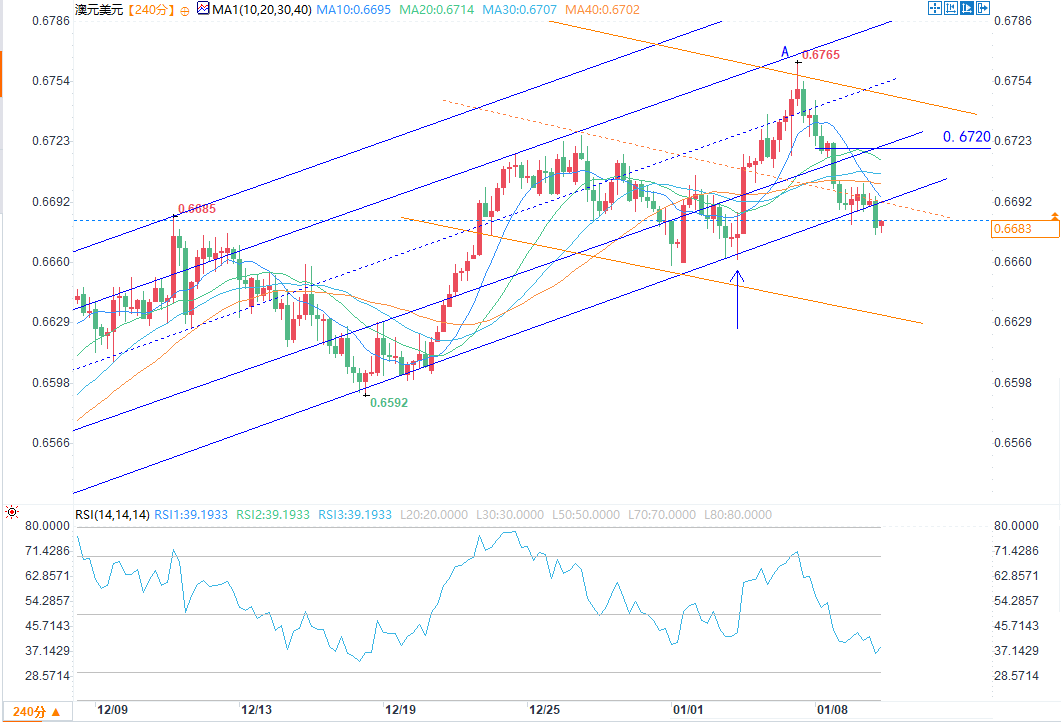
(AUD/USD 4-hour chart source: EasyForex)
We previously drew an upward channel on December 26th of the previous 25th year, which remains valid in early 2026. However, please note the following changes:
The current downward trend has constituted a bearish breakout of the lower channel line;
The bullish momentum that began on January 5 (indicated by the arrow) has been completely offset.
These signals indicate a significant shift in market sentiment, which is clearly reflected in price action. If bulls attempt to push the Australian dollar back into its upward channel against the US dollar, resistance may arise around 0.6720 – the very level where the sharp sell-off began on January 8th, highlighting the sellers' dominance.
The release of high-impact news could further fuel the downward trend, creating room for the downward trend marked in yellow to continue.
The main negative driving factors include:
Inflation expectations have declined. Data released on Wednesday showed that Australia's inflation rate slowed significantly to 3.4%. This has essentially ruled out the possibility of the Reserve Bank of Australia (RBA), which has previously maintained a hawkish stance, raising interest rates in February.
As Australia's largest trading partner, China released mixed PMI data today. This has raised concerns in the market about Chinese demand for Australian commodities and put pressure on the Australian dollar, which is often seen as a "substitute" for the Chinese economy.
Risk aversion related to non-farm payroll (NFP) data. Ahead of today's US labor market report, investors are shifting to a risk-averse mode and increasing demand for the so-called safe-haven asset—the US dollar—due to concerns about potential negative surprises.
Technical Analysis
(AUD/USD 4-hour chart source: EasyForex)
We previously drew an upward channel on December 26th of the previous 25th year, which remains valid in early 2026. However, please note the following changes:
The current downward trend has constituted a bearish breakout of the lower channel line;
The bullish momentum that began on January 5 (indicated by the arrow) has been completely offset.
These signals indicate a significant shift in market sentiment, which is clearly reflected in price action. If bulls attempt to push the Australian dollar back into its upward channel against the US dollar, resistance may arise around 0.6720 – the very level where the sharp sell-off began on January 8th, highlighting the sellers' dominance.
The release of high-impact news could further fuel the downward trend, creating room for the downward trend marked in yellow to continue.
- Risk Warning and Disclaimer
- The market involves risk, and trading may not be suitable for all investors. This article is for reference only and does not constitute personal investment advice, nor does it take into account certain users’ specific investment objectives, financial situation, or other needs. Any investment decisions made based on this information are at your own risk.