Stronger oil prices supported a stronger Canadian dollar, with the USD/CAD pair fluctuating around 1.3870.
2026-01-13 11:32:40
The US dollar continued its weakness against the Canadian dollar during Tuesday's Asian session, facing slight pressure for the second consecutive trading day, with the exchange rate fluctuating around 1.3870. The core support for the Canadian dollar's strength comes from the continued rise in oil prices.
As one of the largest suppliers of crude oil to the United States, the Canadian currency is highly sensitive to oil price fluctuations, and it tends to outperform when oil prices rise. WTI crude oil prices rose for the fourth consecutive trading day, trading around $59.40 per barrel.
The rise in oil prices was primarily driven by supply-side concerns, with heightened tensions in Iran fueling market expectations of potential supply disruptions. Meanwhile, traders are awaiting the API crude oil inventory data to be released later in the day to assess short-term supply and demand dynamics.
 At the geopolitical level, the United States stated that any country doing business with Iran could face higher tariffs. This statement further amplified market sentiment regarding the pricing risk of Middle Eastern oil supply and indirectly enhanced the relative attractiveness of commodity currencies.
However, the downside potential for the US dollar against the Canadian dollar remains somewhat limited. After a slight weakening in the previous trading session, the US dollar showed signs of stabilizing, and market focus is now shifting to the upcoming release of the US December Consumer Price Index (CPI) data.
The market has largely priced in two rate cuts this year, with the first likely to occur in June. However, if inflation data is unexpectedly strong, it could weaken expectations of further easing, thus providing short-term support for the US dollar.
Futures markets indicate that the probability of the Federal Reserve keeping interest rates unchanged at its January meeting remains high. Furthermore, concerns surrounding the Fed's independence continue to weigh on dollar sentiment. Previous actions by the judiciary regarding the Fed Chair's statements have raised market concerns about the stability of the policy environment.
Meanwhile, investors are also awaiting the upcoming ruling from the U.S. Supreme Court on tariff policy, and these uncertainties are keeping dollar bulls cautious.
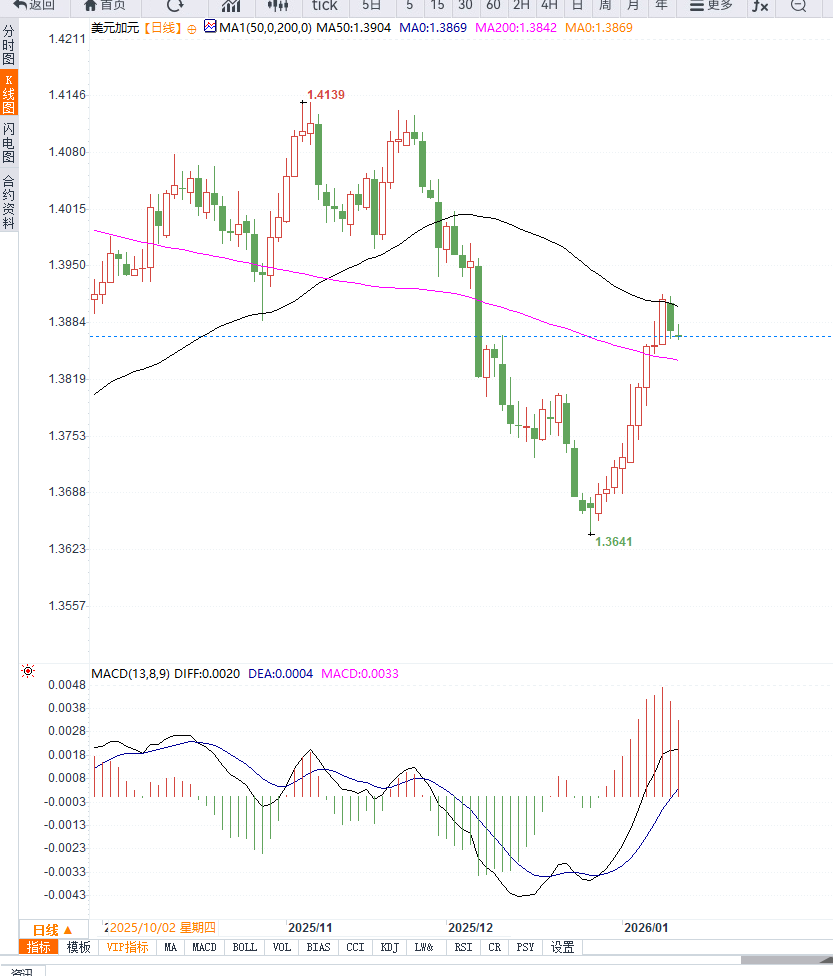
Looking at the daily chart of USD/CAD, the exchange rate fell back again after its previous rebound was blocked. The candlestick pattern shows that the price action at the high level has resulted in a series of small-bodied bullish and bearish candlesticks, reflecting that the forces of bulls and bears are becoming more balanced, but the center of gravity has shifted slightly downward.
Regarding the moving average system, the price is trading below the short-term moving averages. The 20-day moving average is flat and acting as resistance, while the 50-day moving average continues to provide medium-term support. The MACD indicator is near the zero line, with the red bars gradually converging, indicating weakening momentum. The KDJ indicator has fallen from its high level but has not yet entered the oversold zone, suggesting that there is still room for further consolidation at the daily level.
Editor's Note:
Overall, the current USD/CAD exchange rate movement is largely driven by oil prices, with the Canadian dollar holding a relative advantage due to its commodity attributes. In the short term, if oil prices remain strong, the upside potential for the exchange rate may continue to be limited.
However, given the continued uncertainty surrounding US inflation data and policies, the possibility of a temporary rebound in the US dollar has not completely disappeared. The USD/CAD pair is more likely to find a new direction amidst fluctuations, requiring close attention to both oil prices and macroeconomic data.
As one of the largest suppliers of crude oil to the United States, the Canadian currency is highly sensitive to oil price fluctuations, and it tends to outperform when oil prices rise. WTI crude oil prices rose for the fourth consecutive trading day, trading around $59.40 per barrel.
The rise in oil prices was primarily driven by supply-side concerns, with heightened tensions in Iran fueling market expectations of potential supply disruptions. Meanwhile, traders are awaiting the API crude oil inventory data to be released later in the day to assess short-term supply and demand dynamics.
At the geopolitical level, the United States stated that any country doing business with Iran could face higher tariffs. This statement further amplified market sentiment regarding the pricing risk of Middle Eastern oil supply and indirectly enhanced the relative attractiveness of commodity currencies.However, the downside potential for the US dollar against the Canadian dollar remains somewhat limited. After a slight weakening in the previous trading session, the US dollar showed signs of stabilizing, and market focus is now shifting to the upcoming release of the US December Consumer Price Index (CPI) data.
The market has largely priced in two rate cuts this year, with the first likely to occur in June. However, if inflation data is unexpectedly strong, it could weaken expectations of further easing, thus providing short-term support for the US dollar.
Futures markets indicate that the probability of the Federal Reserve keeping interest rates unchanged at its January meeting remains high. Furthermore, concerns surrounding the Fed's independence continue to weigh on dollar sentiment. Previous actions by the judiciary regarding the Fed Chair's statements have raised market concerns about the stability of the policy environment.
Meanwhile, investors are also awaiting the upcoming ruling from the U.S. Supreme Court on tariff policy, and these uncertainties are keeping dollar bulls cautious.
Looking at the daily chart of USD/CAD, the exchange rate fell back again after its previous rebound was blocked. The candlestick pattern shows that the price action at the high level has resulted in a series of small-bodied bullish and bearish candlesticks, reflecting that the forces of bulls and bears are becoming more balanced, but the center of gravity has shifted slightly downward.
Regarding the moving average system, the price is trading below the short-term moving averages. The 20-day moving average is flat and acting as resistance, while the 50-day moving average continues to provide medium-term support. The MACD indicator is near the zero line, with the red bars gradually converging, indicating weakening momentum. The KDJ indicator has fallen from its high level but has not yet entered the oversold zone, suggesting that there is still room for further consolidation at the daily level.
Editor's Note:
Overall, the current USD/CAD exchange rate movement is largely driven by oil prices, with the Canadian dollar holding a relative advantage due to its commodity attributes. In the short term, if oil prices remain strong, the upside potential for the exchange rate may continue to be limited.
However, given the continued uncertainty surrounding US inflation data and policies, the possibility of a temporary rebound in the US dollar has not completely disappeared. The USD/CAD pair is more likely to find a new direction amidst fluctuations, requiring close attention to both oil prices and macroeconomic data.
- Risk Warning and Disclaimer
- The market involves risk, and trading may not be suitable for all investors. This article is for reference only and does not constitute personal investment advice, nor does it take into account certain users’ specific investment objectives, financial situation, or other needs. Any investment decisions made based on this information are at your own risk.