With interest rate hikes and government intervention both in place, is the Japanese yen poised for a major opportunity?
2026-01-20 11:14:31
The USD/JPY pair attracted some bargain hunting in Asian trading on Tuesday (January 20), halting its earlier decline from a 18-month high of 159.44 and currently trading in a narrow range around 157.95. Market expectations of intervention by Japanese authorities to curb further yen weakness continued to support the currency. Furthermore, escalating geopolitical tensions surrounding Greenland and concerns about a renewed trade war dampened investor sentiment, further solidifying the yen's safe-haven status.
Furthermore, the prospect of an earlier-than-expected interest rate hike by the Bank of Japan is another factor supporting the yen. However, traders may prefer to wait for the Bank of Japan's key policy update on Friday before making new long bets on the yen. In addition, domestic political uncertainty in Japan may limit the yen's upside potential. During Tuesday's Asian session, the US dollar index held steady around 99.05, which may help limit the decline in USD/JPY.
Japanese Prime Minister Sanae Takaichi announced on Monday that she will dissolve parliament this week and call a snap election on February 8, hoping to gain stronger authorization to advance her fiscal expansion policies. If the ruling Liberal Democratic Party (LDP) wins an absolute majority in the House of Representatives, Takaichi will have greater freedom to implement her agenda; a narrow majority would exacerbate political uncertainty.
Meanwhile, Japanese Finance Minister Satsuki Katayama warned on Friday that the government would consider all options, including direct market intervention, to address the recent weakness of the yen. Katayama also hinted at a possible joint intervention with the United States to support the currency. This move, coupled with hawkish expectations from the Bank of Japan and continued safe-haven buying, boosted demand for the yen on Tuesday.
The yen's recent fall to an 18-month low could exacerbate inflationary pressures and force the Bank of Japan to act more quickly. In fact, data released last Friday showed that Japan's inflation rate has averaged above the Bank of Japan's 2% target for four consecutive calendar years. Furthermore, sources say that some policymakers within the Bank of Japan believe there is room for a rate hike as early as April, earlier than currently expected by the market.
However, yen bulls appear reluctant to make large bets, opting instead to await more clues about the timing of the Bank of Japan's next rate hike. Therefore, market focus remains on the remarks made by Bank of Japan Governor Kazuo Ueda at the press conference following the policy decision on Friday. The Bank of Japan is expected to maintain its policy unchanged after the two-day meeting—last month it raised the overnight rate to 0.75%, a 30-year high.
US President Donald Trump threatened to impose new tariffs on eight European countries over tensions in Greenland. The statement drew strong opposition from European leaders and exacerbated market uncertainty amid the ongoing Russia-Ukraine conflict, thus boosting the traditional safe-haven asset, the Japanese yen.
Traders reduced their bets on two more Federal Reserve rate cuts in 2026 after Trump expressed his desire for National Economic Council Director Kevin Hassett to remain in his current position. This suggests that the successor to outgoing Fed Chairman Jerome Powell will be someone else, which could help attract buying interest in the dollar.
After rebounding from its January lows, the USD/JPY pair's overnight rally from the 61.8% Fibonacci retracement level (157.38) lacked momentum, failing to break through the 38.2% Fibonacci retracement level (158.16) and encountering resistance at the 100-hour simple moving average (SMA, 158.32), which currently forms a key pivot point. The pair continues to trade below this declining moving average, maintaining a bearish bias.
The Moving Average Convergence Divergence (MACD) indicator remains near zero, and the histogram is flattening, reinforcing the neutral tone. The Relative Strength Index (RSI) is at 50 (neutral), indicating that the market is in a balanced state after a mild rebound.
On the downside, if the price breaks below the 38.2% Fibonacci retracement level (158.16), market focus will shift to the 50% retracement support level at 157.77. If this level is breached, the price may test the 61.8% retracement level at 157.38.
On the upside, if a rebound attempts, initial resistance is at the 100-period moving average of 158.32. A valid breakout and opening up further upside potential requires the MACD indicator to clearly move above the zero line and the RSI to rise above 55 to strengthen momentum.
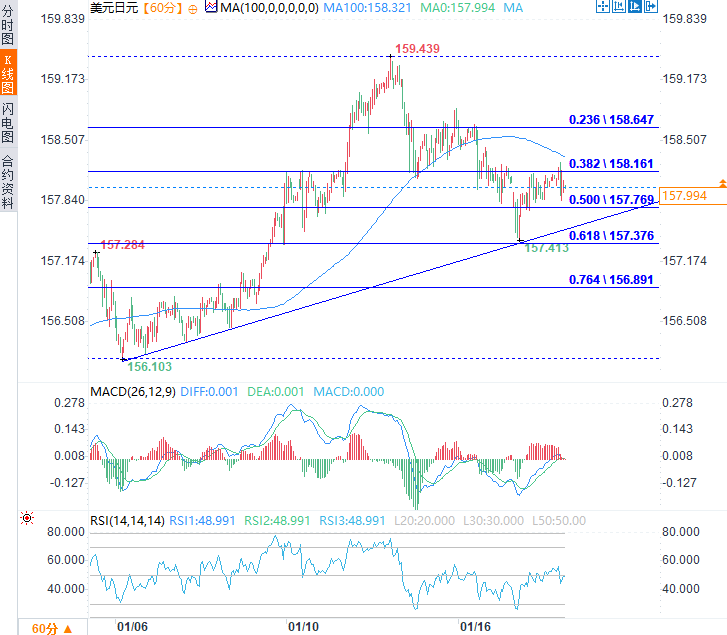
(USD/JPY hourly chart, source: FX678)
At 11:14 Beijing time, the US dollar was trading at 157.96/97 against the Japanese yen.
Furthermore, the prospect of an earlier-than-expected interest rate hike by the Bank of Japan is another factor supporting the yen. However, traders may prefer to wait for the Bank of Japan's key policy update on Friday before making new long bets on the yen. In addition, domestic political uncertainty in Japan may limit the yen's upside potential. During Tuesday's Asian session, the US dollar index held steady around 99.05, which may help limit the decline in USD/JPY.
The yen benefited from safe-haven inflows and concerns about intervention, with bulls showing hesitation ahead of the Bank of Japan's decision.
Japanese Prime Minister Sanae Takaichi announced on Monday that she will dissolve parliament this week and call a snap election on February 8, hoping to gain stronger authorization to advance her fiscal expansion policies. If the ruling Liberal Democratic Party (LDP) wins an absolute majority in the House of Representatives, Takaichi will have greater freedom to implement her agenda; a narrow majority would exacerbate political uncertainty.
Meanwhile, Japanese Finance Minister Satsuki Katayama warned on Friday that the government would consider all options, including direct market intervention, to address the recent weakness of the yen. Katayama also hinted at a possible joint intervention with the United States to support the currency. This move, coupled with hawkish expectations from the Bank of Japan and continued safe-haven buying, boosted demand for the yen on Tuesday.
The yen's recent fall to an 18-month low could exacerbate inflationary pressures and force the Bank of Japan to act more quickly. In fact, data released last Friday showed that Japan's inflation rate has averaged above the Bank of Japan's 2% target for four consecutive calendar years. Furthermore, sources say that some policymakers within the Bank of Japan believe there is room for a rate hike as early as April, earlier than currently expected by the market.
However, yen bulls appear reluctant to make large bets, opting instead to await more clues about the timing of the Bank of Japan's next rate hike. Therefore, market focus remains on the remarks made by Bank of Japan Governor Kazuo Ueda at the press conference following the policy decision on Friday. The Bank of Japan is expected to maintain its policy unchanged after the two-day meeting—last month it raised the overnight rate to 0.75%, a 30-year high.
US President Donald Trump threatened to impose new tariffs on eight European countries over tensions in Greenland. The statement drew strong opposition from European leaders and exacerbated market uncertainty amid the ongoing Russia-Ukraine conflict, thus boosting the traditional safe-haven asset, the Japanese yen.
Traders reduced their bets on two more Federal Reserve rate cuts in 2026 after Trump expressed his desire for National Economic Council Director Kevin Hassett to remain in his current position. This suggests that the successor to outgoing Fed Chairman Jerome Powell will be someone else, which could help attract buying interest in the dollar.
With USD/JPY trading below the key resistance level of the 100-hour simple moving average, bears are in control.
After rebounding from its January lows, the USD/JPY pair's overnight rally from the 61.8% Fibonacci retracement level (157.38) lacked momentum, failing to break through the 38.2% Fibonacci retracement level (158.16) and encountering resistance at the 100-hour simple moving average (SMA, 158.32), which currently forms a key pivot point. The pair continues to trade below this declining moving average, maintaining a bearish bias.
The Moving Average Convergence Divergence (MACD) indicator remains near zero, and the histogram is flattening, reinforcing the neutral tone. The Relative Strength Index (RSI) is at 50 (neutral), indicating that the market is in a balanced state after a mild rebound.
On the downside, if the price breaks below the 38.2% Fibonacci retracement level (158.16), market focus will shift to the 50% retracement support level at 157.77. If this level is breached, the price may test the 61.8% retracement level at 157.38.
On the upside, if a rebound attempts, initial resistance is at the 100-period moving average of 158.32. A valid breakout and opening up further upside potential requires the MACD indicator to clearly move above the zero line and the RSI to rise above 55 to strengthen momentum.
(USD/JPY hourly chart, source: FX678)
At 11:14 Beijing time, the US dollar was trading at 157.96/97 against the Japanese yen.
- Risk Warning and Disclaimer
- The market involves risk, and trading may not be suitable for all investors. This article is for reference only and does not constitute personal investment advice, nor does it take into account certain users’ specific investment objectives, financial situation, or other needs. Any investment decisions made based on this information are at your own risk.