As risk aversion intensifies, the USD/JPY pair remains in a range-bound trading pattern.
2026-01-20 11:24:38
The yen (JPY) attracted bargain hunters during Tuesday's Asian trading session, with the dollar stabilizing around 158 against the yen after retreating from a one-week high.
Multiple safe-haven factors combined have reignited demand for the yen. Markets widely anticipate that Japanese authorities may take measures to curb excessive depreciation of the currency. The yen had previously touched an 18-month low, raising concerns about imported inflation, making investors highly sensitive to potential intervention.
Japanese Finance Minister Satsuki Katayama said last week, "All options, including direct market intervention, are on the table, and we do not rule out taking joint action with the United States to stabilize the exchange rate."

Meanwhile, geopolitical uncertainties surrounding Greenland and rising concerns about trade between the US and Europe have weakened risk appetite, further highlighting the yen's traditional safe-haven status. In an environment where global funds are trending towards defensiveness, the yen has remained relatively strong.
Regarding monetary policy, market expectations for the Bank of Japan to raise interest rates sooner than anticipated are gradually increasing. Data shows that Japan's inflation has been above the 2% target for four consecutive years, providing a basis for policy normalization.
An insider at the Bank of Japan believes that "conditions for another rate hike could be in place as early as April, a pace that may be faster than currently priced into by the market." However, investors are cautious ahead of the Bank of Japan's meeting this Friday. The market widely expects the central bank to maintain its policy rate at 0.75%, with key attention focused on Governor Kazuo Ueda's policy guidance after the meeting.
Domestic political uncertainty may also limit the yen's upside potential to some extent. Prime Minister Sanae Takaichi stated, "We will dissolve parliament this week and hold elections on February 8th to secure a more robust policy mandate."
Regarding the US dollar, a robust US job market led to a downward revision of market expectations for future interest rate cuts, thus supporting the dollar. Some investors also reduced their bets on two rate cuts in 2026, which helped prevent the dollar from falling further against the yen.
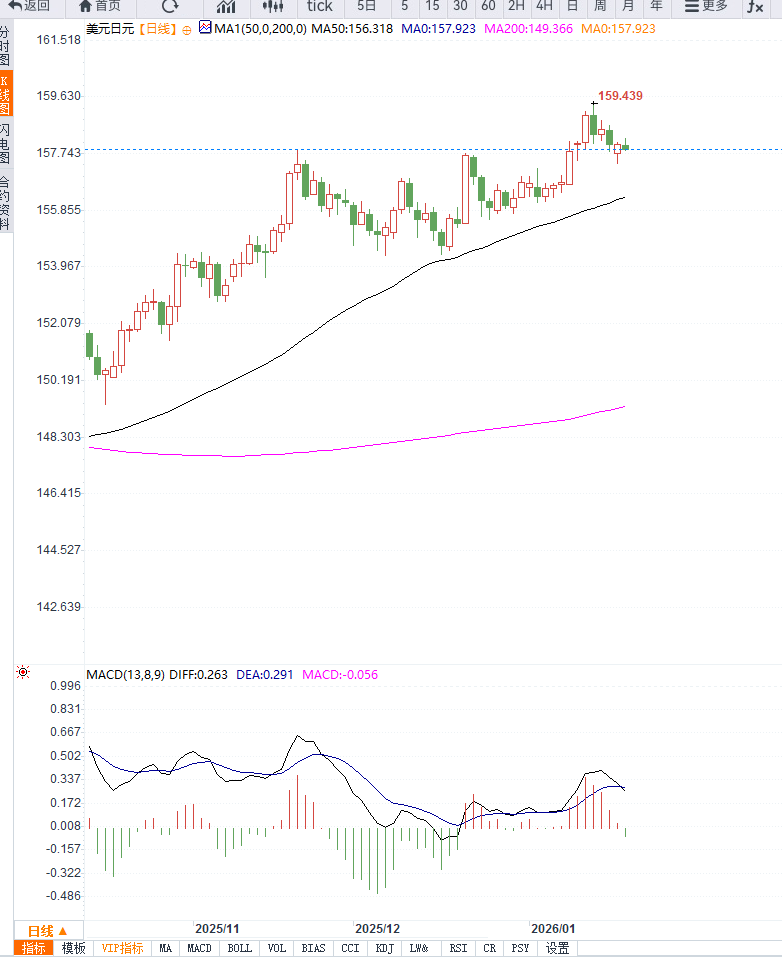
From a short-term and daily chart perspective, USD/JPY remains generally bearish. Overnight, it rebounded from the 61.8% Fibonacci retracement level of the rally since the January lows, but lacked sustained momentum above the 38.2% Fibonacci retracement level and encountered resistance near the 100-hour moving average at 158.35, pulling back. This level has become a key dividing line between bullish and bearish sentiment.
Technical indicators show that the MACD is approaching the zero line and converging, with the histogram shortening, indicating neutral momentum; the RSI is around 50, suggesting the market is currently in a state of equilibrium. As long as the exchange rate remains below 158.35, the overall bearish structure will continue.
On the downside, a break below 157.80 (50% retracement level) could see the exchange rate further test the 61.8% retracement support at 157.40; a breach of this level could lead to a return to the 156.80 area. On the upside, only a sustained move above 158.35, accompanied by a MACD crossing above the zero line and an RSI rising above 55, could re-establish a bullish trend.
Editor's Note:
The current strength of the yen is largely driven by both safe-haven demand and policy expectations. As long as trade concerns and geopolitical risks persist, the yen will continue to receive some support. However, the resilience of the US dollar and the Bank of Japan's wait-and-see stance limit the yen's potential for further gains.
It is expected that the USD/JPY exchange rate will remain in the 157.4-158.5 range before the central bank meeting, with a focus on short-term fluctuations caused by policy signals and potential intervention statements.
Multiple safe-haven factors combined have reignited demand for the yen. Markets widely anticipate that Japanese authorities may take measures to curb excessive depreciation of the currency. The yen had previously touched an 18-month low, raising concerns about imported inflation, making investors highly sensitive to potential intervention.
Japanese Finance Minister Satsuki Katayama said last week, "All options, including direct market intervention, are on the table, and we do not rule out taking joint action with the United States to stabilize the exchange rate."
Meanwhile, geopolitical uncertainties surrounding Greenland and rising concerns about trade between the US and Europe have weakened risk appetite, further highlighting the yen's traditional safe-haven status. In an environment where global funds are trending towards defensiveness, the yen has remained relatively strong.
Regarding monetary policy, market expectations for the Bank of Japan to raise interest rates sooner than anticipated are gradually increasing. Data shows that Japan's inflation has been above the 2% target for four consecutive years, providing a basis for policy normalization.
An insider at the Bank of Japan believes that "conditions for another rate hike could be in place as early as April, a pace that may be faster than currently priced into by the market." However, investors are cautious ahead of the Bank of Japan's meeting this Friday. The market widely expects the central bank to maintain its policy rate at 0.75%, with key attention focused on Governor Kazuo Ueda's policy guidance after the meeting.
Domestic political uncertainty may also limit the yen's upside potential to some extent. Prime Minister Sanae Takaichi stated, "We will dissolve parliament this week and hold elections on February 8th to secure a more robust policy mandate."
Regarding the US dollar, a robust US job market led to a downward revision of market expectations for future interest rate cuts, thus supporting the dollar. Some investors also reduced their bets on two rate cuts in 2026, which helped prevent the dollar from falling further against the yen.
From a short-term and daily chart perspective, USD/JPY remains generally bearish. Overnight, it rebounded from the 61.8% Fibonacci retracement level of the rally since the January lows, but lacked sustained momentum above the 38.2% Fibonacci retracement level and encountered resistance near the 100-hour moving average at 158.35, pulling back. This level has become a key dividing line between bullish and bearish sentiment.
Technical indicators show that the MACD is approaching the zero line and converging, with the histogram shortening, indicating neutral momentum; the RSI is around 50, suggesting the market is currently in a state of equilibrium. As long as the exchange rate remains below 158.35, the overall bearish structure will continue.
On the downside, a break below 157.80 (50% retracement level) could see the exchange rate further test the 61.8% retracement support at 157.40; a breach of this level could lead to a return to the 156.80 area. On the upside, only a sustained move above 158.35, accompanied by a MACD crossing above the zero line and an RSI rising above 55, could re-establish a bullish trend.
Editor's Note:
The current strength of the yen is largely driven by both safe-haven demand and policy expectations. As long as trade concerns and geopolitical risks persist, the yen will continue to receive some support. However, the resilience of the US dollar and the Bank of Japan's wait-and-see stance limit the yen's potential for further gains.
It is expected that the USD/JPY exchange rate will remain in the 157.4-158.5 range before the central bank meeting, with a focus on short-term fluctuations caused by policy signals and potential intervention statements.
- Risk Warning and Disclaimer
- The market involves risk, and trading may not be suitable for all investors. This article is for reference only and does not constitute personal investment advice, nor does it take into account certain users’ specific investment objectives, financial situation, or other needs. Any investment decisions made based on this information are at your own risk.