Just as the euro was catching its breath, the dollar suddenly launched a counterattack?
2026-02-03 21:37:26
On Tuesday, February 3rd, the euro continued its weakness against the dollar, hitting a low of 1.1780 during the session. Although selling pressure eased slightly afterward, and the exchange rate rebounded to around 1.18 during the North American session, it remained generally weak. The earlier brief rally to 1.1874 was completely wiped out, and market sentiment shifted from optimism to caution. Analysts point out that the euro's current volatility is largely driven by dollar-related factors, while the Eurozone itself lacks significant news to drive the market. Traders are generally choosing to wait and see, awaiting key events this week.

This round of dollar strengthening is no accident. Monday's US manufacturing data served as a direct catalyst—the ISM Manufacturing Purchasing Managers' Index jumped sharply from 47.9 in December to 52.6 in January, far exceeding the expected 48.5 and reaching a more than three-year high, clearly signaling an economic recovery. Simultaneously, the S&P Global Manufacturing PMI was revised upward to 52.4, higher than the initial reading of 51.9. The simultaneous entry of both indicators into expansion territory greatly alleviated market concerns about the US growth outlook. The strong data boosted the Federal Reserve's confidence in maintaining high interest rates and increased the attractiveness of dollar assets, leading to accelerated capital inflows into US Treasuries and the dollar, indirectly suppressing the performance of non-US currencies such as the euro.
Besides the support from economic fundamentals, changes in the international situation are also subtly influencing the direction of the foreign exchange market. US President Trump's announcement of lowering tariffs on Indian products from 50% to 18% was seen as a significant signal of easing trade tensions, boosting global risk sentiment. Interestingly, however, the market did not flock to high-risk assets; instead, a phenomenon of "sell the news" emerged—the US dollar, as the global reserve currency, became more attractive when uncertainty decreased. A similar situation occurred in the Middle East: Iranian President Pesashkyan stated that Tehran would initiate nuclear negotiations with the United States, effectively mitigating the risk of escalating regional conflict and further weakening demand for traditional safe-haven assets such as gold, while the US dollar seized the opportunity to consolidate its position.
These seemingly unrelated events actually point to one conclusion: a temporary strengthening of the US dollar is taking shape; such macroeconomic linkages often lead to fluctuations in the euro-dollar exchange rate. Especially in the absence of driving factors within the Eurozone itself, any news from the US can be amplified and interpreted, causing passive pressure on the euro. Currently, the market is in an information vacuum, with the European Central Bank yet to speak, making short-term price movements more susceptible to single data points or breaking news, and it's not surprising that prices are repeatedly fluctuating around key levels.
From a technical chart perspective, the EUR/USD pair is exhibiting a typical consolidation pattern on the 60-minute chart. After falling from a high of 1.1874, it bottomed out at 1.1775 before rebounding, only to be met with resistance again near 1.1824, indicating continued heavy selling pressure. The current price of 1.18 is at the midpoint of the previous rebound, suggesting that the bulls and bears are still evenly matched. Key resistance lies around 1.1850; failure to break through this level could indicate that this rebound is merely a technical correction within a downtrend. Support is concentrated around 1.1782; a break below this level could lead to a retest of the support at the 1.1775 low.
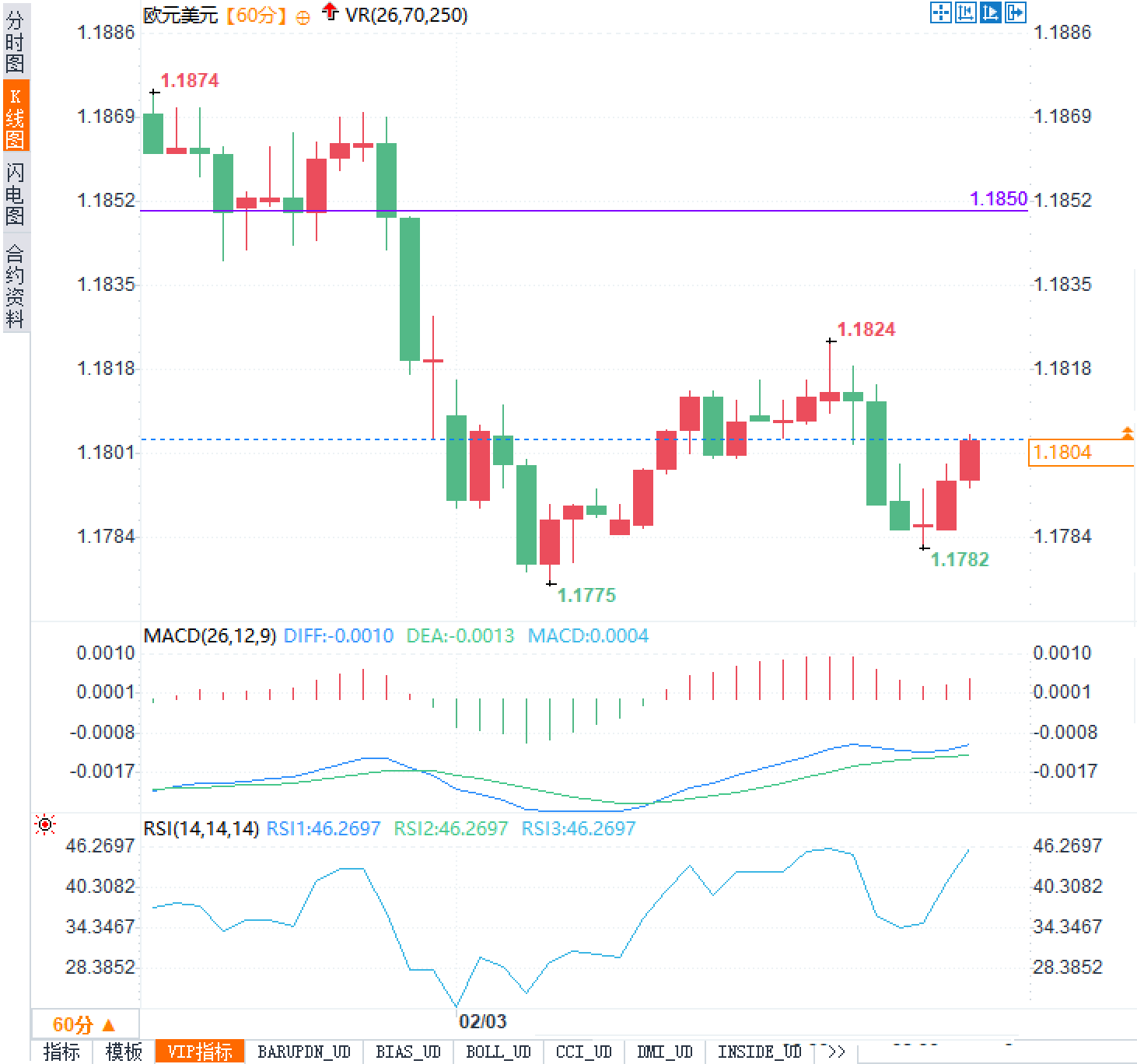
The indicators also suggest a stalemate. The MACD shows DIFF at -0.0010 and DEA at -0.0013. While the histogram has slightly rebounded to 0.0004, it remains below the zero line, indicating that bears still dominate, although downward momentum has weakened. The RSI reading is 46.2697, in the neutral-to-weak range, neither oversold nor showing significant buying power, meaning price movements are highly dependent on external catalysts. Only when the RSI stably rises above 50, accompanied by a price breakout above 1.1824, can a short-term trend reversal be confirmed; conversely, if the RSI falls again and the price breaks below 1.1782, a new round of decline should be anticipated.
The market is currently in a period of calm before major events. Wednesday will see the release of the US ADP employment data, often referred to as the "mini-nonfarm payrolls," which has historically been a strong indicator of the dollar's performance. Thursday will see the European Central Bank announce its latest monetary policy decision, whose interest rate path will directly impact the future direction of the euro. Ahead of these events, most traders are choosing to shorten their holding periods to avoid exposure to uncontrollable risks. Furthermore, the nonfarm payrolls report, originally scheduled for Friday, may be postponed due to the partial government shutdown, further reducing short-term data anchors and exacerbating market uncertainty.
Analysts believe that before new pricing clues emerge, the euro/dollar exchange rate will likely continue to fluctuate around 1.1800, with 1.1850 and 1.1782 becoming key boundaries for short-term trading. A true directional breakout may only become clear after the European Central Bank speaks out or US employment data is released. Until then, every rebound could be a trap, and every decline could be a prelude to a reversal: this silent game is quietly approaching its climax.
This round of dollar strengthening is no accident. Monday's US manufacturing data served as a direct catalyst—the ISM Manufacturing Purchasing Managers' Index jumped sharply from 47.9 in December to 52.6 in January, far exceeding the expected 48.5 and reaching a more than three-year high, clearly signaling an economic recovery. Simultaneously, the S&P Global Manufacturing PMI was revised upward to 52.4, higher than the initial reading of 51.9. The simultaneous entry of both indicators into expansion territory greatly alleviated market concerns about the US growth outlook. The strong data boosted the Federal Reserve's confidence in maintaining high interest rates and increased the attractiveness of dollar assets, leading to accelerated capital inflows into US Treasuries and the dollar, indirectly suppressing the performance of non-US currencies such as the euro.
Geopolitical and policy factors combined to make the US dollar a winner.
Besides the support from economic fundamentals, changes in the international situation are also subtly influencing the direction of the foreign exchange market. US President Trump's announcement of lowering tariffs on Indian products from 50% to 18% was seen as a significant signal of easing trade tensions, boosting global risk sentiment. Interestingly, however, the market did not flock to high-risk assets; instead, a phenomenon of "sell the news" emerged—the US dollar, as the global reserve currency, became more attractive when uncertainty decreased. A similar situation occurred in the Middle East: Iranian President Pesashkyan stated that Tehran would initiate nuclear negotiations with the United States, effectively mitigating the risk of escalating regional conflict and further weakening demand for traditional safe-haven assets such as gold, while the US dollar seized the opportunity to consolidate its position.
These seemingly unrelated events actually point to one conclusion: a temporary strengthening of the US dollar is taking shape; such macroeconomic linkages often lead to fluctuations in the euro-dollar exchange rate. Especially in the absence of driving factors within the Eurozone itself, any news from the US can be amplified and interpreted, causing passive pressure on the euro. Currently, the market is in an information vacuum, with the European Central Bank yet to speak, making short-term price movements more susceptible to single data points or breaking news, and it's not surprising that prices are repeatedly fluctuating around key levels.
The technical indicators remain deadlocked, and the battle between bulls and bears has intensified.
From a technical chart perspective, the EUR/USD pair is exhibiting a typical consolidation pattern on the 60-minute chart. After falling from a high of 1.1874, it bottomed out at 1.1775 before rebounding, only to be met with resistance again near 1.1824, indicating continued heavy selling pressure. The current price of 1.18 is at the midpoint of the previous rebound, suggesting that the bulls and bears are still evenly matched. Key resistance lies around 1.1850; failure to break through this level could indicate that this rebound is merely a technical correction within a downtrend. Support is concentrated around 1.1782; a break below this level could lead to a retest of the support at the 1.1775 low.
The indicators also suggest a stalemate. The MACD shows DIFF at -0.0010 and DEA at -0.0013. While the histogram has slightly rebounded to 0.0004, it remains below the zero line, indicating that bears still dominate, although downward momentum has weakened. The RSI reading is 46.2697, in the neutral-to-weak range, neither oversold nor showing significant buying power, meaning price movements are highly dependent on external catalysts. Only when the RSI stably rises above 50, accompanied by a price breakout above 1.1824, can a short-term trend reversal be confirmed; conversely, if the RSI falls again and the price breaks below 1.1782, a new round of decline should be anticipated.
Awaiting the eve of the storm, the market may ignite on Thursday.
The market is currently in a period of calm before major events. Wednesday will see the release of the US ADP employment data, often referred to as the "mini-nonfarm payrolls," which has historically been a strong indicator of the dollar's performance. Thursday will see the European Central Bank announce its latest monetary policy decision, whose interest rate path will directly impact the future direction of the euro. Ahead of these events, most traders are choosing to shorten their holding periods to avoid exposure to uncontrollable risks. Furthermore, the nonfarm payrolls report, originally scheduled for Friday, may be postponed due to the partial government shutdown, further reducing short-term data anchors and exacerbating market uncertainty.
Analysts believe that before new pricing clues emerge, the euro/dollar exchange rate will likely continue to fluctuate around 1.1800, with 1.1850 and 1.1782 becoming key boundaries for short-term trading. A true directional breakout may only become clear after the European Central Bank speaks out or US employment data is released. Until then, every rebound could be a trap, and every decline could be a prelude to a reversal: this silent game is quietly approaching its climax.
- Risk Warning and Disclaimer
- The market involves risk, and trading may not be suitable for all investors. This article is for reference only and does not constitute personal investment advice, nor does it take into account certain users’ specific investment objectives, financial situation, or other needs. Any investment decisions made based on this information are at your own risk.