A chart summarizing "pivot points + long/short position signals" for gold, crude oil, forex, and stock indices on February 10, 2026.
2026-02-10 11:30:11
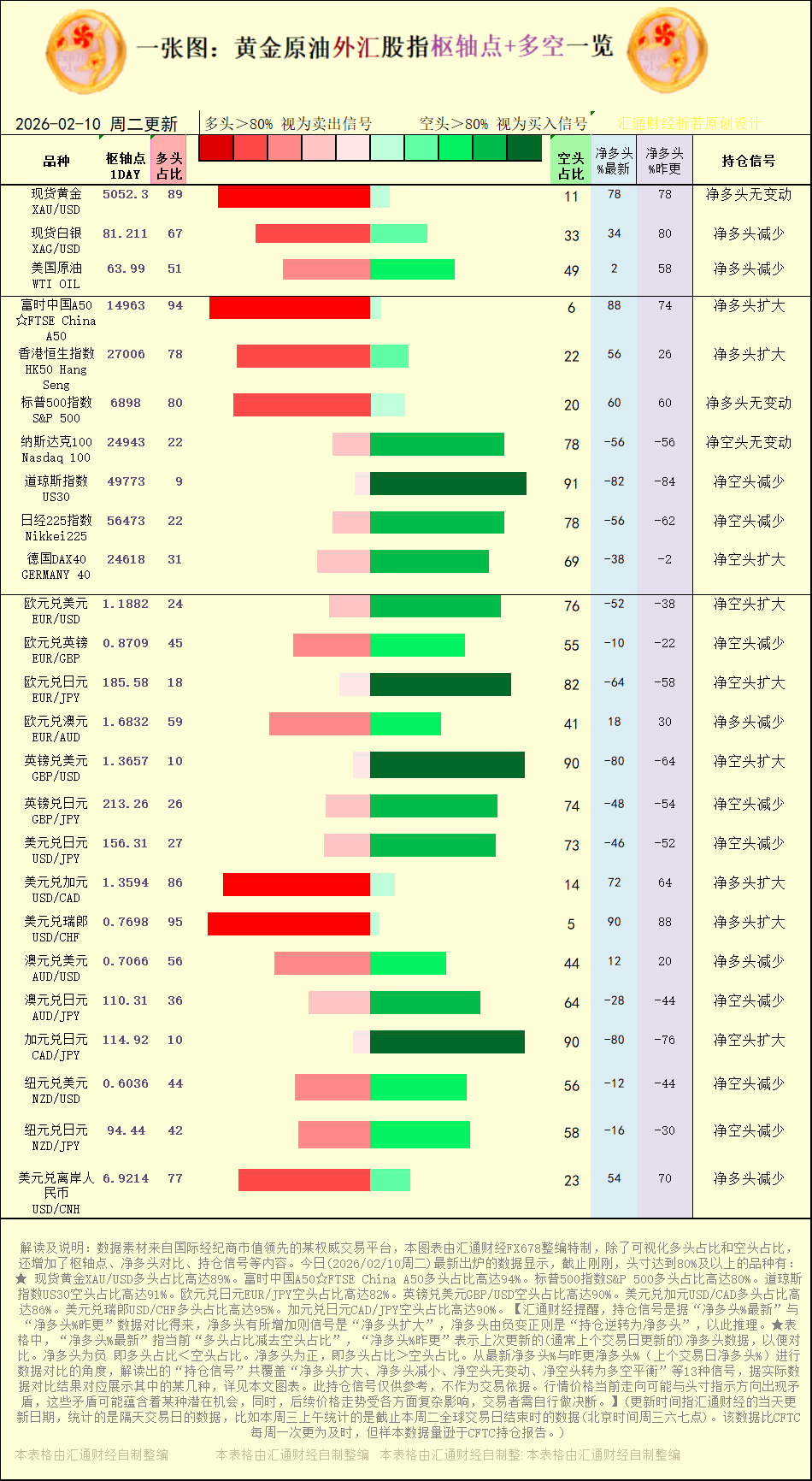
A chart summarizing the "pivot points + long/short position signals" for gold, crude oil, forex, and stock indices on February 10, 2026. The latest data released today (Tuesday, February 10, 2026) shows that, as of now, 4 commodities are currently in an "overbought" state (long positions exceeding 80%), and 4 commodities are currently in an "oversold" state (long positions less than 20%). The commodity with the highest percentage of long positions is USD/CHF. Spot gold (XAU/USD) has a long position percentage of 89%, WTI crude oil has a long position percentage of 51%, and EUR/USD has a long position percentage of 24%. For updated "change signals" and a more detailed list of these commodities compared to yesterday, please see the specially designed chart.
Among the signals of changes in positions, there were 4 instances of increased net long positions, 5 instances of decreased net long positions, 5 instances of increased net short positions, and 8 instances of decreased net short positions. The following instruments had positions of 80% or more: Spot Gold (XAU/USD) with a long ratio of 89%; FTSE China A50 with a long ratio of 94%; S&P 500 with a long ratio of 80%; Dow Jones US30 with a short ratio of 91%; EUR/JPY with a short ratio of 82%; GBP/USD with a short ratio of 90%; USD/CAD with a long ratio of 86%; USD/CHF with a long ratio of 95%; and CAD/JPY with a short ratio of 90%.
[Chart: Pivot Points and Long/Short Position Signals for Gold, Crude Oil, Forex, and Stock Indices. Source: FX678 Special Chart. (Click image to enlarge)]
The following currencies saw a decrease in net short positions: Dow Jones US30, Nikkei 225, EUR/GBP, GBP/JPY, USD/JPY, AUD/JPY, NZD/USD, and NZD/JPY.
The following currencies saw an increase in net long positions: FTSE China A50, Hang Seng Index (HK50), USD/CAD, and USD/CHF. The following currencies saw a decrease in net long positions: XAG/USD, WTI Crude Oil, EUR/AUD, AUD/USD, and USD/CNH.
FX678 reminds you that the position signals are derived by comparing the latest "net long %" and yesterday's "net long %". An increase in net long positions indicates an "expansion of net long positions", while a change from negative to positive indicates a "reversal of positions to net long positions". In the table, "latest net long %" refers to the current "long percentage minus short percentage", and "yesterday's net long %" represents the last updated (usually the previous trading day's) net long position data for comparison. A negative net long position means the long percentage < the short percentage. A positive net long position means the long percentage > the short percentage. From the perspective of comparing the latest net long % with yesterday's net long % (previous trading day's net long %), the interpreted "position signals" cover 13 types, including "expansion of net long positions, decrease of net long positions, no change in net short positions, and a shift to a balance between long and short positions". Some of these signals are displayed based on the actual data comparison results, as detailed in the charts in this article. This position signal is for reference only and should not be used as a basis for trading. The current price movement may contradict the direction indicated by the position signal. These contradictions may contain potential opportunities. Furthermore, subsequent price movements are influenced by various complex factors, and traders must make their own decisions.
[The trading instruments covered in this chart include: spot gold, spot silver, US crude oil, FTSE China A50, Hong Kong Hang Seng Index, S&P 500 Index, Nasdaq 100, Dow Jones Index, German DAX 40, EUR/USD, EUR/GBP, EUR/JPY, EUR/AUD, GBP/USD, GBP/JPY, USD/JPY, USD/CAD, USD/CHF, AUD/USD, AUD/JPY, CAD/JPY, and NZD/USD.]
Among the signals of changes in positions, there were 4 instances of increased net long positions, 5 instances of decreased net long positions, 5 instances of increased net short positions, and 8 instances of decreased net short positions. The following instruments had positions of 80% or more: Spot Gold (XAU/USD) with a long ratio of 89%; FTSE China A50 with a long ratio of 94%; S&P 500 with a long ratio of 80%; Dow Jones US30 with a short ratio of 91%; EUR/JPY with a short ratio of 82%; GBP/USD with a short ratio of 90%; USD/CAD with a long ratio of 86%; USD/CHF with a long ratio of 95%; and CAD/JPY with a short ratio of 90%.
[Chart: Pivot Points and Long/Short Position Signals for Gold, Crude Oil, Forex, and Stock Indices. Source: FX678 Special Chart. (Click image to enlarge)]
The following currencies saw a decrease in net short positions: Dow Jones US30, Nikkei 225, EUR/GBP, GBP/JPY, USD/JPY, AUD/JPY, NZD/USD, and NZD/JPY.
The following currencies saw an increase in net long positions: FTSE China A50, Hang Seng Index (HK50), USD/CAD, and USD/CHF. The following currencies saw a decrease in net long positions: XAG/USD, WTI Crude Oil, EUR/AUD, AUD/USD, and USD/CNH.
FX678 reminds you that the position signals are derived by comparing the latest "net long %" and yesterday's "net long %". An increase in net long positions indicates an "expansion of net long positions", while a change from negative to positive indicates a "reversal of positions to net long positions". In the table, "latest net long %" refers to the current "long percentage minus short percentage", and "yesterday's net long %" represents the last updated (usually the previous trading day's) net long position data for comparison. A negative net long position means the long percentage < the short percentage. A positive net long position means the long percentage > the short percentage. From the perspective of comparing the latest net long % with yesterday's net long % (previous trading day's net long %), the interpreted "position signals" cover 13 types, including "expansion of net long positions, decrease of net long positions, no change in net short positions, and a shift to a balance between long and short positions". Some of these signals are displayed based on the actual data comparison results, as detailed in the charts in this article. This position signal is for reference only and should not be used as a basis for trading. The current price movement may contradict the direction indicated by the position signal. These contradictions may contain potential opportunities. Furthermore, subsequent price movements are influenced by various complex factors, and traders must make their own decisions.
[The trading instruments covered in this chart include: spot gold, spot silver, US crude oil, FTSE China A50, Hong Kong Hang Seng Index, S&P 500 Index, Nasdaq 100, Dow Jones Index, German DAX 40, EUR/USD, EUR/GBP, EUR/JPY, EUR/AUD, GBP/USD, GBP/JPY, USD/JPY, USD/CAD, USD/CHF, AUD/USD, AUD/JPY, CAD/JPY, and NZD/USD.]
- Risk Warning and Disclaimer
- The market involves risk, and trading may not be suitable for all investors. This article is for reference only and does not constitute personal investment advice, nor does it take into account certain users’ specific investment objectives, financial situation, or other needs. Any investment decisions made based on this information are at your own risk.