Gold prices trended lower as a positive risk appetite dampened safe-haven demand, but downside appears limited.
2026-02-10 14:22:58
On Tuesday (February 10th) during the Asian and European sessions, spot gold fluctuated lower, ending a two-day winning streak, and is currently trading around $4035 per ounce, down about 0.4% on the day. However, amid mixed bullish and bearish signals, gold prices have shown some resilience near the psychological level of $5000, without experiencing strong follow-through selling. The results of Japan's snap election last Sunday eliminated political uncertainty, and signs of easing tensions in the Middle East continued to support market optimism, becoming a key factor putting downward pressure on the safe-haven precious metal.
Meanwhile, investors anticipate at least two 25-basis-point rate cuts by the Federal Reserve in 2026. This expectation, coupled with ongoing concerns about the Fed's independence, has pressured the dollar, which hovered near a more than one-week low (96.79), thus providing support for gold, which does not generate interest income. Traders also appear reluctant to make overly aggressive directional bets ahead of Wednesday's US non-farm payroll report and Friday's latest US consumer inflation data.
Indirect talks between the United States and Iran regarding the future of the latter's nuclear program concluded last Friday, with both sides reaching a broad agreement to maintain a diplomatic approach. This eased market concerns about a military confrontation in the Middle East and boosted investor confidence. This continued to support optimistic market sentiment during Tuesday's Asian trading session, leading to outflows from safe-haven assets like gold.
Iranian Foreign Minister Abbas Araqchi described the eight-hour meeting as "a good start in a good atmosphere." US President Donald Trump called the talks "very good" and indicated that another meeting would be held earlier this week.
Meanwhile, Trump stated on Saturday that he might sue his newly nominated Federal Reserve Chair, Kevin Warsh, if he does not lower interest rates, reigniting concerns about the Fed's independence. Furthermore, Treasury Secretary Scott Bessant did not rule out the possibility of launching a criminal investigation against Warsh should he ultimately refuse to cut rates, as stated on Thursday.
The market is increasingly accepting the expectation that the Federal Reserve will cut interest rates twice more in 2026, with the first cut expected in June. This caused the dollar to fall to its lowest point in more than a week. In turn, this provided support for non-yielding gold, limiting its decline. Traders are now focusing on this week's key U.S. macroeconomic data releases for further clues about the Fed's rate-cutting path.
A rather busy week begins with the release of US monthly retail sales data (scheduled for release later Tuesday). However, market focus remains on Wednesday's closely watched US non-farm payrolls report and Friday's US consumer inflation data. These data will drive the dollar's movements and provide new momentum for gold.
The People's Bank of China reported last Saturday that it increased its gold reserves for the 15th consecutive month in January, highlighting stable demand amid fiscal concerns in major economies. In addition, reports indicate that Chinese regulators have advised financial institutions to reduce their holdings of U.S. Treasury bonds due to concerns about concentration risk and market volatility.
Gold prices encountered resistance overnight near last week's lows, suggesting caution is advised before establishing new long positions. The Moving Average Convergence Divergence (MACD) histogram, while still positive, is contracting, indicating weakening upward momentum; the MACD line remains above the signal line and the zero line. The Relative Strength Index (RSI) is not far above the midline, reflecting a mildly upward-biased equilibrium in the market.
Meanwhile, the upward trendline extending from $4401.58 continues to provide support for the bullish stance, currently around $4800. If gold prices can hold this upward trendline support, the bulls are expected to continue their rebound; conversely, if the closing price falls below this line, it will threaten the current upward trend and open up room for prices to fall further to $4400.
If the MACD histogram expands back into positive territory, it will strengthen buying momentum; conversely, if the histogram retraces towards the zero line, it indicates shrinking demand. If the RSI can hold above 50, buyers remain in control; if it falls to around 45, the market may return to a range-bound pattern.
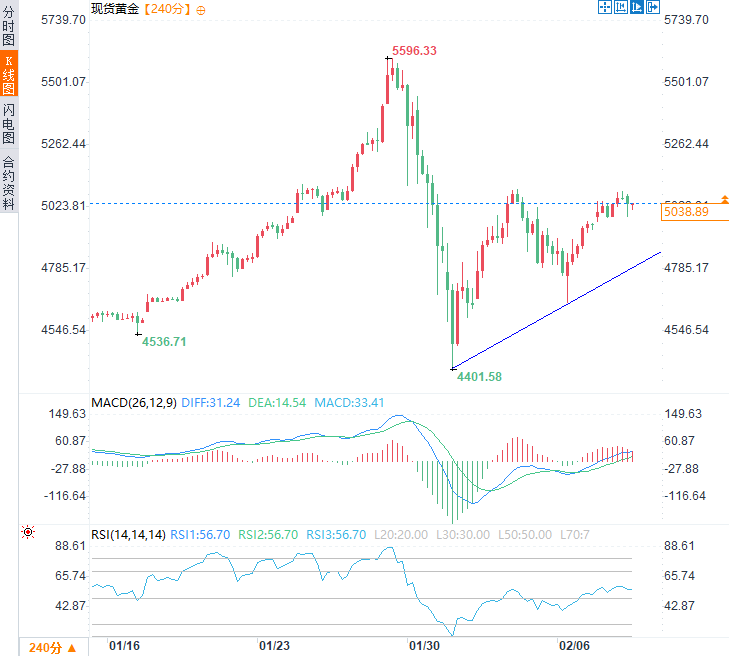
(Spot gold 4-hour chart, source: FX678)
At 14:22 Beijing time, spot gold was trading at $5036.82 per ounce.
Meanwhile, investors anticipate at least two 25-basis-point rate cuts by the Federal Reserve in 2026. This expectation, coupled with ongoing concerns about the Fed's independence, has pressured the dollar, which hovered near a more than one-week low (96.79), thus providing support for gold, which does not generate interest income. Traders also appear reluctant to make overly aggressive directional bets ahead of Wednesday's US non-farm payroll report and Friday's latest US consumer inflation data.
Gold prices fluctuated lower as safe-haven demand waned and expectations of interest rate cuts were offset, but were supported by a weak dollar.
Indirect talks between the United States and Iran regarding the future of the latter's nuclear program concluded last Friday, with both sides reaching a broad agreement to maintain a diplomatic approach. This eased market concerns about a military confrontation in the Middle East and boosted investor confidence. This continued to support optimistic market sentiment during Tuesday's Asian trading session, leading to outflows from safe-haven assets like gold.
Iranian Foreign Minister Abbas Araqchi described the eight-hour meeting as "a good start in a good atmosphere." US President Donald Trump called the talks "very good" and indicated that another meeting would be held earlier this week.
Meanwhile, Trump stated on Saturday that he might sue his newly nominated Federal Reserve Chair, Kevin Warsh, if he does not lower interest rates, reigniting concerns about the Fed's independence. Furthermore, Treasury Secretary Scott Bessant did not rule out the possibility of launching a criminal investigation against Warsh should he ultimately refuse to cut rates, as stated on Thursday.
The market is increasingly accepting the expectation that the Federal Reserve will cut interest rates twice more in 2026, with the first cut expected in June. This caused the dollar to fall to its lowest point in more than a week. In turn, this provided support for non-yielding gold, limiting its decline. Traders are now focusing on this week's key U.S. macroeconomic data releases for further clues about the Fed's rate-cutting path.
A rather busy week begins with the release of US monthly retail sales data (scheduled for release later Tuesday). However, market focus remains on Wednesday's closely watched US non-farm payrolls report and Friday's US consumer inflation data. These data will drive the dollar's movements and provide new momentum for gold.
The People's Bank of China reported last Saturday that it increased its gold reserves for the 15th consecutive month in January, highlighting stable demand amid fiscal concerns in major economies. In addition, reports indicate that Chinese regulators have advised financial institutions to reduce their holdings of U.S. Treasury bonds due to concerns about concentration risk and market volatility.
Gold needs to break through last week's high to provide a basis for further upward movement.
Gold prices encountered resistance overnight near last week's lows, suggesting caution is advised before establishing new long positions. The Moving Average Convergence Divergence (MACD) histogram, while still positive, is contracting, indicating weakening upward momentum; the MACD line remains above the signal line and the zero line. The Relative Strength Index (RSI) is not far above the midline, reflecting a mildly upward-biased equilibrium in the market.
Meanwhile, the upward trendline extending from $4401.58 continues to provide support for the bullish stance, currently around $4800. If gold prices can hold this upward trendline support, the bulls are expected to continue their rebound; conversely, if the closing price falls below this line, it will threaten the current upward trend and open up room for prices to fall further to $4400.
If the MACD histogram expands back into positive territory, it will strengthen buying momentum; conversely, if the histogram retraces towards the zero line, it indicates shrinking demand. If the RSI can hold above 50, buyers remain in control; if it falls to around 45, the market may return to a range-bound pattern.
(Spot gold 4-hour chart, source: FX678)
At 14:22 Beijing time, spot gold was trading at $5036.82 per ounce.
- Risk Warning and Disclaimer
- The market involves risk, and trading may not be suitable for all investors. This article is for reference only and does not constitute personal investment advice, nor does it take into account certain users’ specific investment objectives, financial situation, or other needs. Any investment decisions made based on this information are at your own risk.