The British pound has stabilized and rebounded against the US dollar, and is expected to continue rising in the short term.
2026-02-23 10:09:44
On Monday during Asian trading hours, GBP/USD rose to around 1.3520, with the pressure on the US dollar being the main driving factor.
Last week, the U.S. Supreme Court ruled that some of the tariffs previously implemented by President Trump were illegal and exceeded his authority. However, President Trump subsequently announced a 150-day uniform import tariff.
Repeated policy changes have exacerbated market concerns about trade prospects and global growth, thereby weakening the dollar's performance.
Currency strategist Sim Moh Siong pointed out that the weakening of the US dollar reflects, to some extent, the potential improvement in non-US economic growth expectations, which reduces the attractiveness of the dollar from a relative growth perspective.
In the UK, economic data was strong. Data showed that retail sales rose 1.8% month-on-month in January, far exceeding the previous month's 0.4% and market expectations of 0.2%; year-on-year growth was 4.5%, also exceeding expectations.
This indicates that UK consumer spending remains resilient, providing fundamental support for the pound. The market focus will now shift to the US January PPI data. The market expects both overall and core PPI to rise by 0.3% month-on-month.
If inflation data is higher than expected, it could strengthen market expectations that the Federal Reserve will maintain a high-interest-rate stance, thereby boosting the dollar and suppressing the rise of the pound.
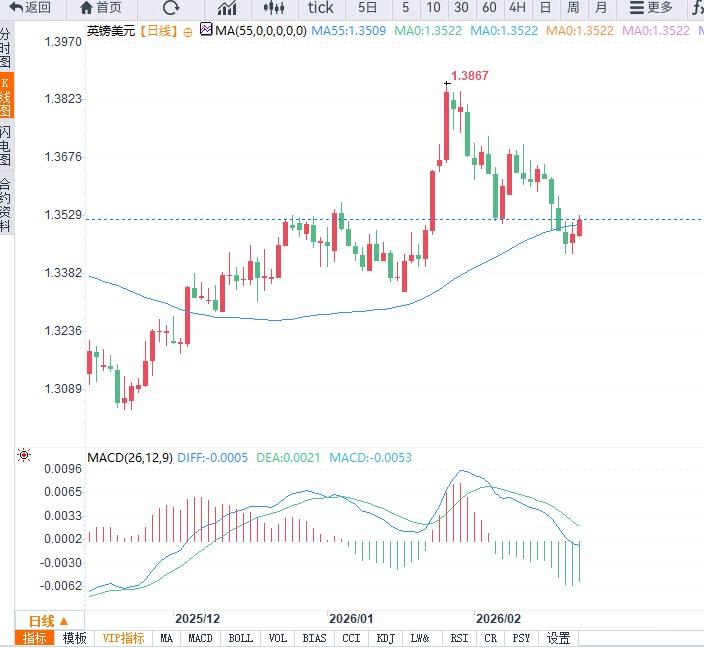
From the daily chart, GBP/USD has broken through the psychological level of 1.3500, indicating a short-term bullish trend. The moving average system is in a bullish alignment, and the MACD is above the zero line, showing improved momentum.
The upside resistance levels to watch are the 1.3580 and 1.3650 area; a break above these levels could lead to a further challenge of the year's high. Support levels are at 1.3450, followed by 1.3380. A break below 1.3450 could increase short-term downward pressure.
The overall structure leans towards an upward trend with fluctuations, but we need to be wary of data-driven volatility risks.
Editor's Note:
The current exchange rate rise is more driven by a weakening US dollar than by a one-sided strength in the British pound. UK retail sales data provides support, but its sustainability remains to be seen. The key in the short term lies in the performance of US PPI data.
If inflation rebounds, the US dollar may see a temporary rebound; if the data is moderate, GBP/USD is expected to continue its upward trend.
Last week, the U.S. Supreme Court ruled that some of the tariffs previously implemented by President Trump were illegal and exceeded his authority. However, President Trump subsequently announced a 150-day uniform import tariff.
Repeated policy changes have exacerbated market concerns about trade prospects and global growth, thereby weakening the dollar's performance.
Currency strategist Sim Moh Siong pointed out that the weakening of the US dollar reflects, to some extent, the potential improvement in non-US economic growth expectations, which reduces the attractiveness of the dollar from a relative growth perspective.
In the UK, economic data was strong. Data showed that retail sales rose 1.8% month-on-month in January, far exceeding the previous month's 0.4% and market expectations of 0.2%; year-on-year growth was 4.5%, also exceeding expectations.
This indicates that UK consumer spending remains resilient, providing fundamental support for the pound. The market focus will now shift to the US January PPI data. The market expects both overall and core PPI to rise by 0.3% month-on-month.
If inflation data is higher than expected, it could strengthen market expectations that the Federal Reserve will maintain a high-interest-rate stance, thereby boosting the dollar and suppressing the rise of the pound.
From the daily chart, GBP/USD has broken through the psychological level of 1.3500, indicating a short-term bullish trend. The moving average system is in a bullish alignment, and the MACD is above the zero line, showing improved momentum.
The upside resistance levels to watch are the 1.3580 and 1.3650 area; a break above these levels could lead to a further challenge of the year's high. Support levels are at 1.3450, followed by 1.3380. A break below 1.3450 could increase short-term downward pressure.
The overall structure leans towards an upward trend with fluctuations, but we need to be wary of data-driven volatility risks.
Editor's Note:
The current exchange rate rise is more driven by a weakening US dollar than by a one-sided strength in the British pound. UK retail sales data provides support, but its sustainability remains to be seen. The key in the short term lies in the performance of US PPI data.
If inflation rebounds, the US dollar may see a temporary rebound; if the data is moderate, GBP/USD is expected to continue its upward trend.
- Risk Warning and Disclaimer
- The market involves risk, and trading may not be suitable for all investors. This article is for reference only and does not constitute personal investment advice, nor does it take into account certain users’ specific investment objectives, financial situation, or other needs. Any investment decisions made based on this information are at your own risk.