The bombs have been dropped, oil prices have risen, but why has Trump failed to provide evidence for his justification for the war?
2026-03-02 11:24:01
The Trump administration claims that the U.S. launched a massive, deadly strike against Iran to stop an impending attack from Tehran, but has yet to release any evidence that Iran actually had such a plan.
As the largest military buildup in the Middle East in decades unfolds, the White House has yet to explain to the public or Congress what Iranian threat prompted the U.S. military to launch this regime-altering operation that could drag the United States into another Middle East war.

The U.S. military began bombing Iran with missiles, drones, and long-range artillery early Saturday morning (February 28), but an explanatory statement did not emerge until 12 hours later. A senior Trump administration official told reporters on Saturday that the U.S. judged that if it waited for Iran to launch a preemptive strike, the U.S. military would suffer far greater casualties than currently observed. At the same briefing, two other officials stated that the president ordered the strikes because he determined that Iran refused to completely halt its uranium enrichment activities.
This method of justifying war by "firing first and then finding a reason" is unprecedented in history. Nearly 36 hours after the start of the US military strikes, the Pentagon has still not held any formal press conference, which violates the conventions for major military operations since the Vietnam War.
Unlike previous presidents who actively sought support from Congress, allies, and the public when launching large-scale military operations, Trump made almost no effort to persuade Congress to authorize the war, nor did he seek support from the United Nations to form an international coalition—a stark contrast to George W. Bush's push for congressional authorization before the Iraq War and George H.W. Bush's efforts to secure UN authorization before the Gulf War.
New Jersey Democratic Senator Andy King pointed out: "The so-called imminent threat they're talking about is very likely a response to our unprecedented regional military buildup. This reflects the president deciding what to do first and then letting his team find any justifiable reason."
Last Sunday, the U.S. government briefed some congressional staff on the operation, but according to two attendees, officials did not present clear evidence that Iran was preparing an imminent attack on U.S. forces.
According to sources, Secretary of State Marco Rubio, Defense Secretary Peter Hegses, Chairman of the Joint Chiefs of Staff General Dan Kane, and CIA Director John Ratcliffe will brief members of the House of Representatives on the situation in Iran on Tuesday and meet with senators.
Following the initial attacks, Trump released an eight-minute video via Truth Social, stating that Iran continues to develop long-range missiles that could threaten Europe and U.S. forces—despite U.S. intelligence assessments suggesting that Tehran would need years to acquire such weapons. In a second video released last Sunday, Trump indicated that operations would continue and that U.S. casualties could increase, but he has not yet formally addressed the nation or answered questions from the media, responding only briefly through a few one-on-one interviews.
This action stands in stark contrast to Trump's campaign promise to end "perpetual wars" and his criticism of the United States' long-standing "nation-building" efforts in the Middle East during a speech in Saudi Arabia last year. He had previously described interventionists as "intervening in complex societies they themselves do not understand."
U.S. Central Command stated that the strikes "prioritize locations posing an imminent threat," including Iranian air defense systems, drone and missile launch sites, and military airfields, but did not mention any specific time-sensitive threats against U.S. forces. Defense Secretary Hergesse posted on the X platform Saturday night, stating, "The United States did not initiate this conflict, but we will end it."
The Pentagon did not respond to requests for comment.
According to a source familiar with the matter, the CIA established contact with some Iranian officials several weeks ago, and this intelligence helped determine the time and location of last Saturday's strike, which resulted in the deaths of Iran's Supreme Leader Ali Khamenei and other senior officials.
The CIA and the Office of the Director of National Intelligence did not respond to requests for comment. The White House said in a statement that diplomacy has always been Trump's preferred path, and his representatives have sought an agreement "in the best of their ability" to ensure that Iran's nuclear and ballistic missile capabilities do not pose a threat to the U.S. homeland. "Unfortunately, the Iranian regime has refused to engage in realistic dialogue with the United States."
However, as Iran's retaliatory strike on Sunday killed the first U.S. soldiers, skepticism about the administration's claims has grown. Senator Mark Warner, vice chairman of the Senate Intelligence Committee, stated in an interview that he had seen no intelligence indicating that "Iran is about to launch any preemptive strike against the United States." He called the president "a war of choice."
Connecticut Senator Richard Blumenthal, a member of the Senate Armed Services Committee, acknowledged that Iran, along with its proxies Hezbollah and the Houthis, poses a continued threat and that U.S. bases in the Middle East face real risks. However, he believes these dangers can be managed through existing U.S. and allied air defense missile systems. "Iran simply doesn't have missiles capable of reaching the United States, and probably won't for years to come."
Supporters of the government in Congress also avoided discussing specific plans regarding Iran. Ohio Republican Representative Mike Turner repeatedly used the word "imminent" to describe the threat in an interview, but declined to provide further details.
Daryl Kimball, executive director of the Arms Control Association, pointed out last week that it would take Iran months to enrich enough weapons-grade materials and years to rebuild the nuclear facilities destroyed by the US military last year. Richard Haass, a former State Department official and president of the Council on Foreign Relations, stated that the Iranian threat is "manageable," therefore this is a "preventative rather than preemptive" war.
The current conflict has resulted in the first US military casualty and has triggered a chain reaction in the region. On Monday (March 2nd) during Asian trading hours, US crude oil prices jumped more than 5%, having previously touched a near nine-month high of $75.33 per barrel, before retreating and currently trading around $70.40 per barrel, a daily increase of approximately 5%. The market is closely watching oil price fluctuations, geopolitical risk premiums, and the potential impact of disruptions to the global energy supply chain.
The core issue is that while the Trump administration characterized the action as "defensive/preemptive," it lacked supporting publicly available intelligence evidence, significantly contradicting intelligence community assessments and historical precedents. This led to widespread questioning of its legitimacy by both parties in Congress (especially Democrats) and experts. The conflict continues, with casualties and regional tensions escalating.
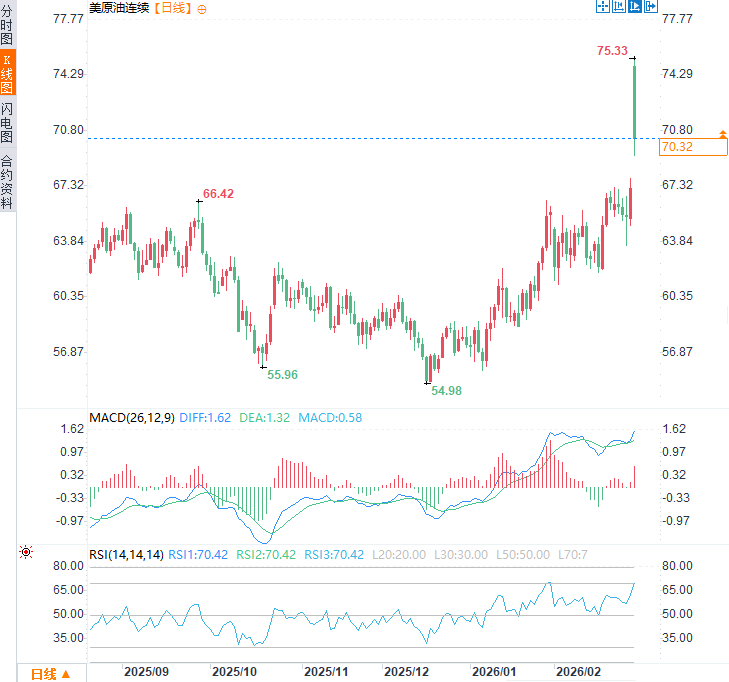
(US crude oil daily chart, source: FX678)
At 11:23 Beijing time, US crude oil futures were trading at $70.38 per barrel.
As the largest military buildup in the Middle East in decades unfolds, the White House has yet to explain to the public or Congress what Iranian threat prompted the U.S. military to launch this regime-altering operation that could drag the United States into another Middle East war.
The launch of the strike and the official explanation for the delay
The U.S. military began bombing Iran with missiles, drones, and long-range artillery early Saturday morning (February 28), but an explanatory statement did not emerge until 12 hours later. A senior Trump administration official told reporters on Saturday that the U.S. judged that if it waited for Iran to launch a preemptive strike, the U.S. military would suffer far greater casualties than currently observed. At the same briefing, two other officials stated that the president ordered the strikes because he determined that Iran refused to completely halt its uranium enrichment activities.
This method of justifying war by "firing first and then finding a reason" is unprecedented in history. Nearly 36 hours after the start of the US military strikes, the Pentagon has still not held any formal press conference, which violates the conventions for major military operations since the Vietnam War.
Unlike previous presidents who actively sought support from Congress, allies, and the public when launching large-scale military operations, Trump made almost no effort to persuade Congress to authorize the war, nor did he seek support from the United Nations to form an international coalition—a stark contrast to George W. Bush's push for congressional authorization before the Iraq War and George H.W. Bush's efforts to secure UN authorization before the Gulf War.
Democratic members of Congress strongly questioned
New Jersey Democratic Senator Andy King pointed out: "The so-called imminent threat they're talking about is very likely a response to our unprecedented regional military buildup. This reflects the president deciding what to do first and then letting his team find any justifiable reason."
Last Sunday, the U.S. government briefed some congressional staff on the operation, but according to two attendees, officials did not present clear evidence that Iran was preparing an imminent attack on U.S. forces.
According to sources, Secretary of State Marco Rubio, Defense Secretary Peter Hegses, Chairman of the Joint Chiefs of Staff General Dan Kane, and CIA Director John Ratcliffe will brief members of the House of Representatives on the situation in Iran on Tuesday and meet with senators.
Contrast between Trump's personal statements and stance
Following the initial attacks, Trump released an eight-minute video via Truth Social, stating that Iran continues to develop long-range missiles that could threaten Europe and U.S. forces—despite U.S. intelligence assessments suggesting that Tehran would need years to acquire such weapons. In a second video released last Sunday, Trump indicated that operations would continue and that U.S. casualties could increase, but he has not yet formally addressed the nation or answered questions from the media, responding only briefly through a few one-on-one interviews.
This action stands in stark contrast to Trump's campaign promise to end "perpetual wars" and his criticism of the United States' long-standing "nation-building" efforts in the Middle East during a speech in Saudi Arabia last year. He had previously described interventionists as "intervening in complex societies they themselves do not understand."
Latest statements from the US military and government
U.S. Central Command stated that the strikes "prioritize locations posing an imminent threat," including Iranian air defense systems, drone and missile launch sites, and military airfields, but did not mention any specific time-sensitive threats against U.S. forces. Defense Secretary Hergesse posted on the X platform Saturday night, stating, "The United States did not initiate this conflict, but we will end it."
The Pentagon did not respond to requests for comment.
According to a source familiar with the matter, the CIA established contact with some Iranian officials several weeks ago, and this intelligence helped determine the time and location of last Saturday's strike, which resulted in the deaths of Iran's Supreme Leader Ali Khamenei and other senior officials.
The CIA and the Office of the Director of National Intelligence did not respond to requests for comment. The White House said in a statement that diplomacy has always been Trump's preferred path, and his representatives have sought an agreement "in the best of their ability" to ensure that Iran's nuclear and ballistic missile capabilities do not pose a threat to the U.S. homeland. "Unfortunately, the Iranian regime has refused to engage in realistic dialogue with the United States."
Iranian retaliation and further questioning from Congress
However, as Iran's retaliatory strike on Sunday killed the first U.S. soldiers, skepticism about the administration's claims has grown. Senator Mark Warner, vice chairman of the Senate Intelligence Committee, stated in an interview that he had seen no intelligence indicating that "Iran is about to launch any preemptive strike against the United States." He called the president "a war of choice."
Connecticut Senator Richard Blumenthal, a member of the Senate Armed Services Committee, acknowledged that Iran, along with its proxies Hezbollah and the Houthis, poses a continued threat and that U.S. bases in the Middle East face real risks. However, he believes these dangers can be managed through existing U.S. and allied air defense missile systems. "Iran simply doesn't have missiles capable of reaching the United States, and probably won't for years to come."
Supporters of the government in Congress also avoided discussing specific plans regarding Iran. Ohio Republican Representative Mike Turner repeatedly used the word "imminent" to describe the threat in an interview, but declined to provide further details.
Expert assessment: Preventative rather than preemptive.
Daryl Kimball, executive director of the Arms Control Association, pointed out last week that it would take Iran months to enrich enough weapons-grade materials and years to rebuild the nuclear facilities destroyed by the US military last year. Richard Haass, a former State Department official and president of the Council on Foreign Relations, stated that the Iranian threat is "manageable," therefore this is a "preventative rather than preemptive" war.
The current conflict has resulted in the first US military casualty and has triggered a chain reaction in the region. On Monday (March 2nd) during Asian trading hours, US crude oil prices jumped more than 5%, having previously touched a near nine-month high of $75.33 per barrel, before retreating and currently trading around $70.40 per barrel, a daily increase of approximately 5%. The market is closely watching oil price fluctuations, geopolitical risk premiums, and the potential impact of disruptions to the global energy supply chain.
The core issue is that while the Trump administration characterized the action as "defensive/preemptive," it lacked supporting publicly available intelligence evidence, significantly contradicting intelligence community assessments and historical precedents. This led to widespread questioning of its legitimacy by both parties in Congress (especially Democrats) and experts. The conflict continues, with casualties and regional tensions escalating.
(US crude oil daily chart, source: FX678)
At 11:23 Beijing time, US crude oil futures were trading at $70.38 per barrel.
- Risk Warning and Disclaimer
- The market involves risk, and trading may not be suitable for all investors. This article is for reference only and does not constitute personal investment advice, nor does it take into account certain users’ specific investment objectives, financial situation, or other needs. Any investment decisions made based on this information are at your own risk.