Will Trump interfere in the Iranian election? On the seventh day, war has spread across three continents, and oil prices have skyrocketed?
2026-03-06 10:24:45
US President Trump has made it clear that he "must be involved" in the appointment process of Iran's next Supreme Leader, and bluntly stated that hardline frontrunner Mojtaba Khamenei is "unacceptable," calling him a "lightweight." This move marks a shift in US strategy toward Iran from military strikes to "regime shaping," sparking internal controversy in Iran and concerns about external interference.
Affected by the disruption of the Strait of Hormuz and attacks on oil tankers, global energy logistics have been hampered. Brent crude oil prices fluctuated upwards in Asian trading on Friday (March 6), currently trading around $84.15, with a daily increase of about 0.25% and a weekly increase of nearly 20%, the largest weekly gain since 2022.

US President Donald Trump said he must participate in the selection of Iran's next Supreme Leader and bluntly stated that hardliner Mojtaba Khamenei (the 56-year-old second son of the late Ali Khamenei) is "unacceptable".
Trump stated, "Mojtaba is a lightweight who will continue his father's policies and could potentially trigger another conflict within five years. We need people who can benefit the people and bring harmony and peace." He even drew a parallel with Venezuela, emphasizing, "I must be involved in the appointment."
Iran's expert committee is urgently discussing a successor, with Mojtaba, a close confidant of the Revolutionary Guard and a representative of the hardliners, considered a frontrunner. However, Trump's remarks have exacerbated the controversy surrounding external interference and could potentially provoke internal division or unrest within Iran .
As of March 6, the US-Iran conflict entered its seventh day. The Israeli military warned residents east of Tehran to evacuate, and explosions were heard in multiple locations. Iranian missiles struck several Gulf countries: the BAPCO oil refinery in Bahrain was hit and caught fire (now under control); sirens sounded in Dubai and Abu Dhabi; and debris from intercepted missiles caused damage.
Azerbaijan accused Iran of drone attacks on its territory and announced the closure of its southern airspace for 12 hours.
Cyprus and Turkey were also attacked, and European countries pledged to send more warships to the eastern Mediterranean. Iran's Revolutionary Guard claimed responsibility for hitting a US oil tanker in the northern Persian Gulf, causing a fire and further disrupting global energy routes.
A U.S. submarine launched a torpedo in international waters near Sri Lanka on Tuesday, sinking the Iranian Navy frigate IRIS Dena and killing at least 87 people. 32 were rescued, and approximately 60 are missing. The ship had just returned from a naval exercise in the Indian Ocean. This marks the first time a submarine has sunk an enemy vessel since World War II. U.S. Defense Secretary Pete Hegseth called it "destroying a key asset of the Iranian Navy." Iran vowed retaliation, and the conflict has now extended to the Indian Ocean, demonstrating the U.S. military's "global pursuit" posture.
The latest statistics from the Iranian Red Crescent show that since the outbreak of the conflict, US and Israeli airstrikes have caused at least 1,230 deaths in Iran (including civilians and military personnel). The Lebanese Ministry of Health reported 77 deaths, mainly due to spillover effects from Israeli strikes against Hezbollah targets. The US reported 6 soldiers killed. The casualty figures continue to rise, civilian areas and infrastructure have been severely damaged, and Iran's internet is nearly paralyzed, severely restricting the flow of information.
One-fifth of the world's oil and LNG supply has been disrupted by the Strait of Hormuz, with continued flight cancellations and supply chain disruptions. The Trump administration is considering releasing strategic reserves or exempting fuel blending requirements to lower prices, but Iranian attacks on oil tankers have exacerbated uncertainty. If the conflict persists, oil prices could return to $90-100, pushing up global inflation and triggering a supply chain crisis.
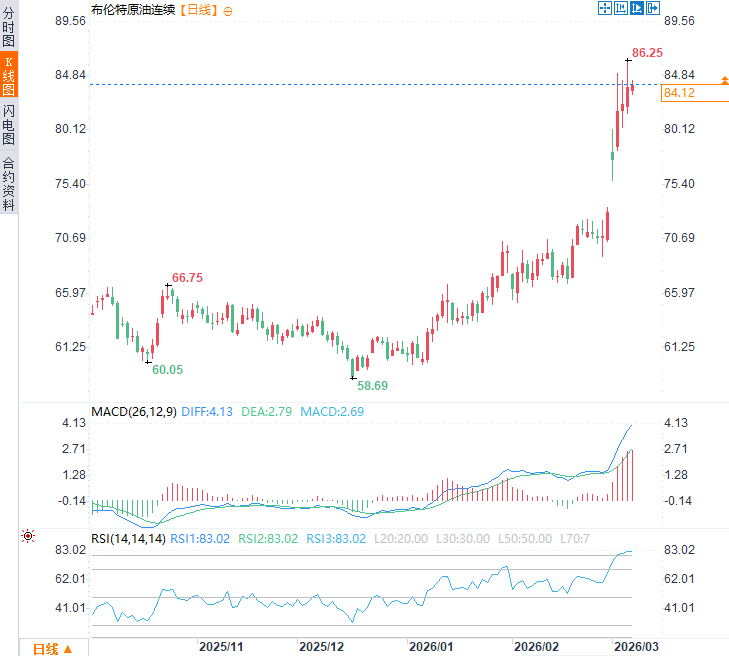
(Brent crude oil daily chart, source: EasyForex)
Iranian state television was hacked, briefly airing a video of exiled opposition leader Reza Pahlavi (son of the former king). He called on the people to "stand together until final victory" and urged security forces "not to fire on the people." This is one of several recent hacking attacks aimed at amplifying internal discontent and undermining the regime's legitimacy. Iranian officials claimed "sabotage by external forces," but the incident highlights the regime's fragile control over information.
Israel has declared the start of the "second phase" of its war, focusing its attacks on Iranian underground bunkers and infrastructure storing ballistic missiles. The US-Israeli coalition maintains high-intensity airstrikes, and Iran's missile retaliatory intensity has decreased by more than 90%, but proxy networks and low-intensity retaliation continue. Iranian Foreign Minister Abbas Araghchi denied seeking peace, stating that he is "confident in dealing with any invasion."
Trump's open interference in the succession of Iran's Supreme Leader, rejecting Mojtaba Khamenei and demanding to participate in the selection process, marks a shift in the US's focus from "limited strikes" to "regime shaping," exacerbating internal and international tensions in Iran.
The conflict quickly spread to multiple countries including Azerbaijan, Sri Lanka, and Türkiye, resulting in over 1,300 casualties. The disruption of the Hormuz gas pipeline has driven up energy prices.
The hacking of videos of the Pahlavi regime exposed its vulnerability, and Israel's second phase of strikes against underground facilities may further weaken Iran's missile capabilities. However, with no clear ceasefire path, the risk of a regional war of attrition is rising. The global economy faces the threat of stagflation, and the dual challenges to humanitarian and geopolitical stability are intensifying.
At 10:24 Beijing time, Brent crude oil futures were trading at $84.11 per barrel.
Affected by the disruption of the Strait of Hormuz and attacks on oil tankers, global energy logistics have been hampered. Brent crude oil prices fluctuated upwards in Asian trading on Friday (March 6), currently trading around $84.15, with a daily increase of about 0.25% and a weekly increase of nearly 20%, the largest weekly gain since 2022.
Trump's intervention in Iran's succession selection has made hardliner Mojtaba the biggest point of contention.
US President Donald Trump said he must participate in the selection of Iran's next Supreme Leader and bluntly stated that hardliner Mojtaba Khamenei (the 56-year-old second son of the late Ali Khamenei) is "unacceptable".
Trump stated, "Mojtaba is a lightweight who will continue his father's policies and could potentially trigger another conflict within five years. We need people who can benefit the people and bring harmony and peace." He even drew a parallel with Venezuela, emphasizing, "I must be involved in the appointment."
Iran's expert committee is urgently discussing a successor, with Mojtaba, a close confidant of the Revolutionary Guard and a representative of the hardliners, considered a frontrunner. However, Trump's remarks have exacerbated the controversy surrounding external interference and could potentially provoke internal division or unrest within Iran .
The conflict zone has spread, an explosion occurred in Tehran, and a fire broke out at an oil refinery in Bahrain.
As of March 6, the US-Iran conflict entered its seventh day. The Israeli military warned residents east of Tehran to evacuate, and explosions were heard in multiple locations. Iranian missiles struck several Gulf countries: the BAPCO oil refinery in Bahrain was hit and caught fire (now under control); sirens sounded in Dubai and Abu Dhabi; and debris from intercepted missiles caused damage.
Azerbaijan accused Iran of drone attacks on its territory and announced the closure of its southern airspace for 12 hours.
Cyprus and Turkey were also attacked, and European countries pledged to send more warships to the eastern Mediterranean. Iran's Revolutionary Guard claimed responsibility for hitting a US oil tanker in the northern Persian Gulf, causing a fire and further disrupting global energy routes.
US submarine sinks Iranian warship; 87 dead off Sri Lanka
A U.S. submarine launched a torpedo in international waters near Sri Lanka on Tuesday, sinking the Iranian Navy frigate IRIS Dena and killing at least 87 people. 32 were rescued, and approximately 60 are missing. The ship had just returned from a naval exercise in the Indian Ocean. This marks the first time a submarine has sunk an enemy vessel since World War II. U.S. Defense Secretary Pete Hegseth called it "destroying a key asset of the Iranian Navy." Iran vowed retaliation, and the conflict has now extended to the Indian Ocean, demonstrating the U.S. military's "global pursuit" posture.
1,230 people have died in Iran and 77 in Lebanon.
The latest statistics from the Iranian Red Crescent show that since the outbreak of the conflict, US and Israeli airstrikes have caused at least 1,230 deaths in Iran (including civilians and military personnel). The Lebanese Ministry of Health reported 77 deaths, mainly due to spillover effects from Israeli strikes against Hezbollah targets. The US reported 6 soldiers killed. The casualty figures continue to rise, civilian areas and infrastructure have been severely damaged, and Iran's internet is nearly paralyzed, severely restricting the flow of information.
Global energy logistics paralyzed, oil prices soar
One-fifth of the world's oil and LNG supply has been disrupted by the Strait of Hormuz, with continued flight cancellations and supply chain disruptions. The Trump administration is considering releasing strategic reserves or exempting fuel blending requirements to lower prices, but Iranian attacks on oil tankers have exacerbated uncertainty. If the conflict persists, oil prices could return to $90-100, pushing up global inflation and triggering a supply chain crisis.
(Brent crude oil daily chart, source: EasyForex)
Iranian state television was hacked; Reza Pahlavi calls for uprising.
Iranian state television was hacked, briefly airing a video of exiled opposition leader Reza Pahlavi (son of the former king). He called on the people to "stand together until final victory" and urged security forces "not to fire on the people." This is one of several recent hacking attacks aimed at amplifying internal discontent and undermining the regime's legitimacy. Iranian officials claimed "sabotage by external forces," but the incident highlights the regime's fragile control over information.
Israel enters second phase, targeting underground missile bunkers.
Israel has declared the start of the "second phase" of its war, focusing its attacks on Iranian underground bunkers and infrastructure storing ballistic missiles. The US-Israeli coalition maintains high-intensity airstrikes, and Iran's missile retaliatory intensity has decreased by more than 90%, but proxy networks and low-intensity retaliation continue. Iranian Foreign Minister Abbas Araghchi denied seeking peace, stating that he is "confident in dealing with any invasion."
Editor's Summary
Trump's open interference in the succession of Iran's Supreme Leader, rejecting Mojtaba Khamenei and demanding to participate in the selection process, marks a shift in the US's focus from "limited strikes" to "regime shaping," exacerbating internal and international tensions in Iran.
The conflict quickly spread to multiple countries including Azerbaijan, Sri Lanka, and Türkiye, resulting in over 1,300 casualties. The disruption of the Hormuz gas pipeline has driven up energy prices.
The hacking of videos of the Pahlavi regime exposed its vulnerability, and Israel's second phase of strikes against underground facilities may further weaken Iran's missile capabilities. However, with no clear ceasefire path, the risk of a regional war of attrition is rising. The global economy faces the threat of stagflation, and the dual challenges to humanitarian and geopolitical stability are intensifying.
At 10:24 Beijing time, Brent crude oil futures were trading at $84.11 per barrel.
- Risk Warning and Disclaimer
- The market involves risk, and trading may not be suitable for all investors. This article is for reference only and does not constitute personal investment advice, nor does it take into account certain users’ specific investment objectives, financial situation, or other needs. Any investment decisions made based on this information are at your own risk.