400 million barrels not enough? IEA Director hints at "increased support at any time," but can oil prices be kept under control?
2026-03-17 09:48:31
International Energy Agency (IEA) Executive Director Fatih Birol said on Monday (March 16) that although the 32 member countries have unanimously agreed to release 400 million barrels of strategic petroleum reserves, further use of reserves may be necessary in the future. This statement preserves policy space for the continued tight global oil supply and demonstrates the IEA's high vigilance and preparedness for the current risk of supply disruptions.
Birol emphasized that while the current reserve release is at a record high, member states are prepared to take further action to stabilize the market should the conflict continue and the shortfall widen. This statement may limit the upside potential of oil prices to some extent, but the continued congestion in the Strait of Hormuz is contributing to the premium, causing oil prices to fluctuate at high levels. On Tuesday in Asian trading, US crude oil prices fluctuated higher, currently trading around $95.55 per barrel, a daily increase of approximately 2.15%.

On March 11, the International Energy Agency issued a statement saying that its 32 member countries unanimously agreed to release 400 million barrels of strategic oil reserves to address the global oil supply shortages caused by the US and Israeli military strikes against Iran.
This is the largest collective release of reserves by the IEA since its inception in 1974, exceeding the 182 million barrels released during the Russia-Ukraine conflict in 2022. The United States contributed the largest share (approximately 172 million barrels), with other member countries sharing the remainder. The release aims to alleviate the panic premium and inflationary transmission pressures caused by the Hormuz disruption by injecting a large amount of supply.
Shipping through the Strait of Hormuz remains disrupted, trapping approximately one-fifth of the world's oil supply (about 20 million barrels per day). Iranian threats and attacks have led to a mass exodus of shipowners, causing insurance premiums to skyrocket and shipping costs to surge.
Gulf oil-producing countries are forced to cut production as their storage facilities reach capacity, sharply widening the global supply gap. Asian importers are facing the biggest impact, with both gasoline and diesel prices in the United States hitting near-record highs. The IEA warns that if the disruptions continue, supply losses could escalate further.
Birol's statement that it would "use reserves further if necessary" sends a clear signal: although the current release of 400 million barrels is unprecedented, the IEA is prepared to deal with a prolonged supply crisis.
Member states have a total reserve of approximately 1.2 billion barrels, with ample room to release additional reserves in stages depending on the escalation of the situation. This move is intended to reassure the market that the IEA has sufficient ammunition for a stable supply, while potentially warning Iran and other relevant parties that continued disruptions will face a larger-scale collective response.
Despite the record-breaking release of reserves by the IEA, oil prices remain volatile at high levels, with the market skeptical about its actual effectiveness. Traders believe that the logistical delays (requiring 60-90 days for actual delivery) will only partially fill the Hormuz Day gap and cannot fundamentally solve the supply disruption.
Birol's latest statement has drawn significant market attention to the pace and scale of the IEA's subsequent actions. If the situation deteriorates further, expectations for additional reserve releases will rise, potentially continuing to suppress speculative premiums in the short term; however, if Iran continues its retaliation, oil prices could rebound.
In the short term: the release of 400 million barrels from reserves and the statement that Birol will "further utilize" oil can provide a buffer, alleviate some of the panic premium, and prevent oil prices from soaring out of control.
Long term: If the Hormuz strike continues for several months, the scale and speed of reserve releases will struggle to keep up with the shortfall, and high-level volatility in oil prices will become the new normal. The risks of global inflation transmission, economic slowdown, and supply chain disruptions continue to amplify. Investors need to closely monitor Iran's response, the resumption of navigation in the Strait of Hormuz, and signals from the IEA regarding additional reserve releases; the energy market faces extremely high uncertainty.
International Energy Agency (IEA) Executive Director Fatih Birol said on the 16th that although 32 countries have agreed to release 400 million barrels of strategic oil reserves (the largest amount in IEA history), the reserves may be used further in the future "if necessary" to reserve policy space to cope with the continued tight global oil supply.
Shipping through the Hormuz remains disrupted, trapping one-fifth of the world's oil supply, and production cuts by Gulf oil-producing countries are exacerbating the gap. This statement from the IEA sends a clear signal: while the current reserve release is unprecedented in scale, preparations are made for a prolonged crisis.
Oil prices continue to fluctuate at high levels, with the market paying close attention to the pace and scale of the IEA's subsequent actions. Short-term reserve releases can provide a buffer, but whether they can fundamentally alleviate the situation in the long term depends on the course of the conflict and the speed of recovery in the Strait of Hormuz. Investors should be wary of further deterioration in supply caused by escalating Iranian retaliation, and pay close attention to signals of additional reserve releases from the IEA and their actual implementation.
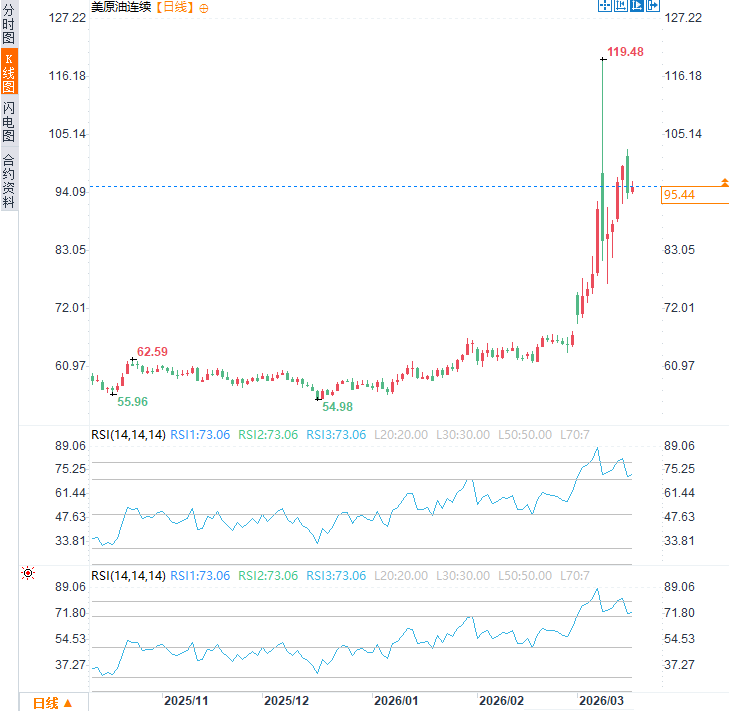
(US crude oil daily chart, source: FX678)
At 9:48 Beijing time, US crude oil futures were trading at $95.50 per barrel.
Birol emphasized that while the current reserve release is at a record high, member states are prepared to take further action to stabilize the market should the conflict continue and the shortfall widen. This statement may limit the upside potential of oil prices to some extent, but the continued congestion in the Strait of Hormuz is contributing to the premium, causing oil prices to fluctuate at high levels. On Tuesday in Asian trading, US crude oil prices fluctuated higher, currently trading around $95.55 per barrel, a daily increase of approximately 2.15%.
400 million barrels mark the largest collective release of reserves in IEA history; 32 countries unanimously agree to address supply shortages.
On March 11, the International Energy Agency issued a statement saying that its 32 member countries unanimously agreed to release 400 million barrels of strategic oil reserves to address the global oil supply shortages caused by the US and Israeli military strikes against Iran.
This is the largest collective release of reserves by the IEA since its inception in 1974, exceeding the 182 million barrels released during the Russia-Ukraine conflict in 2022. The United States contributed the largest share (approximately 172 million barrels), with other member countries sharing the remainder. The release aims to alleviate the panic premium and inflationary transmission pressures caused by the Hormuz disruption by injecting a large amount of supply.
Shipping to the Hormuz continues to be disrupted, trapping one-fifth of the world's oil supply.
Shipping through the Strait of Hormuz remains disrupted, trapping approximately one-fifth of the world's oil supply (about 20 million barrels per day). Iranian threats and attacks have led to a mass exodus of shipowners, causing insurance premiums to skyrocket and shipping costs to surge.
Gulf oil-producing countries are forced to cut production as their storage facilities reach capacity, sharply widening the global supply gap. Asian importers are facing the biggest impact, with both gasoline and diesel prices in the United States hitting near-record highs. The IEA warns that if the disruptions continue, supply losses could escalate further.
If necessary, further reserves will be released to signal a potential supply crisis or a prolonged crisis.
Birol's statement that it would "use reserves further if necessary" sends a clear signal: although the current release of 400 million barrels is unprecedented, the IEA is prepared to deal with a prolonged supply crisis.
Member states have a total reserve of approximately 1.2 billion barrels, with ample room to release additional reserves in stages depending on the escalation of the situation. This move is intended to reassure the market that the IEA has sufficient ammunition for a stable supply, while potentially warning Iran and other relevant parties that continued disruptions will face a larger-scale collective response.
Oil prices are fluctuating at high levels, and the market is paying close attention to the IEA's next move.
Despite the record-breaking release of reserves by the IEA, oil prices remain volatile at high levels, with the market skeptical about its actual effectiveness. Traders believe that the logistical delays (requiring 60-90 days for actual delivery) will only partially fill the Hormuz Day gap and cannot fundamentally solve the supply disruption.
Birol's latest statement has drawn significant market attention to the pace and scale of the IEA's subsequent actions. If the situation deteriorates further, expectations for additional reserve releases will rise, potentially continuing to suppress speculative premiums in the short term; however, if Iran continues its retaliation, oil prices could rebound.
Short-term buffer vs. long-term gap: Whether releasing reserves can fundamentally alleviate the situation remains to be seen.
In the short term: the release of 400 million barrels from reserves and the statement that Birol will "further utilize" oil can provide a buffer, alleviate some of the panic premium, and prevent oil prices from soaring out of control.
Long term: If the Hormuz strike continues for several months, the scale and speed of reserve releases will struggle to keep up with the shortfall, and high-level volatility in oil prices will become the new normal. The risks of global inflation transmission, economic slowdown, and supply chain disruptions continue to amplify. Investors need to closely monitor Iran's response, the resumption of navigation in the Strait of Hormuz, and signals from the IEA regarding additional reserve releases; the energy market faces extremely high uncertainty.
Editor's Summary
International Energy Agency (IEA) Executive Director Fatih Birol said on the 16th that although 32 countries have agreed to release 400 million barrels of strategic oil reserves (the largest amount in IEA history), the reserves may be used further in the future "if necessary" to reserve policy space to cope with the continued tight global oil supply.
Shipping through the Hormuz remains disrupted, trapping one-fifth of the world's oil supply, and production cuts by Gulf oil-producing countries are exacerbating the gap. This statement from the IEA sends a clear signal: while the current reserve release is unprecedented in scale, preparations are made for a prolonged crisis.
Oil prices continue to fluctuate at high levels, with the market paying close attention to the pace and scale of the IEA's subsequent actions. Short-term reserve releases can provide a buffer, but whether they can fundamentally alleviate the situation in the long term depends on the course of the conflict and the speed of recovery in the Strait of Hormuz. Investors should be wary of further deterioration in supply caused by escalating Iranian retaliation, and pay close attention to signals of additional reserve releases from the IEA and their actual implementation.
(US crude oil daily chart, source: FX678)
At 9:48 Beijing time, US crude oil futures were trading at $95.50 per barrel.
- Risk Warning and Disclaimer
- The market involves risk, and trading may not be suitable for all investors. This article is for reference only and does not constitute personal investment advice, nor does it take into account certain users’ specific investment objectives, financial situation, or other needs. Any investment decisions made based on this information are at your own risk.