Gold's $4,700 level is in jeopardy; the Fed's hawkish stance has shattered expectations of rate cuts, and a medium-term correction is inevitable.
2026-03-19 16:54:24
This round of gold price increases is essentially the result of a confluence of multiple macroeconomic drivers. The core logic includes safe-haven demand driven by escalating global geopolitical risks, structural support from continued gold purchases by global central banks, and market pricing in the Federal Reserve's entry into a rate-cutting cycle. Under the combined effect of these three factors, gold prices have continued to strengthen and repeatedly hit new highs.

However, with changes in the market environment, the aforementioned driving factors are showing a clear weakening or even reversal, and the gold market is gradually transitioning from a one-sided upward trend to a correction phase. From the current market structure, the most critical change stems from the reshaping of monetary policy expectations. Previously, the market widely expected the Federal Reserve to enter a rate-cutting cycle relatively quickly, but with rising energy prices pushing up inflation expectations and the latest policy meeting releasing a clearly hawkish signal, the market has begun to reassess the interest rate path. This change means that previously fully priced-in rate-cutting expectations are being revised, and there may even be a situation of "rate-cutting expectations backfiring," thus directly suppressing gold prices.
Beyond the logic of interest rates, the changing flow of safe-haven funds is also noteworthy. Despite ongoing geopolitical risks, gold has not gained commensurate upward momentum, instead exhibiting clear signs of pressure at higher levels. This suggests that safe-haven funds are currently being diverted, with more flowing into dollar assets rather than gold . Given the dollar's advantages in liquidity and interest rates, its safe-haven attributes are being strengthened in stages, thus weakening gold's appeal. This structural shift—where "safe-haven demand is no longer solely bullish for gold" —is one of the key characteristics of the current market.
Meanwhile, the overall performance of the commodity market also indirectly pressured gold. The general weakening of non-ferrous metal prices reflects a more cautious market outlook on global economic demand, and also indicates that funds are flowing out of the commodities sector. Against this backdrop, gold is unlikely to strengthen independently and is more susceptible to being dragged down by fund reallocation, further exacerbating the downward pressure.
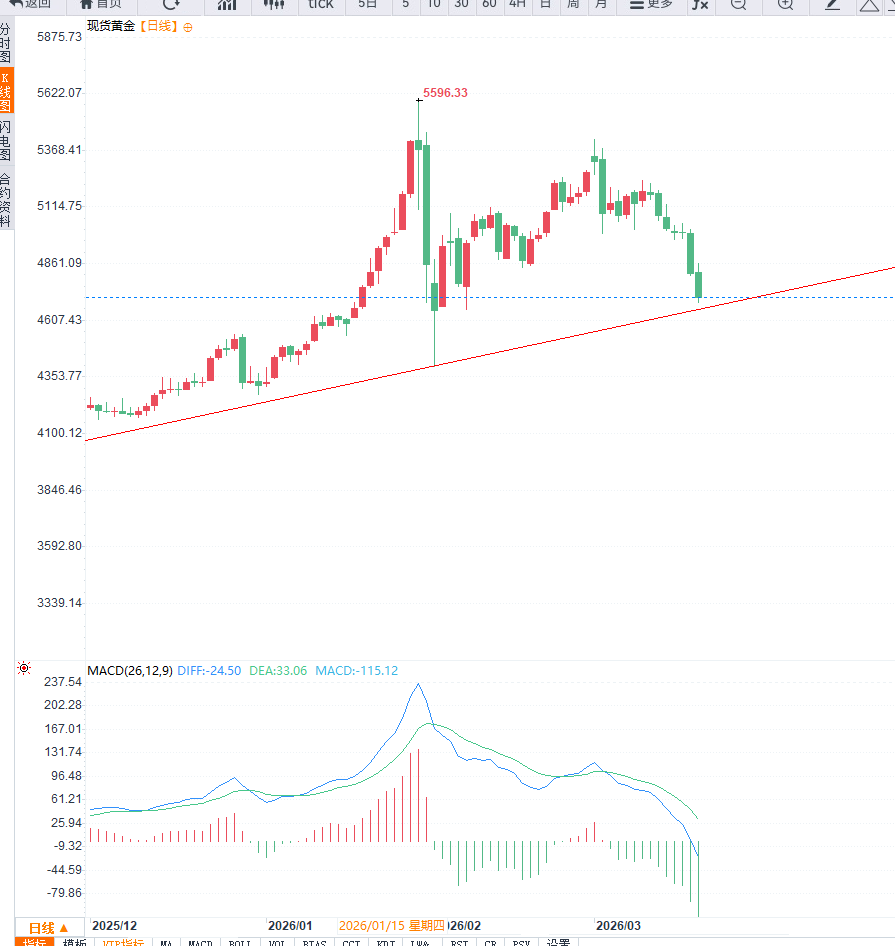
From a technical perspective, gold is currently at a critical trend juncture. The area around $4700 corresponds to the medium-term uptrend line and is also a significant support zone during the previous upward movement. This level constitutes a key watershed for the medium-term trend. A decisive break below this level would signify the breakdown of the previous upward structure, and the market would transition from a "correction within an uptrend" to a "medium-term correction phase."
In terms of downside potential, $4,500 constitutes the first important target area , corresponding to a previous area of dense trading and a psychological level, thus possessing strong support significance. If $4,700 is breached, the market may quickly move towards this area. Furthermore, if $4,500 is further broken, the possibility of extending to even lower levels cannot be ruled out, at which point the correction would be more significant.
It should be noted that although gold faces adjustment pressures in the short and medium term, structural support remains in the longer term. The continued gold purchases by global central banks reflect long-term considerations regarding asset allocation and monetary system stability, a factor that has not fundamentally changed. Therefore, this round of adjustment is more likely to be seen as a phase of correction within an upward trend, rather than a long-term trend reversal.
Editor's Summary : The gold market is at a critical juncture, shifting from a confluence of multiple bullish factors to a reshaping of its underlying logic. A reversal in interest rate cut expectations, the diversion of safe-haven funds, and weakness in the commodity sector are all contributing to current downward pressure. $4700 has become a watershed for the medium-term trend ; if this level is breached, $4500 will become a significant downside target. Overall, gold may have entered a medium-term correction cycle, but the long-term investment logic remains unchanged.
However, with changes in the market environment, the aforementioned driving factors are showing a clear weakening or even reversal, and the gold market is gradually transitioning from a one-sided upward trend to a correction phase. From the current market structure, the most critical change stems from the reshaping of monetary policy expectations. Previously, the market widely expected the Federal Reserve to enter a rate-cutting cycle relatively quickly, but with rising energy prices pushing up inflation expectations and the latest policy meeting releasing a clearly hawkish signal, the market has begun to reassess the interest rate path. This change means that previously fully priced-in rate-cutting expectations are being revised, and there may even be a situation of "rate-cutting expectations backfiring," thus directly suppressing gold prices.
Beyond the logic of interest rates, the changing flow of safe-haven funds is also noteworthy. Despite ongoing geopolitical risks, gold has not gained commensurate upward momentum, instead exhibiting clear signs of pressure at higher levels. This suggests that safe-haven funds are currently being diverted, with more flowing into dollar assets rather than gold . Given the dollar's advantages in liquidity and interest rates, its safe-haven attributes are being strengthened in stages, thus weakening gold's appeal. This structural shift—where "safe-haven demand is no longer solely bullish for gold" —is one of the key characteristics of the current market.
Meanwhile, the overall performance of the commodity market also indirectly pressured gold. The general weakening of non-ferrous metal prices reflects a more cautious market outlook on global economic demand, and also indicates that funds are flowing out of the commodities sector. Against this backdrop, gold is unlikely to strengthen independently and is more susceptible to being dragged down by fund reallocation, further exacerbating the downward pressure.
From a technical perspective, gold is currently at a critical trend juncture. The area around $4700 corresponds to the medium-term uptrend line and is also a significant support zone during the previous upward movement. This level constitutes a key watershed for the medium-term trend. A decisive break below this level would signify the breakdown of the previous upward structure, and the market would transition from a "correction within an uptrend" to a "medium-term correction phase."
In terms of downside potential, $4,500 constitutes the first important target area , corresponding to a previous area of dense trading and a psychological level, thus possessing strong support significance. If $4,700 is breached, the market may quickly move towards this area. Furthermore, if $4,500 is further broken, the possibility of extending to even lower levels cannot be ruled out, at which point the correction would be more significant.
It should be noted that although gold faces adjustment pressures in the short and medium term, structural support remains in the longer term. The continued gold purchases by global central banks reflect long-term considerations regarding asset allocation and monetary system stability, a factor that has not fundamentally changed. Therefore, this round of adjustment is more likely to be seen as a phase of correction within an upward trend, rather than a long-term trend reversal.
Editor's Summary : The gold market is at a critical juncture, shifting from a confluence of multiple bullish factors to a reshaping of its underlying logic. A reversal in interest rate cut expectations, the diversion of safe-haven funds, and weakness in the commodity sector are all contributing to current downward pressure. $4700 has become a watershed for the medium-term trend ; if this level is breached, $4500 will become a significant downside target. Overall, gold may have entered a medium-term correction cycle, but the long-term investment logic remains unchanged.
- Risk Warning and Disclaimer
- The market involves risk, and trading may not be suitable for all investors. This article is for reference only and does not constitute personal investment advice, nor does it take into account certain users’ specific investment objectives, financial situation, or other needs. Any investment decisions made based on this information are at your own risk.