The US military plans to seize three islands in the Strait of Hormuz, jeopardizing Iran's oil lifeline.
2026-03-23 10:15:42
The Wall Street Journal recently revealed that the US military has developed an amphibious landing plan to seize three key Iranian islands—Kharg, Qeshm, and Kish—in order to gain complete control of the Strait of Hormuz. This plan signifies an escalation of the US-Israeli conflict with Iran from air strikes to joint ground and sea operations, directly targeting Iran's energy lifeline and the strait's strategic chokepoint. If implemented, it would fundamentally alter the regional balance of power and become the most dangerous trigger for further conflict.
On Monday (March 23) during the Asian session, US crude oil prices initially rose and then fell back before fluctuating upwards. They are currently trading around $98.75 per barrel, up about 0.55% on the day. At the start of the session, prices jumped 3% to $101.50 per barrel, a new high since March 16.

All three islands are key strategic strongholds for Iran in the Persian Gulf, and their location determines their decisive value. Kharg Island is located in the southwestern waters of Iran, controlling the main oil export route; Qeshm Island and Kish Island are situated at the entrance to the Strait of Hormuz, controlling crucial points for ship entry and exit.
If the US military successfully lands, it can not only sever the connection between the Iranian mainland and the Strait of Hormuz, but also use the three islands as permanent military outposts and bargaining chips, forcing Iran to make significant concessions on passage through the Strait and energy exports.
Kharg Island, known as Iran's "oil export valve," handles approximately 90% of the country's crude oil exports and is one of the world's most important oil terminals. The island's facilities include large storage tanks, pipelines, and a deep-water terminal. If it falls into US control, Iran's oil exports will be instantly paralyzed, directly severing its lifeline of foreign exchange earnings.
Shipping in the Strait of Hormuz is already disrupted. Although the United States has issued a 30-day waiver for sanctions on Iranian oil to alleviate supply pressure, the military island-seizure plan, if implemented, will have a far greater effect than the sanctions and could cause a permanent disruption to global crude oil supply.
The Strait of Hormuz handles approximately one-fifth of the world's seaborne oil shipments, making it a crucial choke point for global energy transport. The core objective of the US island-seizure plan is to gain actual control of the strait by occupying the three islands, thereby breaking Iran's current "conditional opening" rule and restoring the US-led shipping order.
This move can not only immediately alleviate the pressure of high oil prices, but also serve as a long-term strategic lever to force Iran to make full concessions in future negotiations.
Foreign media also warned that the US amphibious landing operation would not be smooth sailing. Iranian troops on the island are on high alert, and Iranian missiles and drones could launch a fierce counterattack, posing a high-intensity fire threat to the US landing fleet. Once the operation begins, it could trigger a full-scale Iranian retaliation, including blocking the Strait of Hormuz and attacking oil production facilities in the Gulf, leading to a global oil supply disruption far exceeding current levels.
Currently, shipping in the Strait of Hormuz is severely hampered. If the island-seizure plan is implemented, it will directly impact the global energy transport lifeline, and the risk of persistently high oil prices will rise sharply.
The Wall Street Journal's disclosure of the US military's island-seizing plan has escalated the struggle for control of the Strait of Hormuz to a new level. If the three key islands—Kharg Island, which serves as a valve for oil exports, and Qeshm Island and Kish Island, which guard the entrance to the strait—fall into US control, it will completely cut off Iran's energy exports and give the US control of one-fifth of the world's oil transportation lifeline.
With shipping across the Taiwan Strait continuing to be disrupted, the 30-day US sanctions waiver is only a short-term buffer, and the risks of military action far outweigh diplomatic efforts. Iranian homeland fire and garrison defenses make a landing extremely difficult, but the very fact that the plan has surfaced has significantly increased market expectations for a full-blown energy war.
The fragility of the global energy supply chain has been laid bare, and investors need to be highly vigilant about the structural surge in oil prices and the geopolitical chain reaction that may be triggered by the implementation of these measures.
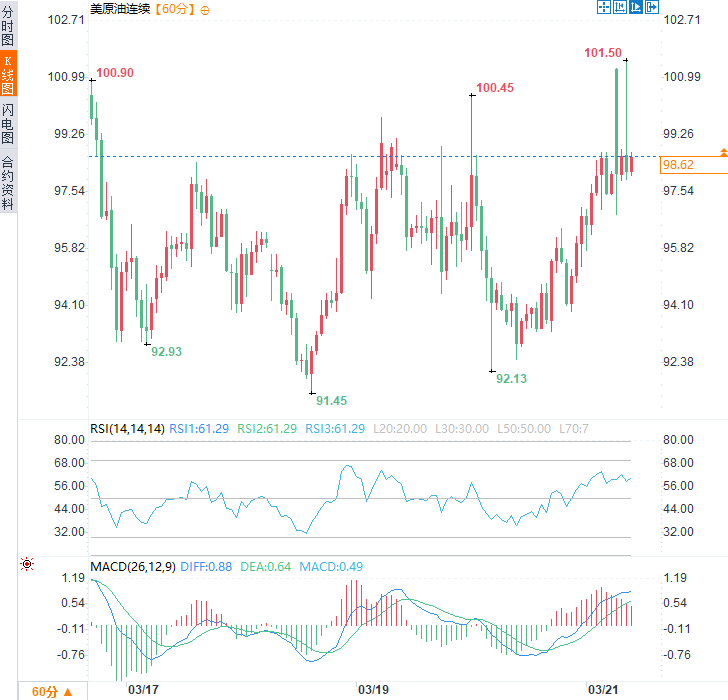
(US crude oil hourly chart, source: FX678)
At 10:14 Beijing time, US crude oil futures were trading at $98.66 per barrel.
On Monday (March 23) during the Asian session, US crude oil prices initially rose and then fell back before fluctuating upwards. They are currently trading around $98.75 per barrel, up about 0.55% on the day. At the start of the session, prices jumped 3% to $101.50 per barrel, a new high since March 16.
Detailed Explanation of the Strategic Importance of Three Key Islands
All three islands are key strategic strongholds for Iran in the Persian Gulf, and their location determines their decisive value. Kharg Island is located in the southwestern waters of Iran, controlling the main oil export route; Qeshm Island and Kish Island are situated at the entrance to the Strait of Hormuz, controlling crucial points for ship entry and exit.
If the US military successfully lands, it can not only sever the connection between the Iranian mainland and the Strait of Hormuz, but also use the three islands as permanent military outposts and bargaining chips, forcing Iran to make significant concessions on passage through the Strait and energy exports.
Kharg Island as a valve for Iranian oil exports
Kharg Island, known as Iran's "oil export valve," handles approximately 90% of the country's crude oil exports and is one of the world's most important oil terminals. The island's facilities include large storage tanks, pipelines, and a deep-water terminal. If it falls into US control, Iran's oil exports will be instantly paralyzed, directly severing its lifeline of foreign exchange earnings.
Shipping in the Strait of Hormuz is already disrupted. Although the United States has issued a 30-day waiver for sanctions on Iranian oil to alleviate supply pressure, the military island-seizure plan, if implemented, will have a far greater effect than the sanctions and could cause a permanent disruption to global crude oil supply.
The core significance of vying for control of the Strait of Hormuz
The Strait of Hormuz handles approximately one-fifth of the world's seaborne oil shipments, making it a crucial choke point for global energy transport. The core objective of the US island-seizure plan is to gain actual control of the strait by occupying the three islands, thereby breaking Iran's current "conditional opening" rule and restoring the US-led shipping order.
This move can not only immediately alleviate the pressure of high oil prices, but also serve as a long-term strategic lever to force Iran to make full concessions in future negotiations.
Potential risks of island seizure and global energy shock
Foreign media also warned that the US amphibious landing operation would not be smooth sailing. Iranian troops on the island are on high alert, and Iranian missiles and drones could launch a fierce counterattack, posing a high-intensity fire threat to the US landing fleet. Once the operation begins, it could trigger a full-scale Iranian retaliation, including blocking the Strait of Hormuz and attacking oil production facilities in the Gulf, leading to a global oil supply disruption far exceeding current levels.
Currently, shipping in the Strait of Hormuz is severely hampered. If the island-seizure plan is implemented, it will directly impact the global energy transport lifeline, and the risk of persistently high oil prices will rise sharply.
Editor's Summary
The Wall Street Journal's disclosure of the US military's island-seizing plan has escalated the struggle for control of the Strait of Hormuz to a new level. If the three key islands—Kharg Island, which serves as a valve for oil exports, and Qeshm Island and Kish Island, which guard the entrance to the strait—fall into US control, it will completely cut off Iran's energy exports and give the US control of one-fifth of the world's oil transportation lifeline.
With shipping across the Taiwan Strait continuing to be disrupted, the 30-day US sanctions waiver is only a short-term buffer, and the risks of military action far outweigh diplomatic efforts. Iranian homeland fire and garrison defenses make a landing extremely difficult, but the very fact that the plan has surfaced has significantly increased market expectations for a full-blown energy war.
The fragility of the global energy supply chain has been laid bare, and investors need to be highly vigilant about the structural surge in oil prices and the geopolitical chain reaction that may be triggered by the implementation of these measures.
(US crude oil hourly chart, source: FX678)
At 10:14 Beijing time, US crude oil futures were trading at $98.66 per barrel.
- Risk Warning and Disclaimer
- The market involves risk, and trading may not be suitable for all investors. This article is for reference only and does not constitute personal investment advice, nor does it take into account certain users’ specific investment objectives, financial situation, or other needs. Any investment decisions made based on this information are at your own risk.