IEA is considering releasing more reserves! Birol warns: The Middle East crisis is worse than the two previous oil crises, and oil prices are unlikely to escape a surge.
2026-03-23 10:48:57
International Energy Agency (IEA) Executive Director Fatih Birol said on Monday (March 23) that, given the impact of the escalating war in Iran on global crude oil supplies, the agency is in close consultation with governments in Asia and Europe to decide whether to release more oil from strategic reserves as needed.
Birol emphasized that the IEA will act based on actual supply gaps and market pressures, but will not set a specific crude oil price as a threshold to trigger the next release, in order to maintain the flexibility and forward-looking nature of its decision-making.
On Monday during Asian trading hours, US crude oil prices initially rose and then fell back before fluctuating upwards. They are currently trading around $98.90 per barrel, up about 0.7% on the day. Earlier in the session, prices jumped 3% to $101.50 per barrel, a new high since March 16.
On March 11, the 31 member countries of the IEA reached an agreement to release a record 400 million barrels of oil from the strategic petroleum reserve, the largest collective release in history, in response to the sharp rise in crude oil prices following the outbreak of the conflict with Iran.
Some of the released stock has entered the market, but with continued disruptions to shipping in the Strait of Hormuz, floating inventories at sea plummeting to 78 million barrels (an evaporation of 1.8 million barrels per day), supply pressures are intensifying, prompting the IEA to consider further intervention.
Birol described the Middle East crisis as "extremely serious," with its impact extending beyond mere energy supply disruptions.
He pointed out that this crisis not only involves the long-term uncertainty of the Strait of Hormuz, a vital waterway for about one-fifth of the world's oil transportation, but also includes structural damage such as the risk of mutual destruction of energy infrastructure between Iran and the Gulf countries and the long-term paralysis of Qatar's LNG production capacity, making its overall severity unprecedented.
Birol stated bluntly that the current Middle East crisis is even more severe than the combined impact of the two oil crises of the 1970s (the 1973 Arab oil embargo and the 1979 Iranian Revolution) and the Russia-Ukraine conflict on the natural gas market.
The crises of the 1970s were mainly characterized by supply disruptions and soaring prices, while the Russia-Ukraine conflict focused on European natural gas. This crisis threatens both the oil and gas energy systems, impacting the depth and breadth of the global supply chain, and the recovery period may take several years.
Birol emphasized that the "key" to solving the current energy crisis lies in the full and sustainable opening of the Strait of Hormuz, ensuring the normal passage of about one-fifth of the world's seaborne oil.
Although Iran has stated that the Strait of Hormuz is not blocked, it is implementing a "conditional opening" and "necessary measures." US and Israeli vessels are excluded, and non-hostile vessels require prior coordination, significantly restricting actual freedom of navigation. If the Strait cannot return to a state of non-threat, the release of IEA reserves can only provide a short-term buffer and is unlikely to reverse the structural shortage.
International Energy Agency (IEA) Executive Director Fatih Birol issued an urgent statement on Monday, characterizing the current Middle East crisis as "extremely serious," exceeding the combined severity of the two oil crises of the 1970s and the Russia-Ukraine gas crisis. The IEA is negotiating with Asian and European countries to release more strategic reserves as needed. A record 400 million barrels were released on March 11, but given the continued obstruction of the Strait of Hormuz, the risk of mutual destruction of Iranian energy facilities, and the daily evaporation of 1.8 million barrels from offshore storage, this reserve release is only a short-term buffer.
Birol clearly stated that the core of resolving the crisis lies in fully opening the Strait of Hormuz and ensuring the restoration of normal operations for one-fifth of global oil shipments. Currently, Iran's "conditional opening" rule and the potential US island-seizure plan make the future of the strait highly uncertain. The global energy market is facing the dual challenges of structural shortages and persistently high oil prices, and central bank policies, inflation expectations, and economic growth will all be under unprecedented pressure.
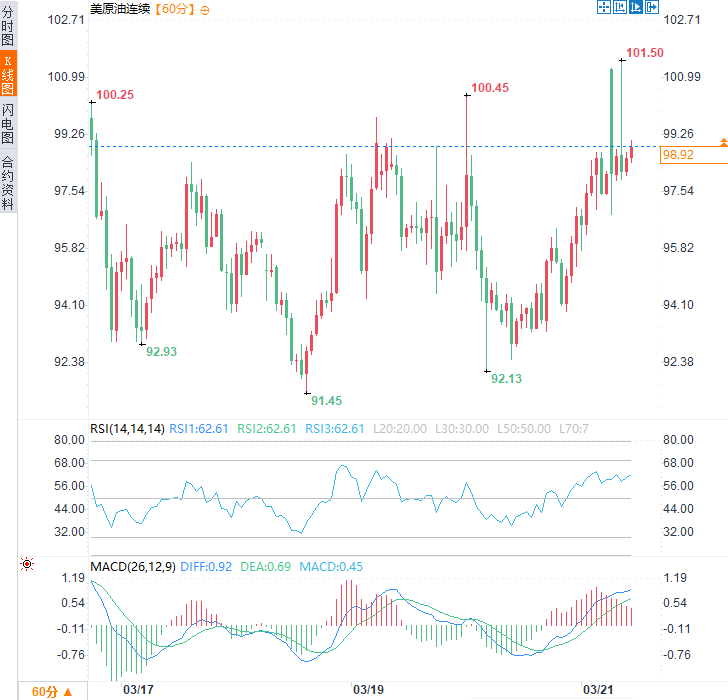
(US crude oil hourly chart, source: FX678)
At 10:48 Beijing time, US crude oil futures were trading at $98.88 per barrel.
Birol emphasized that the IEA will act based on actual supply gaps and market pressures, but will not set a specific crude oil price as a threshold to trigger the next release, in order to maintain the flexibility and forward-looking nature of its decision-making.
On Monday during Asian trading hours, US crude oil prices initially rose and then fell back before fluctuating upwards. They are currently trading around $98.90 per barrel, up about 0.7% on the day. Earlier in the session, prices jumped 3% to $101.50 per barrel, a new high since March 16.
A record 400 million barrels of reserves were released on March 11.
On March 11, the 31 member countries of the IEA reached an agreement to release a record 400 million barrels of oil from the strategic petroleum reserve, the largest collective release in history, in response to the sharp rise in crude oil prices following the outbreak of the conflict with Iran.
Some of the released stock has entered the market, but with continued disruptions to shipping in the Strait of Hormuz, floating inventories at sea plummeting to 78 million barrels (an evaporation of 1.8 million barrels per day), supply pressures are intensifying, prompting the IEA to consider further intervention.
Birol: The current crisis is extremely serious
Birol described the Middle East crisis as "extremely serious," with its impact extending beyond mere energy supply disruptions.
He pointed out that this crisis not only involves the long-term uncertainty of the Strait of Hormuz, a vital waterway for about one-fifth of the world's oil transportation, but also includes structural damage such as the risk of mutual destruction of energy infrastructure between Iran and the Gulf countries and the long-term paralysis of Qatar's LNG production capacity, making its overall severity unprecedented.
The severity exceeds the combined impact of the two oil crises of the 1970s and the Russia-Ukraine gas crisis.
Birol stated bluntly that the current Middle East crisis is even more severe than the combined impact of the two oil crises of the 1970s (the 1973 Arab oil embargo and the 1979 Iranian Revolution) and the Russia-Ukraine conflict on the natural gas market.
The crises of the 1970s were mainly characterized by supply disruptions and soaring prices, while the Russia-Ukraine conflict focused on European natural gas. This crisis threatens both the oil and gas energy systems, impacting the depth and breadth of the global supply chain, and the recovery period may take several years.
The key to solving this problem lies in opening the Strait of Hormuz.
Birol emphasized that the "key" to solving the current energy crisis lies in the full and sustainable opening of the Strait of Hormuz, ensuring the normal passage of about one-fifth of the world's seaborne oil.
Although Iran has stated that the Strait of Hormuz is not blocked, it is implementing a "conditional opening" and "necessary measures." US and Israeli vessels are excluded, and non-hostile vessels require prior coordination, significantly restricting actual freedom of navigation. If the Strait cannot return to a state of non-threat, the release of IEA reserves can only provide a short-term buffer and is unlikely to reverse the structural shortage.
Editor's Summary
International Energy Agency (IEA) Executive Director Fatih Birol issued an urgent statement on Monday, characterizing the current Middle East crisis as "extremely serious," exceeding the combined severity of the two oil crises of the 1970s and the Russia-Ukraine gas crisis. The IEA is negotiating with Asian and European countries to release more strategic reserves as needed. A record 400 million barrels were released on March 11, but given the continued obstruction of the Strait of Hormuz, the risk of mutual destruction of Iranian energy facilities, and the daily evaporation of 1.8 million barrels from offshore storage, this reserve release is only a short-term buffer.
Birol clearly stated that the core of resolving the crisis lies in fully opening the Strait of Hormuz and ensuring the restoration of normal operations for one-fifth of global oil shipments. Currently, Iran's "conditional opening" rule and the potential US island-seizure plan make the future of the strait highly uncertain. The global energy market is facing the dual challenges of structural shortages and persistently high oil prices, and central bank policies, inflation expectations, and economic growth will all be under unprecedented pressure.
(US crude oil hourly chart, source: FX678)
At 10:48 Beijing time, US crude oil futures were trading at $98.88 per barrel.
- Risk Warning and Disclaimer
- The market involves risk, and trading may not be suitable for all investors. This article is for reference only and does not constitute personal investment advice, nor does it take into account certain users’ specific investment objectives, financial situation, or other needs. Any investment decisions made based on this information are at your own risk.