With three parties working together to mediate, will the US and Iran be able to sit down at the negotiating table on Thursday? Oil prices fall by more than 5%.
2026-03-25 09:42:10
Mediators from Turkey, Egypt, and Pakistan are intensifying efforts to arrange a meeting between U.S. and Iranian officials before Thursday (March 26) to push for an end to the Middle East conflict. However, significant differences remain between the two sides, and Iran has not yet formally approved face-to-face talks in Islamabad.
Influenced by expectations of mediation efforts by the other party, US crude oil prices fluctuated downwards during the Asian trading session on Wednesday, currently trading around $87.50 per barrel, down about 5.2% from Tuesday's settlement price.
The current conflict has entered its fourth week, disrupting shipping in the Strait of Hormuz and keeping oil prices generally high. While mediation efforts indicate that diplomatic channels remain active, a trust deficit and internal power restructuring have made the prospects for negotiations highly uncertain.
Arab and American officials revealed that Turkey, Egypt, and Pakistan had conveyed messages to both sides over the past two days. The foreign ministers of the three countries held separate talks with US White House Special Envoy Steve Witkov and Iranian Foreign Minister Abbas Araqchi.
The mediators hope to facilitate a direct or indirect meeting as soon as possible to discuss ending the war and resolving outstanding issues such as the nuclear issue and regional security. A US source said the mediation is "making progress," but Iran is highly suspicious of the US and fears another military strike during negotiations.
US President Trump said on Tuesday that the Iranian leadership is facing negotiating pressure. "Nobody knows who to talk to, but we are talking to the right people, and they are very eager to make a deal." He specifically emphasized that Iran recently agreed not to "possess nuclear weapons" and said the two sides reached "significant consensus" on several key points.
Trump had previously announced a five-day pause in strikes against Iranian energy facilities and stated that an agreement would be reached soon if negotiations continued to yield results.
However, Iranian officials continue to deny that substantive negotiations are taking place , accusing the media of leaks and the United States of undermining trust through past actions.
Informed officials revealed that Iran harbors a deep distrust of the Trump administration, citing two attacks launched by the U.S. during high-level diplomatic exchanges. After consolidating power within the regime, the Islamic Revolutionary Guard Corps (IRGC) has presented a series of tough demands, including the closure of all U.S. military bases in the Gulf region, a halt to attacks on Hezbollah in Lebanon, and full compensation for damages caused by the conflict.
A U.S. official bluntly called these demands "absurd and unrealistic." The Iranian Revolutionary Guard emphasized that a "new order" must be established, and it would not easily concede otherwise. This further complicates the mediation efforts to bridge the differences .
U.S. War Secretary Peter Hegses stated at a White House event that the United States will continue to "negotiate with bombs" in its military action against Iran. He emphasized that the U.S. military is "unbound" on the Iran issue and will continue to wield this leverage as much as possible, as needed.
This statement highlights the US strategy of "using pressure to force talks": military action and diplomatic efforts are proceeding in parallel, and negotiations will not rely solely on media or indirect channels. The White House also stated that Operation Epic Fury will continue and will not be altered by media coverage.
In the short term, whether a meeting can be arranged before Thursday will be a key point of observation. If mediation is successful and substantive dialogue is initiated, regional tensions are expected to ease, and oil prices will face downward pressure. Conversely, if Iran insists on its hardline demands or the United States continues military pressure, the conflict may be prolonged, further pushing up global energy prices and inflation risks.
The consolidation of power within the Iranian Revolutionary Guard and the chaotic state of the Iranian regime have increased uncertainty in negotiations. Investors need to closely monitor subsequent statements from Trump, progress of the mediators, and oil price movements; geopolitical risks will remain the dominant factor in the market.
Türkiye, Egypt, and Pakistan, among other mediators, are pushing hard for a meeting between the US and Iran before Thursday, but the two sides remain far apart on core issues such as nuclear issues, military bases, and reparations.
Trump optimistically claimed that there was a "major consensus," while the Iranian Revolutionary Guard made tough demands such as closing US military bases, and US War Secretary Hergese clearly used military pressure as leverage in negotiations.
Overall, while diplomatic efforts are underway, the lack of trust and power restructuring make breakthroughs extremely difficult, the risk of continued conflict remains high, and uncertainty in the global energy market will remain high.
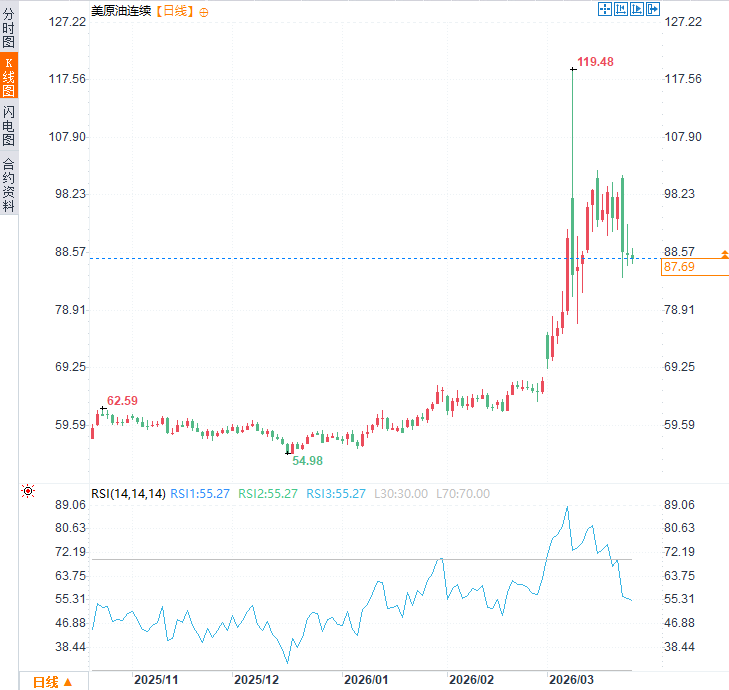
(US crude oil daily chart, source: FX678)
At 9:41 AM Beijing time, US crude oil futures were trading at $87.79 per barrel.
Influenced by expectations of mediation efforts by the other party, US crude oil prices fluctuated downwards during the Asian trading session on Wednesday, currently trading around $87.50 per barrel, down about 5.2% from Tuesday's settlement price.
The current conflict has entered its fourth week, disrupting shipping in the Strait of Hormuz and keeping oil prices generally high. While mediation efforts indicate that diplomatic channels remain active, a trust deficit and internal power restructuring have made the prospects for negotiations highly uncertain.
The mediators facilitated the meeting.
Arab and American officials revealed that Turkey, Egypt, and Pakistan had conveyed messages to both sides over the past two days. The foreign ministers of the three countries held separate talks with US White House Special Envoy Steve Witkov and Iranian Foreign Minister Abbas Araqchi.
The mediators hope to facilitate a direct or indirect meeting as soon as possible to discuss ending the war and resolving outstanding issues such as the nuclear issue and regional security. A US source said the mediation is "making progress," but Iran is highly suspicious of the US and fears another military strike during negotiations.
Trump expressed optimism
US President Trump said on Tuesday that the Iranian leadership is facing negotiating pressure. "Nobody knows who to talk to, but we are talking to the right people, and they are very eager to make a deal." He specifically emphasized that Iran recently agreed not to "possess nuclear weapons" and said the two sides reached "significant consensus" on several key points.
Trump had previously announced a five-day pause in strikes against Iranian energy facilities and stated that an agreement would be reached soon if negotiations continued to yield results.
However, Iranian officials continue to deny that substantive negotiations are taking place , accusing the media of leaks and the United States of undermining trust through past actions.
Iran's hardline stance and the Revolutionary Guard's demands
Informed officials revealed that Iran harbors a deep distrust of the Trump administration, citing two attacks launched by the U.S. during high-level diplomatic exchanges. After consolidating power within the regime, the Islamic Revolutionary Guard Corps (IRGC) has presented a series of tough demands, including the closure of all U.S. military bases in the Gulf region, a halt to attacks on Hezbollah in Lebanon, and full compensation for damages caused by the conflict.
A U.S. official bluntly called these demands "absurd and unrealistic." The Iranian Revolutionary Guard emphasized that a "new order" must be established, and it would not easily concede otherwise. This further complicates the mediation efforts to bridge the differences .
U.S. War Secretary Hergese made a statement
U.S. War Secretary Peter Hegses stated at a White House event that the United States will continue to "negotiate with bombs" in its military action against Iran. He emphasized that the U.S. military is "unbound" on the Iran issue and will continue to wield this leverage as much as possible, as needed.
This statement highlights the US strategy of "using pressure to force talks": military action and diplomatic efforts are proceeding in parallel, and negotiations will not rely solely on media or indirect channels. The White House also stated that Operation Epic Fury will continue and will not be altered by media coverage.
Market Outlook and Risks
In the short term, whether a meeting can be arranged before Thursday will be a key point of observation. If mediation is successful and substantive dialogue is initiated, regional tensions are expected to ease, and oil prices will face downward pressure. Conversely, if Iran insists on its hardline demands or the United States continues military pressure, the conflict may be prolonged, further pushing up global energy prices and inflation risks.
The consolidation of power within the Iranian Revolutionary Guard and the chaotic state of the Iranian regime have increased uncertainty in negotiations. Investors need to closely monitor subsequent statements from Trump, progress of the mediators, and oil price movements; geopolitical risks will remain the dominant factor in the market.
Editor's Summary
Türkiye, Egypt, and Pakistan, among other mediators, are pushing hard for a meeting between the US and Iran before Thursday, but the two sides remain far apart on core issues such as nuclear issues, military bases, and reparations.
Trump optimistically claimed that there was a "major consensus," while the Iranian Revolutionary Guard made tough demands such as closing US military bases, and US War Secretary Hergese clearly used military pressure as leverage in negotiations.
Overall, while diplomatic efforts are underway, the lack of trust and power restructuring make breakthroughs extremely difficult, the risk of continued conflict remains high, and uncertainty in the global energy market will remain high.
(US crude oil daily chart, source: FX678)
At 9:41 AM Beijing time, US crude oil futures were trading at $87.79 per barrel.
- Risk Warning and Disclaimer
- The market involves risk, and trading may not be suitable for all investors. This article is for reference only and does not constitute personal investment advice, nor does it take into account certain users’ specific investment objectives, financial situation, or other needs. Any investment decisions made based on this information are at your own risk.