The Cuban president confirmed that revolutionary veterans are leading the US-Cuba dialogue; can it break the deadlock under Trump's blockade?
2026-03-26 11:25:50
Cuban President Miguel Díaz-Canel said on Wednesday (March 25) that former leader Raúl Castro is involved in the dialogue process between Cuba and the United States, and that the dialogue is still in its early stages. This statement comes amid escalating tensions between the US and Cuba, as Cuba suffers a severe energy crisis and has experienced several widespread power outages across the country.
The dialogue is being conducted through a collective leadership mechanism, as the Cuban government attempts to find diplomatic space under pressure from the Trump administration's hardline policies while simultaneously addressing domestic power shortages and socioeconomic difficulties.
In a video interview with Spanish left-wing leader Pablo Iglesias, Miguel Díaz-Canel revealed that Raúl Castro, as a historical leader of the revolution, continues to guide the dialogue process alongside the current leadership, despite having stepped down from specific positions. He emphasized, "Raúl Castro is a historical leader of the revolution, possessing prestige bestowed upon him by the people—a historical recognition that no one can deny."
Raul Castro spearheaded negotiations with the Obama administration in 2014 to restore diplomatic relations and reopen embassies between the two countries. This early dialogue is seen as a continuation of a similar process, but faces a more complex geopolitical environment.
Cuba is currently facing a severe energy shortage. The collapse of the national power grid has led to numerous widespread blackouts, severely impacting the lives of millions. For the past three months, Cuba has received no fuel shipments, power outages have become the norm, and economic and social activities are nearing paralysis.
The UN coordinator in Cuba, Francisco Pijon, warned that the crisis would worsen rapidly if fuel reserves ran out, potentially leading to loss of life. He appealed for an emergency fuel supply and suggested developing solar power to keep schools and hospitals running.
The Trump administration increased pressure on Cuba to change its political model by imposing an oil blockade and threatening tariffs on any country supplying oil to Cuba. Trump has publicly stated that he would be "honored to take over Cuba" and push for changes to the island nation's political system.
Although initial threats softened, the blockade remained in effect, leading to a severe energy shortage in Cuba. The Trump administration's explicit opposition to Obama's policy of détente with Cuba, further tightening sanctions, exacerbated the domestic crisis in Cuba.
Díaz-Canel emphasized that dialogue is a long process that requires first establishing channels of communication, then developing an agenda of shared interests, and demonstrating a willingness to move forward. Currently, the dialogue is still in its early stages and is being conducted under the collective leadership of the Cuban government.
UN officials have called for a swift solution to alleviate the humanitarian crisis. Cuba stated that any agreement must be based on mutual benefit and respect for sovereignty, and that the Trump administration's hardline stance presents significant challenges to the negotiations.
In the short term, progress in the US-Cuba dialogue could alleviate Cuba's energy crisis and gradually restore normal power supply; however, if the Trump administration continues to exert pressure or the blockade persists, the risks of power outages and social unrest will further increase.
In the medium to long term, the outcome of the dialogue will profoundly impact the geopolitical landscape of the Caribbean and Cuba's economic recovery. Investors need to pay attention to oil price trends, fuel supply dynamics, and subsequent statements from both sides, as the energy crisis and humanitarian risks remain the main uncertainties. During Thursday's Asian trading session, US crude oil prices fluctuated upwards, currently trading around $91.80 per barrel, with a daily increase of approximately 1.65%.
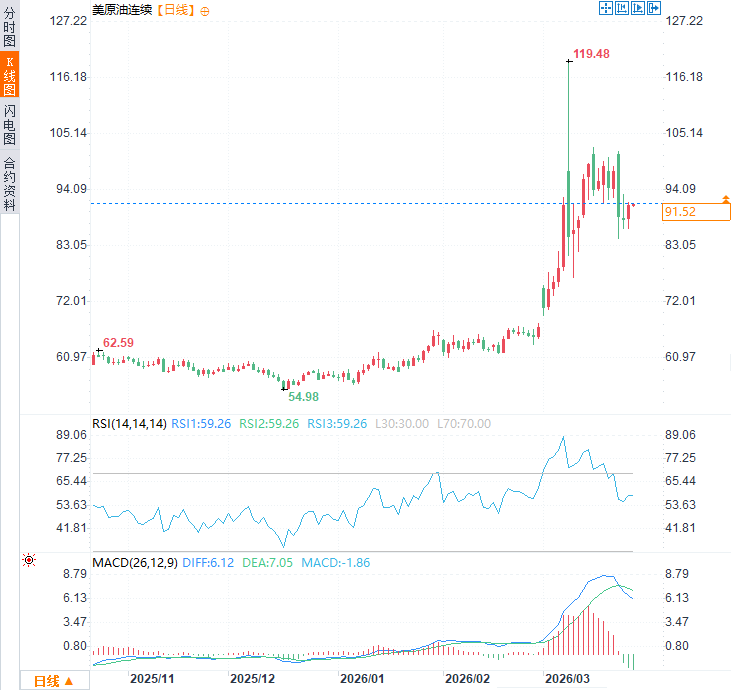
(US crude oil daily chart, source: FX678)
Cuban President Miguel Díaz-Canel confirmed Raúl Castro's participation in the early dialogue between the US and Cuba, but emphasized that the process is still in its initial stages and faces the dual challenges of the Trump administration's oil blockade and pressure for political change.
Cuba is suffering from a severe energy crisis, with multiple nationwide blackouts severely impacting its economy and social life. The United Nations is calling for urgent fuel and solar energy solutions.
Overall, with escalating tensions in US-Cuba relations, the prospects for dialogue are fraught with uncertainty, Cuba's energy crisis is unlikely to ease in the short term, and its impact on regional stability and the global energy market warrants continued attention.
At 11:24 Beijing time, US crude oil futures were trading at $91.84 per barrel.
The dialogue is being conducted through a collective leadership mechanism, as the Cuban government attempts to find diplomatic space under pressure from the Trump administration's hardline policies while simultaneously addressing domestic power shortages and socioeconomic difficulties.
Historical revolutionary leaders participate in dialogue
In a video interview with Spanish left-wing leader Pablo Iglesias, Miguel Díaz-Canel revealed that Raúl Castro, as a historical leader of the revolution, continues to guide the dialogue process alongside the current leadership, despite having stepped down from specific positions. He emphasized, "Raúl Castro is a historical leader of the revolution, possessing prestige bestowed upon him by the people—a historical recognition that no one can deny."
Raul Castro spearheaded negotiations with the Obama administration in 2014 to restore diplomatic relations and reopen embassies between the two countries. This early dialogue is seen as a continuation of a similar process, but faces a more complex geopolitical environment.
Current Status of Cuba's Energy Crisis
Cuba is currently facing a severe energy shortage. The collapse of the national power grid has led to numerous widespread blackouts, severely impacting the lives of millions. For the past three months, Cuba has received no fuel shipments, power outages have become the norm, and economic and social activities are nearing paralysis.
The UN coordinator in Cuba, Francisco Pijon, warned that the crisis would worsen rapidly if fuel reserves ran out, potentially leading to loss of life. He appealed for an emergency fuel supply and suggested developing solar power to keep schools and hospitals running.
Trump administration policy pressure
The Trump administration increased pressure on Cuba to change its political model by imposing an oil blockade and threatening tariffs on any country supplying oil to Cuba. Trump has publicly stated that he would be "honored to take over Cuba" and push for changes to the island nation's political system.
Although initial threats softened, the blockade remained in effect, leading to a severe energy shortage in Cuba. The Trump administration's explicit opposition to Obama's policy of détente with Cuba, further tightening sanctions, exacerbated the domestic crisis in Cuba.
Dialogue Process and Prospects
Díaz-Canel emphasized that dialogue is a long process that requires first establishing channels of communication, then developing an agenda of shared interests, and demonstrating a willingness to move forward. Currently, the dialogue is still in its early stages and is being conducted under the collective leadership of the Cuban government.
UN officials have called for a swift solution to alleviate the humanitarian crisis. Cuba stated that any agreement must be based on mutual benefit and respect for sovereignty, and that the Trump administration's hardline stance presents significant challenges to the negotiations.
Market Outlook and Risks
In the short term, progress in the US-Cuba dialogue could alleviate Cuba's energy crisis and gradually restore normal power supply; however, if the Trump administration continues to exert pressure or the blockade persists, the risks of power outages and social unrest will further increase.
In the medium to long term, the outcome of the dialogue will profoundly impact the geopolitical landscape of the Caribbean and Cuba's economic recovery. Investors need to pay attention to oil price trends, fuel supply dynamics, and subsequent statements from both sides, as the energy crisis and humanitarian risks remain the main uncertainties. During Thursday's Asian trading session, US crude oil prices fluctuated upwards, currently trading around $91.80 per barrel, with a daily increase of approximately 1.65%.
(US crude oil daily chart, source: FX678)
Editor's Summary
Cuban President Miguel Díaz-Canel confirmed Raúl Castro's participation in the early dialogue between the US and Cuba, but emphasized that the process is still in its initial stages and faces the dual challenges of the Trump administration's oil blockade and pressure for political change.
Cuba is suffering from a severe energy crisis, with multiple nationwide blackouts severely impacting its economy and social life. The United Nations is calling for urgent fuel and solar energy solutions.
Overall, with escalating tensions in US-Cuba relations, the prospects for dialogue are fraught with uncertainty, Cuba's energy crisis is unlikely to ease in the short term, and its impact on regional stability and the global energy market warrants continued attention.
At 11:24 Beijing time, US crude oil futures were trading at $91.84 per barrel.
- Risk Warning and Disclaimer
- The market involves risk, and trading may not be suitable for all investors. This article is for reference only and does not constitute personal investment advice, nor does it take into account certain users’ specific investment objectives, financial situation, or other needs. Any investment decisions made based on this information are at your own risk.