The dollar index fell, coupled with uncertainty about the Japanese economic outlook, leading to a correction in the USD/JPY exchange rate.
2026-04-01 10:18:55
On Wednesday during Asian trading hours, the USD/JPY pair rebounded slightly from near a one-week low, but remained weak overall, fluctuating below 159.00 . The market is currently in a wait-and-see mode, primarily pricing in developments in the Middle East and upcoming key US economic data.
US President Trump stated that the US will gradually end its military operations against Iran over the next two to three weeks, emphasizing that it can withdraw from the conflict even without an agreement. This statement strengthened market expectations for easing geopolitical tensions and boosted global risk sentiment. The decline in safe-haven demand directly weakened the dollar's attractiveness, which is one of the key reasons for the recent pressure on the dollar.

Against this backdrop, the yen received some support. The Bank of Japan's Tankan survey showed that the business sentiment index for large manufacturers rose to 17 , marking the fourth consecutive quarter of improvement and reaching its highest level since December 2021. This data reflects a recovery in Japanese business confidence, providing fundamental support for the yen.
However, the market has not fully shifted to a bullish stance on the yen. On one hand, Bank of Japan officials pointed out that the survey did not fully reflect the impact of the Middle East conflict; on the other hand, Japan is highly dependent on energy imports from the Middle East, and disruptions to shipping through the Strait of Hormuz would have a significant impact on the economy. Energy risks pose a potential pressure on the Japanese economy , thus limiting the yen's appreciation potential.
Furthermore, reports of the UAE launching military operations to restore passage through the Strait of Hormuz have further increased the possibility of escalation. This has caused the market to fluctuate between "risk easing" and "potential escalation," resulting in a lack of clear direction for the exchange rate.
It is worth noting that the market widely expects Japanese authorities to intervene in the foreign exchange market if necessary to stabilize the yen, which to some extent has limited the upside potential of the USD/JPY exchange rate. Expectations of policy intervention have become a significant downward pressure .
From a technical perspective, the USD/JPY pair is currently consolidating at high levels on the daily chart. The price has repeatedly encountered resistance in the 159-160 area, indicating strong selling pressure above. Initial support has formed around 158.00 ; a break below this level could lead to a further test of the 156 area. Momentum indicators suggest the upward trend is slowing, with the MACD gradually converging and the RSI falling back into neutral territory, indicating weakening bullish momentum.
From a 4-hour chart perspective, the short-term trend shows a weak rebound structure. Although the price has rebounded from the low, it has failed to effectively hold above 159, indicating insufficient buying momentum. The moving average system is trending flat, and the MACD is oscillating around the zero line, reflecting a balance between bullish and bearish forces. If the price fails to break through the 159.50 resistance level in the short term, it may fall back to test the 158 support level; conversely, if it breaks through, it may open up upward potential.
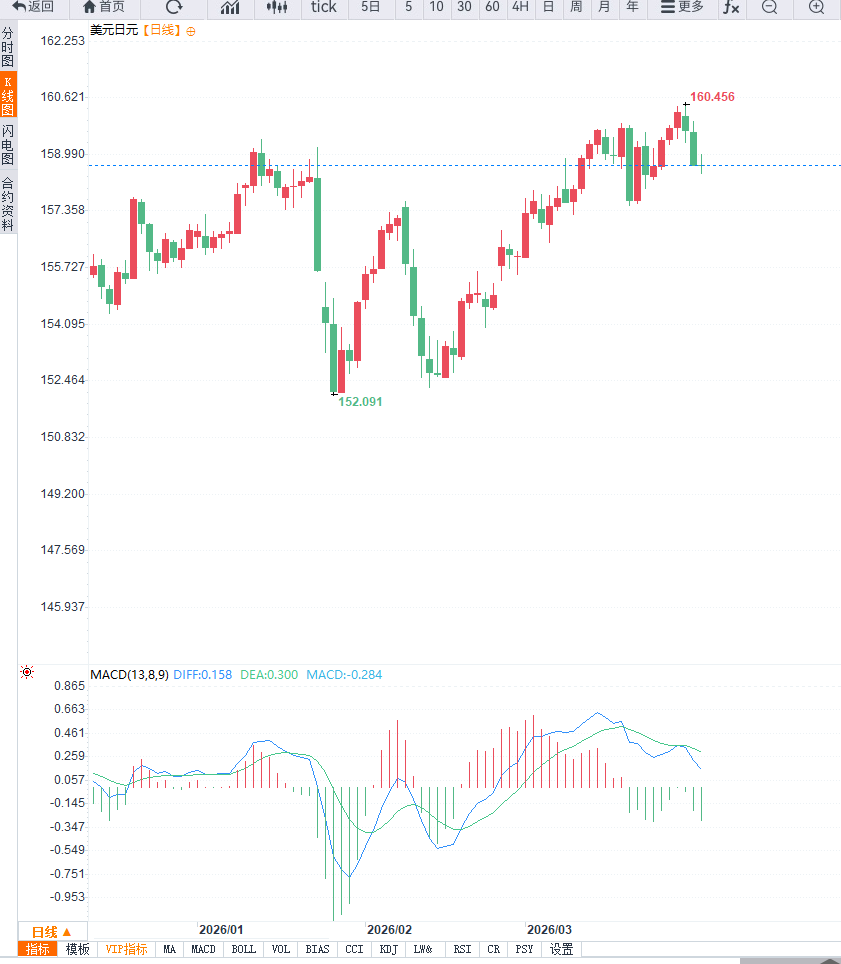
Overall, USD/JPY is currently in a structure of "fundamental divergence + technical fluctuations" , and its short-term direction depends on new catalysts.
Editor's Summary : The current USD/JPY exchange rate is influenced by a confluence of factors. On the one hand, easing tensions in the Middle East have reduced demand for the dollar as a safe haven; on the other hand, Japanese economic data is supporting the yen, but energy risks and policy uncertainties limit its appreciation potential. Meanwhile, upcoming US economic data could be a key catalyst for short-term direction. Overall, the exchange rate is likely to remain volatile in the short term, requiring close attention to geopolitical developments and macroeconomic data.
US President Trump stated that the US will gradually end its military operations against Iran over the next two to three weeks, emphasizing that it can withdraw from the conflict even without an agreement. This statement strengthened market expectations for easing geopolitical tensions and boosted global risk sentiment. The decline in safe-haven demand directly weakened the dollar's attractiveness, which is one of the key reasons for the recent pressure on the dollar.
Against this backdrop, the yen received some support. The Bank of Japan's Tankan survey showed that the business sentiment index for large manufacturers rose to 17 , marking the fourth consecutive quarter of improvement and reaching its highest level since December 2021. This data reflects a recovery in Japanese business confidence, providing fundamental support for the yen.
However, the market has not fully shifted to a bullish stance on the yen. On one hand, Bank of Japan officials pointed out that the survey did not fully reflect the impact of the Middle East conflict; on the other hand, Japan is highly dependent on energy imports from the Middle East, and disruptions to shipping through the Strait of Hormuz would have a significant impact on the economy. Energy risks pose a potential pressure on the Japanese economy , thus limiting the yen's appreciation potential.
Furthermore, reports of the UAE launching military operations to restore passage through the Strait of Hormuz have further increased the possibility of escalation. This has caused the market to fluctuate between "risk easing" and "potential escalation," resulting in a lack of clear direction for the exchange rate.
It is worth noting that the market widely expects Japanese authorities to intervene in the foreign exchange market if necessary to stabilize the yen, which to some extent has limited the upside potential of the USD/JPY exchange rate. Expectations of policy intervention have become a significant downward pressure .
From a technical perspective, the USD/JPY pair is currently consolidating at high levels on the daily chart. The price has repeatedly encountered resistance in the 159-160 area, indicating strong selling pressure above. Initial support has formed around 158.00 ; a break below this level could lead to a further test of the 156 area. Momentum indicators suggest the upward trend is slowing, with the MACD gradually converging and the RSI falling back into neutral territory, indicating weakening bullish momentum.
From a 4-hour chart perspective, the short-term trend shows a weak rebound structure. Although the price has rebounded from the low, it has failed to effectively hold above 159, indicating insufficient buying momentum. The moving average system is trending flat, and the MACD is oscillating around the zero line, reflecting a balance between bullish and bearish forces. If the price fails to break through the 159.50 resistance level in the short term, it may fall back to test the 158 support level; conversely, if it breaks through, it may open up upward potential.
Overall, USD/JPY is currently in a structure of "fundamental divergence + technical fluctuations" , and its short-term direction depends on new catalysts.
Editor's Summary : The current USD/JPY exchange rate is influenced by a confluence of factors. On the one hand, easing tensions in the Middle East have reduced demand for the dollar as a safe haven; on the other hand, Japanese economic data is supporting the yen, but energy risks and policy uncertainties limit its appreciation potential. Meanwhile, upcoming US economic data could be a key catalyst for short-term direction. Overall, the exchange rate is likely to remain volatile in the short term, requiring close attention to geopolitical developments and macroeconomic data.
- Risk Warning and Disclaimer
- The market involves risk, and trading may not be suitable for all investors. This article is for reference only and does not constitute personal investment advice, nor does it take into account certain users’ specific investment objectives, financial situation, or other needs. Any investment decisions made based on this information are at your own risk.