The expectation of easing tensions in the Middle East weighed on the US dollar, and coupled with falling oil prices, the USD/CAD exchange rate fluctuated and declined.
2026-04-01 15:04:01
On Wednesday, the market as a whole showed a recovery in risk appetite but remained cautious, with the US dollar index weakening slightly while the Canadian dollar remained relatively strong. The core factor driving this change was the expectation of easing tensions in the Middle East. US President Trump stated that the US could end its military action against Iran within two to three weeks and hinted at withdrawing from the conflict even without an agreement, while also believing that the Strait of Hormuz would reopen to traffic after the US withdrawal. This statement increased market expectations of a de-escalation of the conflict, leading to a decline in risk aversion and thus putting pressure on the US dollar.

However, market reaction remained generally cautious. Despite expectations of easing tensions, the conflict is not truly over. The US continues to strike Iranian targets, while the regional situation remains complex, including missile threats from Yemen and the possibility of the UAE launching military action to restore shipping lanes. This multifaceted uncertainty has kept markets cautious despite a rise in risk appetite, as the geopolitical situation remains prone to recurrence .
For the Canadian dollar, oil price movements have become a key variable. As a major crude oil exporter, Canada's economy is highly correlated with oil prices. However, oil prices have recently fallen for two consecutive days, with US WTI crude oil falling by nearly 5% and dropping below the $100 mark again. This change has weakened the fundamental support for the Canadian dollar, making it difficult for it to form a strong upward trend. The decline in oil prices has significantly dragged down the Canadian dollar .
From a macroeconomic perspective, the market is focused on the upcoming Canadian manufacturing PMI data to assess changes in economic momentum. Meanwhile, the US will release ADP employment data, retail sales, and the ISM manufacturing PMI. These data will provide forward guidance for the upcoming non-farm payroll report and directly influence market expectations regarding the Federal Reserve's policy path.
In the current environment, the interplay between the US dollar and the Canadian dollar mainly revolves around two themes: first, the impact of geopolitical changes on risk sentiment; and second, the direct influence of oil price trends on the Canadian dollar. The US dollar is under pressure due to decreased safe-haven demand, but falling oil prices limit the Canadian dollar's strength, resulting in overall exchange rate volatility.
From a technical perspective, the USD/CAD pair is consolidating on the daily chart. After retreating from previous highs, the pair has entered a range-bound trading pattern. Resistance is around 1.3700 , while support lies at 1.3550 . The MACD momentum is gradually converging, and the RSI has fallen back to the neutral zone, indicating weakening trend momentum.
From a 4-hour chart perspective, the short-term trend is weak and volatile, with prices fluctuating repeatedly within a range, and the moving average system tending to flatten. The MACD is oscillating around the zero line, indicating a balance between bullish and bearish forces. If the exchange rate breaks below the 1.3550 support level, it may further decline to 1.3500; conversely, if it rebounds above 1.3700, it may resume upward momentum.
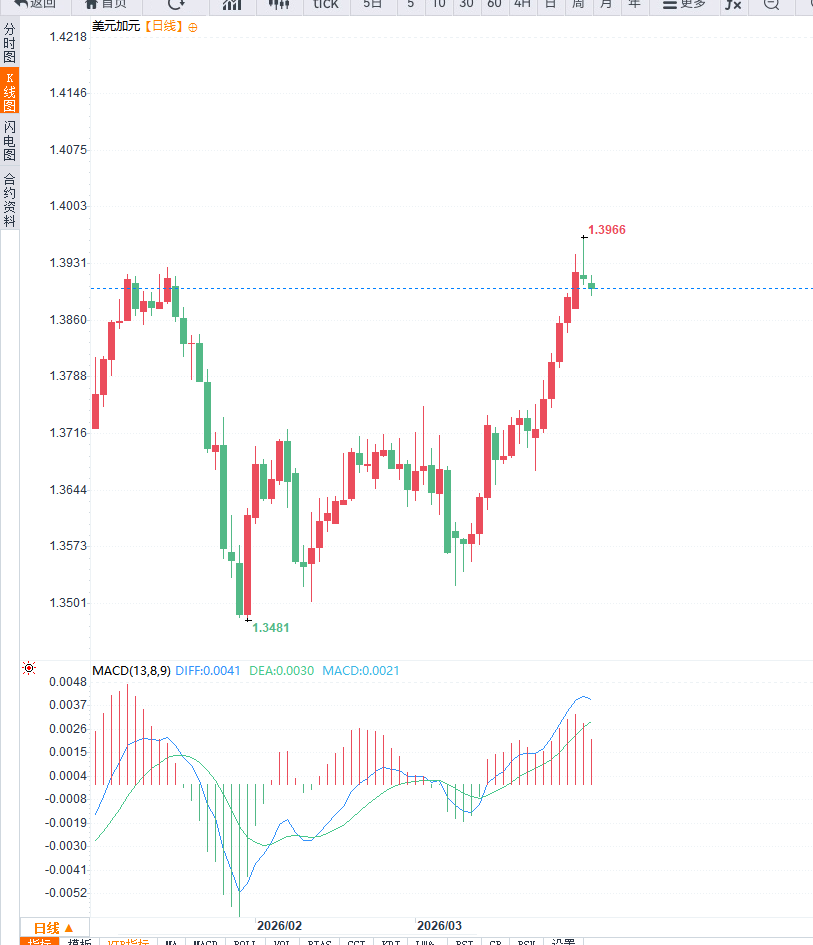
Overall, the USD/CAD pair is in a fluctuating pattern characterized by a weakening US dollar and pressure from oil prices , with its short-term direction depending on new catalysts.
Editor's Summary : The current market is caught between expectations of easing geopolitical tensions and actual uncertainties. The US dollar has weakened due to reduced safe-haven demand, but the Canadian dollar is struggling to stage a strong rebound due to falling oil prices. This balancing act keeps the exchange rate in a volatile pattern. Future trends will depend on the actual developments in the Middle East, oil price fluctuations, and US economic data. Investors should pay close attention to key events and exercise caution when making directional judgments.
However, market reaction remained generally cautious. Despite expectations of easing tensions, the conflict is not truly over. The US continues to strike Iranian targets, while the regional situation remains complex, including missile threats from Yemen and the possibility of the UAE launching military action to restore shipping lanes. This multifaceted uncertainty has kept markets cautious despite a rise in risk appetite, as the geopolitical situation remains prone to recurrence .
For the Canadian dollar, oil price movements have become a key variable. As a major crude oil exporter, Canada's economy is highly correlated with oil prices. However, oil prices have recently fallen for two consecutive days, with US WTI crude oil falling by nearly 5% and dropping below the $100 mark again. This change has weakened the fundamental support for the Canadian dollar, making it difficult for it to form a strong upward trend. The decline in oil prices has significantly dragged down the Canadian dollar .
From a macroeconomic perspective, the market is focused on the upcoming Canadian manufacturing PMI data to assess changes in economic momentum. Meanwhile, the US will release ADP employment data, retail sales, and the ISM manufacturing PMI. These data will provide forward guidance for the upcoming non-farm payroll report and directly influence market expectations regarding the Federal Reserve's policy path.
In the current environment, the interplay between the US dollar and the Canadian dollar mainly revolves around two themes: first, the impact of geopolitical changes on risk sentiment; and second, the direct influence of oil price trends on the Canadian dollar. The US dollar is under pressure due to decreased safe-haven demand, but falling oil prices limit the Canadian dollar's strength, resulting in overall exchange rate volatility.
From a technical perspective, the USD/CAD pair is consolidating on the daily chart. After retreating from previous highs, the pair has entered a range-bound trading pattern. Resistance is around 1.3700 , while support lies at 1.3550 . The MACD momentum is gradually converging, and the RSI has fallen back to the neutral zone, indicating weakening trend momentum.
From a 4-hour chart perspective, the short-term trend is weak and volatile, with prices fluctuating repeatedly within a range, and the moving average system tending to flatten. The MACD is oscillating around the zero line, indicating a balance between bullish and bearish forces. If the exchange rate breaks below the 1.3550 support level, it may further decline to 1.3500; conversely, if it rebounds above 1.3700, it may resume upward momentum.
Overall, the USD/CAD pair is in a fluctuating pattern characterized by a weakening US dollar and pressure from oil prices , with its short-term direction depending on new catalysts.
Editor's Summary : The current market is caught between expectations of easing geopolitical tensions and actual uncertainties. The US dollar has weakened due to reduced safe-haven demand, but the Canadian dollar is struggling to stage a strong rebound due to falling oil prices. This balancing act keeps the exchange rate in a volatile pattern. Future trends will depend on the actual developments in the Middle East, oil price fluctuations, and US economic data. Investors should pay close attention to key events and exercise caution when making directional judgments.
- Risk Warning and Disclaimer
- The market involves risk, and trading may not be suitable for all investors. This article is for reference only and does not constitute personal investment advice, nor does it take into account certain users’ specific investment objectives, financial situation, or other needs. Any investment decisions made based on this information are at your own risk.