Trump's failure to commit to guaranteeing passage through the Strait of Hormuz provides short-term support for the dollar's strength due to geopolitical risks.
2026-04-02 10:18:26
According to APP, Carol Kong, an economist and currency strategist at the Commonwealth Bank of Australia, stated that it appears Trump has failed to assure the market that the conflict will de-escalate from now on, nor has he committed to US assistance in securing passage through the Strait of Hormuz . The reality is that US military assets continue to accumulate in the region, and the possibility of a ground offensive remains, meaning the US dollar will continue to be supported in the short term.
Carol Kong recently further pointed out that the conflict doesn't look like it will end anytime soon, and as long as it continues, the US dollar will reign supreme. If the conflict drags on, oil prices will continue to rise, further pushing up the dollar index, especially putting pressure on currencies of net energy importers such as the euro and the yen. She emphasized that although Trump has extended the suspension of strikes against Iranian energy facilities until April, diplomatic negotiations have made limited progress, significant differences remain between the two sides, and the damage to energy infrastructure makes it difficult for supplies to quickly return to pre-war levels.
The latest data shows that the Strait of Hormuz, a vital waterway for approximately 20% of global oil and liquefied natural gas transport, has seen its passage restricted, directly driving up energy prices. Brent crude futures have recently fluctuated around $105 per barrel, a significant increase of about 50% from pre-conflict levels of around $70 per barrel, while WTI crude has also remained above $100 per barrel. The presence of US military assets in the Gulf region has not significantly diminished, and related reinforcement options are still under evaluation. While the potential for ground operations is not a mainstream expectation, it still constitutes a factor of market uncertainty.
This geopolitical risk premium directly translates into the safe-haven appeal of the US dollar . The latest US Dollar Index (DXY) hovers around 99.8, having slightly retreated from its previous high, but remains strong overall, benefiting from investors' safe-haven demand driven by concerns about energy inflation and global growth. In contrast, currencies of net energy importers face greater pressure, with the euro and yen both experiencing varying degrees of stress.
To visually demonstrate the impact of conflict on key metrics, the following is a comparison of data before and after the conflict:
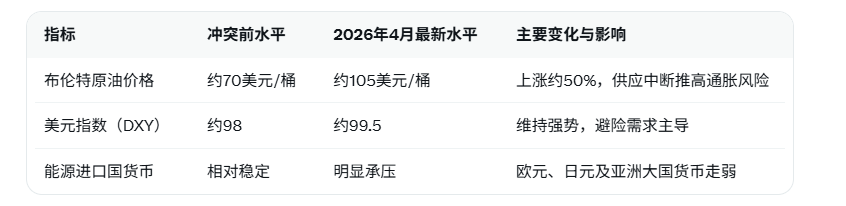
Carol Kong 's analysis is logically sound: in the short term, unless there are clear and comprehensive signs of de-escalation—including the complete restoration of normal navigation in the Strait of Hormuz —geopolitical premiums will continue to support the US dollar . The market is currently closely watching Trump's latest statements on Iran; if military buildup or diplomatic stalemate continues, upward pressure on oil prices and the strong dollar are expected to intensify further.
Editor's Summary : Geopolitical uncertainty remains one of the dominant factors in the current financial markets. The combination of the US military presence in the region and obstructed energy routes is continuously strengthening the safe-haven status of the US dollar. The transmission effects of high energy prices on global inflation and monetary policy deserve continued monitoring. Investors need to pay attention to the pace of conflict evolution and the policy responses of major economies to grasp short-term exchange rate and commodity trends.
Carol Kong recently further pointed out that the conflict doesn't look like it will end anytime soon, and as long as it continues, the US dollar will reign supreme. If the conflict drags on, oil prices will continue to rise, further pushing up the dollar index, especially putting pressure on currencies of net energy importers such as the euro and the yen. She emphasized that although Trump has extended the suspension of strikes against Iranian energy facilities until April, diplomatic negotiations have made limited progress, significant differences remain between the two sides, and the damage to energy infrastructure makes it difficult for supplies to quickly return to pre-war levels.
The latest data shows that the Strait of Hormuz, a vital waterway for approximately 20% of global oil and liquefied natural gas transport, has seen its passage restricted, directly driving up energy prices. Brent crude futures have recently fluctuated around $105 per barrel, a significant increase of about 50% from pre-conflict levels of around $70 per barrel, while WTI crude has also remained above $100 per barrel. The presence of US military assets in the Gulf region has not significantly diminished, and related reinforcement options are still under evaluation. While the potential for ground operations is not a mainstream expectation, it still constitutes a factor of market uncertainty.
This geopolitical risk premium directly translates into the safe-haven appeal of the US dollar . The latest US Dollar Index (DXY) hovers around 99.8, having slightly retreated from its previous high, but remains strong overall, benefiting from investors' safe-haven demand driven by concerns about energy inflation and global growth. In contrast, currencies of net energy importers face greater pressure, with the euro and yen both experiencing varying degrees of stress.
To visually demonstrate the impact of conflict on key metrics, the following is a comparison of data before and after the conflict:
Carol Kong 's analysis is logically sound: in the short term, unless there are clear and comprehensive signs of de-escalation—including the complete restoration of normal navigation in the Strait of Hormuz —geopolitical premiums will continue to support the US dollar . The market is currently closely watching Trump's latest statements on Iran; if military buildup or diplomatic stalemate continues, upward pressure on oil prices and the strong dollar are expected to intensify further.
Editor's Summary : Geopolitical uncertainty remains one of the dominant factors in the current financial markets. The combination of the US military presence in the region and obstructed energy routes is continuously strengthening the safe-haven status of the US dollar. The transmission effects of high energy prices on global inflation and monetary policy deserve continued monitoring. Investors need to pay attention to the pace of conflict evolution and the policy responses of major economies to grasp short-term exchange rate and commodity trends.
- Risk Warning and Disclaimer
- The market involves risk, and trading may not be suitable for all investors. This article is for reference only and does not constitute personal investment advice, nor does it take into account certain users’ specific investment objectives, financial situation, or other needs. Any investment decisions made based on this information are at your own risk.