Non-farm payrolls surge by 178,000, triggering a rally in the US dollar and Japanese yen, pushing them close to the 160 mark and prompting Japan to sound intervention alarms.
2026-04-03 21:05:26
U.S. nonfarm payrolls surged by 178,000 in March, far exceeding market expectations of 65,000 and completely reversing the negative job growth trend of the previous month, marking the highest increase since December 2024.
Meanwhile, the unemployment rate fell to 4.3%, also better than expected; the average hourly wage growth slowed to 0.2% month-on-month. The combination of strong employment and moderate wages constitutes the Fed's ideal "Goldilocks" economic scenario, which not only demonstrates the resilience of the US economy but also avoids further inflationary pressures.
Strong non-farm payroll data provided solid fundamental support for the US dollar, coupled with a surge in safe-haven buying, causing the dollar index to rise by about 0.1% on Friday, marking its second consecutive day of gains and maintaining its strength against a basket of global currencies.

Amid thin trading in the foreign exchange market due to the Good Friday holiday, the yen weakened against a basket of major and minor currencies in Asian trading on Friday. The dollar fell for the third consecutive trading day, rising 0.1% to 159.72 against the yen.
Japan's core inflation rate slowed in Tokyo in March, becoming the latest signal of easing inflationary pressures. Market expectations for a 25 basis point rate hike at the Bank of Japan's April meeting were lowered from 25% to 15%, with expectations for a rate hike cooling significantly.
Investors are awaiting key economic data from Japan, including inflation, unemployment, and wages, to further assess the Bank of Japan's forward guidance at its April 28 policy meeting. Uncertainty surrounding the monetary policy outlook continues to weigh on the yen's performance.
Faced with the continued depreciation of the yen, Japanese Finance Minister Satsuki Katayama has repeatedly warned foreign exchange traders, pointing out that speculative activities in the foreign exchange and crude oil futures markets have increased significantly, market volatility has risen sharply, and the weakening yen has had a substantial impact on people's livelihoods and the Japanese domestic economy.
She reiterated that the Japanese government is prepared to take comprehensive measures at all levels and does not rule out taking "decisive" intervention in the foreign exchange market to maintain market stability.
Affected by the situation in the Middle East, the US dollar rose above the 160 yen mark against the Japanese yen in late March, reaching a rare high since July 2024. The last time Japan intervened in the foreign exchange market was in July 2024 when the yen fell to a near 38-year low.
As geopolitical conflicts in the Middle East continue to escalate, US President Trump has made tough statements on the Iranian issue, warning of increased military action in the next two to three weeks. Iran has responded strongly, and the geopolitical risks are constantly increasing the demand for the US dollar as a safe haven.
While senior officials at the Bank of Japan have stated that they will continue raising interest rates if economic forecasts meet expectations, thus reinforcing the policy tightening trend, Executive Director Koji Nakamura also pointed out that rising oil prices, while suppressing economic growth, may also push up long-term inflation expectations. This dual impact makes the central bank's decision-making more cautious.
Amid a confluence of negative factors, the yen continues to face pressure against the dollar, and its short-term weakness is unlikely to reverse.
From a technical perspective, the USD/JPY pair has maintained its upward trend and remains in a healthy bullish formation, supported by the middle line of the dotted upward channel and the psychological level of 159.
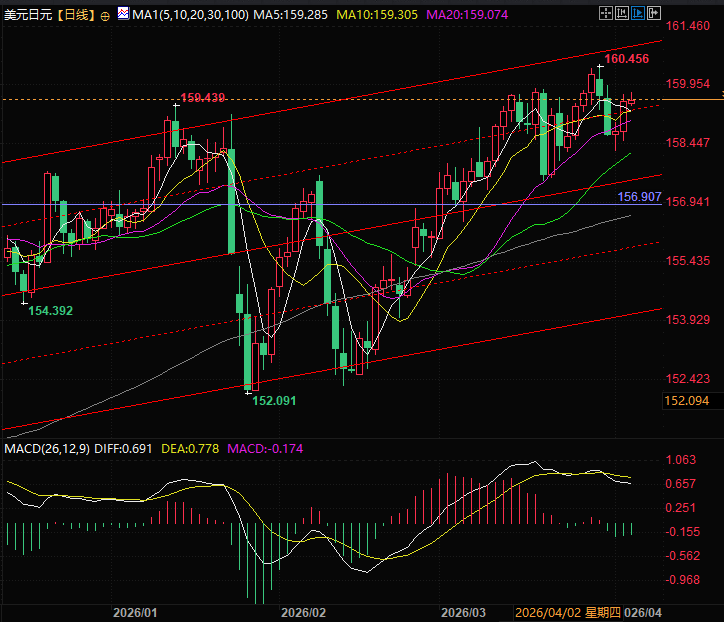
(USD/JPY daily chart, source: EasyForex)
At 21:01 Beijing time, the USD/JPY exchange rate is currently at 159.59/60.
Meanwhile, the unemployment rate fell to 4.3%, also better than expected; the average hourly wage growth slowed to 0.2% month-on-month. The combination of strong employment and moderate wages constitutes the Fed's ideal "Goldilocks" economic scenario, which not only demonstrates the resilience of the US economy but also avoids further inflationary pressures.
Strong non-farm payroll data provided solid fundamental support for the US dollar, coupled with a surge in safe-haven buying, causing the dollar index to rise by about 0.1% on Friday, marking its second consecutive day of gains and maintaining its strength against a basket of global currencies.
The yen weakened across the board, significantly cooling expectations for a Bank of Japan interest rate hike.
Amid thin trading in the foreign exchange market due to the Good Friday holiday, the yen weakened against a basket of major and minor currencies in Asian trading on Friday. The dollar fell for the third consecutive trading day, rising 0.1% to 159.72 against the yen.
Japan's core inflation rate slowed in Tokyo in March, becoming the latest signal of easing inflationary pressures. Market expectations for a 25 basis point rate hike at the Bank of Japan's April meeting were lowered from 25% to 15%, with expectations for a rate hike cooling significantly.
Investors are awaiting key economic data from Japan, including inflation, unemployment, and wages, to further assess the Bank of Japan's forward guidance at its April 28 policy meeting. Uncertainty surrounding the monetary policy outlook continues to weigh on the yen's performance.
Japanese authorities have repeatedly warned of rising expectations of currency intervention.
Faced with the continued depreciation of the yen, Japanese Finance Minister Satsuki Katayama has repeatedly warned foreign exchange traders, pointing out that speculative activities in the foreign exchange and crude oil futures markets have increased significantly, market volatility has risen sharply, and the weakening yen has had a substantial impact on people's livelihoods and the Japanese domestic economy.
She reiterated that the Japanese government is prepared to take comprehensive measures at all levels and does not rule out taking "decisive" intervention in the foreign exchange market to maintain market stability.
Affected by the situation in the Middle East, the US dollar rose above the 160 yen mark against the Japanese yen in late March, reaching a rare high since July 2024. The last time Japan intervened in the foreign exchange market was in July 2024 when the yen fell to a near 38-year low.
Summary and Technical Analysis:
As geopolitical conflicts in the Middle East continue to escalate, US President Trump has made tough statements on the Iranian issue, warning of increased military action in the next two to three weeks. Iran has responded strongly, and the geopolitical risks are constantly increasing the demand for the US dollar as a safe haven.
While senior officials at the Bank of Japan have stated that they will continue raising interest rates if economic forecasts meet expectations, thus reinforcing the policy tightening trend, Executive Director Koji Nakamura also pointed out that rising oil prices, while suppressing economic growth, may also push up long-term inflation expectations. This dual impact makes the central bank's decision-making more cautious.
Amid a confluence of negative factors, the yen continues to face pressure against the dollar, and its short-term weakness is unlikely to reverse.
From a technical perspective, the USD/JPY pair has maintained its upward trend and remains in a healthy bullish formation, supported by the middle line of the dotted upward channel and the psychological level of 159.
(USD/JPY daily chart, source: EasyForex)
At 21:01 Beijing time, the USD/JPY exchange rate is currently at 159.59/60.
- Risk Warning and Disclaimer
- The market involves risk, and trading may not be suitable for all investors. This article is for reference only and does not constitute personal investment advice, nor does it take into account certain users’ specific investment objectives, financial situation, or other needs. Any investment decisions made based on this information are at your own risk.