High oil prices are supporting a stronger Canadian dollar, and the USD/CAD pair is expected to strengthen further.
2026-04-07 11:29:51
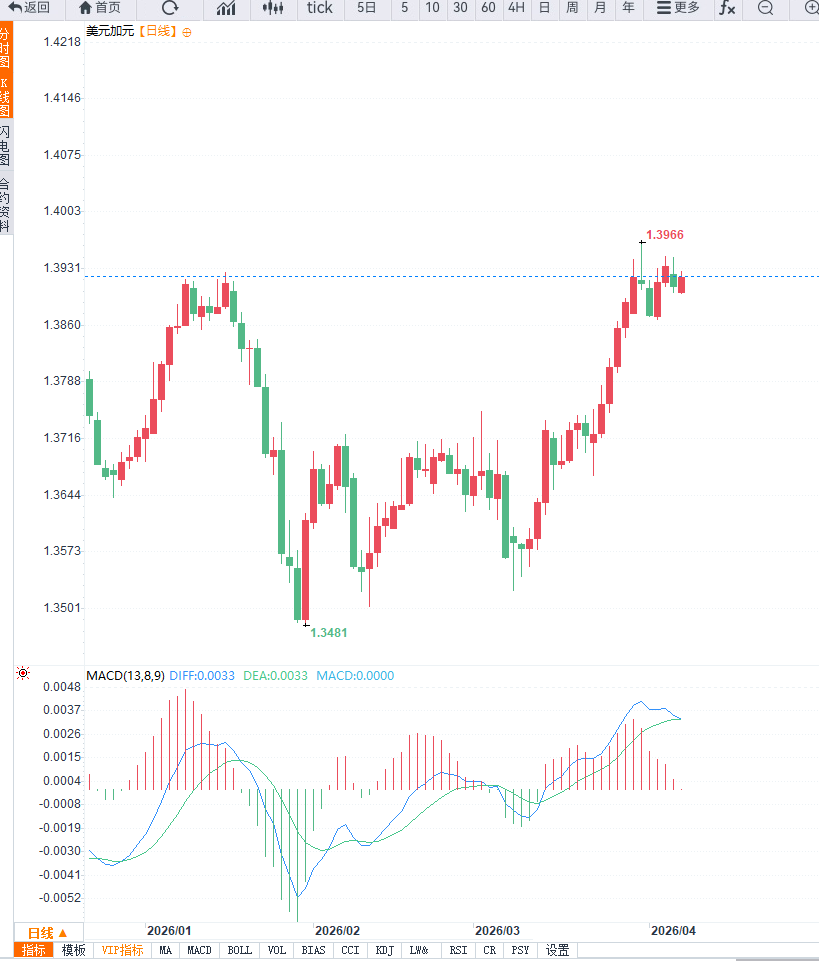
During Tuesday's Asian session, USD/CAD rebounded to around 1.3930 , a technical bounce after the previous day's decline. Overall, the exchange rate remains within a trading range, with its direction influenced by multiple fundamental factors.
From a macroeconomic perspective, the ongoing tensions in the Middle East are a significant factor driving the strengthening of the US dollar. The situation surrounding the Strait of Hormuz remains unresolved, with US President Donald Trump stating that the current ceasefire proposal is "not enough" and hinting at possible further action. This uncertainty is fueling risk aversion in the market, enhancing the attractiveness of the US dollar, and thus providing upward pressure on the USD/CAD exchange rate.
However, slightly weak US economic data exerted some downward pressure on the dollar. According to data released by the Institute for Supply Management (ISM), the March services PMI fell to 54.0 , below market expectations, indicating a slowdown in economic expansion. This data limited the dollar's gains to some extent, preventing a stronger breakout.
Meanwhile, the Canadian dollar was supported by rising oil prices. As a major global energy exporter, Canada's economy is highly correlated with crude oil prices. Currently, WTI crude oil prices remain high, with market concerns about supply disruptions keeping prices firm. This provides support for the Canadian dollar, thus putting downward pressure on USD/CAD.
Furthermore, signals from Iran indicating a potential intensification of attacks on energy infrastructure have fueled market expectations of further tightening of global energy supplies. Against this backdrop, rising oil prices not only impact the energy market but also transmit to the currency market through trade structures, resulting in a relatively strong Canadian dollar.
From a technical perspective, on the daily chart, USD/CAD remains within an overall upward channel, but the current price is approaching previous highs and faces some resistance. Key resistance is at the psychological level of 1.4000 , with further resistance at 1.4050 . Support is at 1.3850 , with further support at 1.3780 . The moving average system indicates a still bullish medium-term trend, but short-term momentum has weakened.
On the 4-hour chart, the exchange rate is exhibiting a range-bound structure, fluctuating repeatedly between 1.3850 and 1.4000. Short-term moving averages are flat, and the RSI is in neutral territory, indicating a lack of clear market direction. A break above 1.4000 could open up further upside potential; a break below 1.3850 could trigger a pullback.
Editor's Summary:
The current USD/CAD exchange rate exhibits a typical bullish-bearish hedging pattern. On one hand, the Middle East situation is boosting safe-haven demand, supporting a stronger US dollar; on the other hand, rising oil prices are bolstering the Canadian dollar, limiting the exchange rate's upside potential. In the short term, lacking clear catalysts, USD/CAD is more likely to maintain a range-bound trading pattern. Going forward, key attention should be paid to geopolitical developments and oil price changes, as these will be crucial variables determining the exchange rate's direction.
From a macroeconomic perspective, the ongoing tensions in the Middle East are a significant factor driving the strengthening of the US dollar. The situation surrounding the Strait of Hormuz remains unresolved, with US President Donald Trump stating that the current ceasefire proposal is "not enough" and hinting at possible further action. This uncertainty is fueling risk aversion in the market, enhancing the attractiveness of the US dollar, and thus providing upward pressure on the USD/CAD exchange rate.
However, slightly weak US economic data exerted some downward pressure on the dollar. According to data released by the Institute for Supply Management (ISM), the March services PMI fell to 54.0 , below market expectations, indicating a slowdown in economic expansion. This data limited the dollar's gains to some extent, preventing a stronger breakout.
Meanwhile, the Canadian dollar was supported by rising oil prices. As a major global energy exporter, Canada's economy is highly correlated with crude oil prices. Currently, WTI crude oil prices remain high, with market concerns about supply disruptions keeping prices firm. This provides support for the Canadian dollar, thus putting downward pressure on USD/CAD.
Furthermore, signals from Iran indicating a potential intensification of attacks on energy infrastructure have fueled market expectations of further tightening of global energy supplies. Against this backdrop, rising oil prices not only impact the energy market but also transmit to the currency market through trade structures, resulting in a relatively strong Canadian dollar.
From a technical perspective, on the daily chart, USD/CAD remains within an overall upward channel, but the current price is approaching previous highs and faces some resistance. Key resistance is at the psychological level of 1.4000 , with further resistance at 1.4050 . Support is at 1.3850 , with further support at 1.3780 . The moving average system indicates a still bullish medium-term trend, but short-term momentum has weakened.
On the 4-hour chart, the exchange rate is exhibiting a range-bound structure, fluctuating repeatedly between 1.3850 and 1.4000. Short-term moving averages are flat, and the RSI is in neutral territory, indicating a lack of clear market direction. A break above 1.4000 could open up further upside potential; a break below 1.3850 could trigger a pullback.
Editor's Summary:
The current USD/CAD exchange rate exhibits a typical bullish-bearish hedging pattern. On one hand, the Middle East situation is boosting safe-haven demand, supporting a stronger US dollar; on the other hand, rising oil prices are bolstering the Canadian dollar, limiting the exchange rate's upside potential. In the short term, lacking clear catalysts, USD/CAD is more likely to maintain a range-bound trading pattern. Going forward, key attention should be paid to geopolitical developments and oil price changes, as these will be crucial variables determining the exchange rate's direction.
- Risk Warning and Disclaimer
- The market involves risk, and trading may not be suitable for all investors. This article is for reference only and does not constitute personal investment advice, nor does it take into account certain users’ specific investment objectives, financial situation, or other needs. Any investment decisions made based on this information are at your own risk.