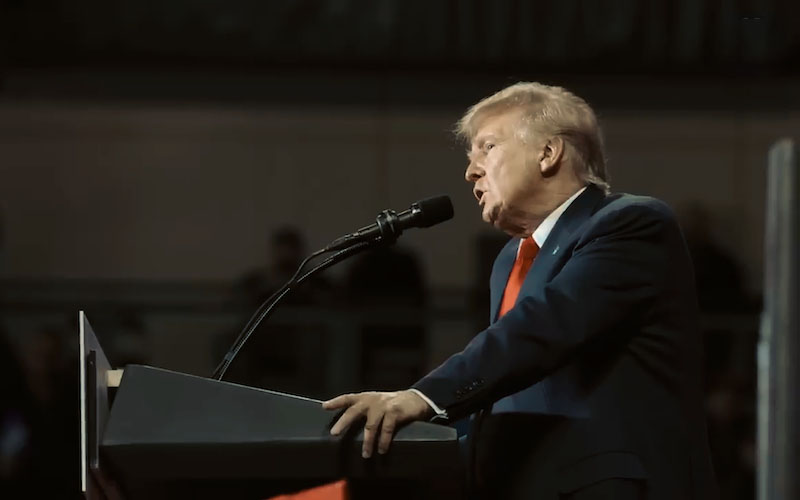
Trump's last-minute reversal: US and Iran reach two-week temporary ceasefire agreement, oil prices plummet and global markets tremble.
2026-04-08 08:55:01
As the six-week-long Middle East conflict reached its most critical moment, US President Trump suddenly announced an agreement to a two-week temporary ceasefire with Iran. This news quickly broke the tense atmosphere and put a pause on what could have been a further escalation of military confrontation. The agreement came less than two hours before Trump's deadline, marking a stunning reversal from hardline threats to diplomatic compromise and creating a buffer for subsequent formal negotiations in Islamabad, Pakistan.
On the evening of April 7 local time (early Wednesday morning Beijing time), US President Trump issued a statement via the social media platform Truth Social, clearly stating that he had agreed to a two-week bilateral ceasefire agreement with Iran . This decision came less than two hours before the deadline he had previously set for Tehran. Previously, Trump had issued a strong warning that if Iran did not reopen the Strait of Hormuz, its civilian infrastructure would face massive attacks, even implying that "the entire civilization will perish tonight."
Trump emphasized that the core condition of the agreement, brokered by Pakistan at the last minute, was Iran's agreement to suspend its blockade of oil and gas supply routes through the Strait of Hormuz. He wrote, "This will be a two-way ceasefire! This is because we have achieved and surpassed all military objectives and made significant progress on a final agreement on lasting peace with Iran and on peace in the Middle East." Trump also noted that Iran's 10-point proposal formed a "workable basis" for the negotiations and expected a final agreement to be finalized and completed during the two-week ceasefire period.
Iran reacted swiftly. Iranian state television issued a statement declaring that Trump had accepted Iran's ceasefire terms, describing it as a "humiliating concession" by the US president. Iran's Supreme National Security Council subsequently formally released the main contents of the 10 ceasefire terms submitted to the US through Pakistan, and the two sides planned to begin formal negotiations on Friday (April 10) in Islamabad, the capital of Pakistan.
The statement from Iran's Supreme National Security Council detailed the ceasefire terms, aimed at ending the conflict through diplomatic means and safeguarding Iran's core geopolitical and economic interests. Specifically, the key provisions include: controlled passage through the Strait of Hormuz, coordinated with the Iranian armed forces, to ensure the stability and security of this strategic waterway; an end to the war against all resistance forces in the region; a demand for the complete withdrawal of US combat troops from all bases and deployments in the region; the establishment of a safe passage agreement for the Strait of Hormuz, clearly defining Iran's dominant position; full compensation for the estimated losses suffered by Iran in the conflict; the lifting of all primary and secondary sanctions and the revocation of relevant resolutions of the International Atomic Energy Agency and the UN Security Council; the unfreezing of all frozen Iranian overseas assets and property; and finally, the adoption of a binding UN Security Council resolution approving all the above provisions, making them part of international law.
Iran stated that the ratification of this UN Security Council resolution would be a major diplomatic victory for it. Pakistan has confirmed to Iran that the US accepts the aforementioned principles as the basis for negotiations. These terms not only involve a military ceasefire but also touch upon deeper issues such as the lifting of sanctions, the unfreezing of assets, and regional security arrangements, demonstrating Iran's intention to reshape the geopolitical landscape of the Middle East through this agreement.
The situation deteriorated sharply before the agreement was reached. As Trump's deadline approached, US-Israeli military strikes against Iran escalated. Railway and highway bridges, an airport, and a petrochemical plant were attacked, and the US military also carried out a precision strike on Iran's main oil export terminal on Kharg Island. Iran swiftly responded, announcing it would no longer hesitate to strike the infrastructure of its Gulf neighbors and launched a new round of operations against a ship in the Gulf region and a large Saudi petrochemical facility. Witnesses in Doha, the capital of Qatar, reported hearing loud explosions late at night.
According to government sources and human rights organizations, the six-week-long war has claimed more than 5,000 lives in nearly 12 countries, including more than 1,600 civilians in Iran alone. The conflict has not only caused numerous casualties but has also severely damaged regional infrastructure and severely disrupted the global energy supply chain.
Meanwhile, domestic political pressure continues to build in the United States. Trump's approval rating has plummeted to a historic low, and with the midterm election campaign heating up, his Republican Party faces the risk of losing control of Congress. Multiple polls show that a majority of Americans oppose the war and are strongly dissatisfied with the resulting increase in gasoline prices.
The news of the ceasefire agreement quickly eased market concerns about the Middle East situation, triggering a significant reaction in financial markets. US crude oil prices plunged, falling by approximately 19.35% to a more than one-week low. Market concerns about inflation eased considerably, with the US dollar index hitting a two-week low, down about 0.82%. US stock index futures surged by over 2%, reaching a three-week high, and non-US currencies generally strengthened. Spot gold prices also rose by over 3%, briefly reaching a more than two-week high of $4865 per ounce.
Several international financial institutions and economists have provided in-depth analysis of this market upheaval. Some analysts point out that Trump's move clearly indicates that he is actively seeking an opportunity to extricate himself from the conflict with Iran, and that his previous series of tough statements are often strategic turning points before diplomatic negotiations, helping him to secure more favorable negotiating terms at the last minute.
Other experts emphasize that while this is the first substantial ceasefire since the start of hostilities, and the market may experience a degree of cautious optimism, investors must remain vigilant. The sustainability of the ceasefire agreement has not been fully validated, and the risk of renewed conflict could quickly arise if either side adopts a hardline stance in subsequent negotiations . The severe damage to infrastructure will require a lengthy repair process; even if the conflict eases in the short term, the full recovery of the global energy supply chain will take weeks or even months. Oil prices are unlikely to quickly fall back to pre-conflict lows in the short term, which will have a complex impact on global inflation trends and central bank monetary policies.
However, most market observers believe that this temporary ceasefire provides a valuable window of time for emergency replenishment of energy reserves, gradual mitigation of the economic impact, and initial stabilization of global supply chains. If the ceasefire can be successfully maintained and ultimately evolve into a lasting political solution, it will greatly contribute to the orderly recovery of oil and gas exports from the Gulf region, thereby effectively stabilizing international energy market supply, alleviating inflationary pressures caused by high energy prices, and injecting new momentum into global economic growth. The bond market subsequently strengthened, and the positive performance of the stock market further boosted investor confidence, demonstrating a positive response from the capital markets to the easing of tensions in the Middle East. However, in the long term, core issues such as the passage mechanism through the Strait of Hormuz, the actual implementation of sanctions lifting, and regional security arrangements will remain key variables determining market trends.
Despite the temporary ceasefire, the Iranian government continues to signal its intention to maintain control of the Strait of Hormuz. This strait, a vital global energy transport route, saw over 100 ships pass freely daily before the conflict. Iranian Foreign Minister Abbas Araghchi stated on social media platform X that, after a two-week period of coordination with the Iranian armed forces and full consideration of technical limitations, safe passage through the Strait of Hormuz would be possible.
In a separate statement, Iran's Supreme National Security Council reiterated that its peace agreement plan includes regulating passage through the Strait of Hormuz under the coordination of the Iranian armed forces, thereby granting Iran a unique economic and geopolitical status. Iranian officials have also recently stated their desire to perpetuate their influence over the strait and have proposed charging transit fees similar to those for the Suez Canal. Trump has repeatedly emphasized that the ceasefire agreement's maintenance depends on Iran reopening the strait.
The two-week ceasefire agreement reached between Trump and Iran has undoubtedly injected a glimmer of hope into the escalating tensions in the Middle East. This agreement not only temporarily halted further escalation of the conflict but also created conditions for both sides to resolve their core differences through negotiations. However, Iran's insistence on its dominance over the Strait of Hormuz, and the significant differences between the two sides on issues such as troop withdrawal, sanctions lifting, and reparations, mean that future negotiations in Islamabad will remain fraught with challenges.
Currently, global attention is focused on the formal negotiations scheduled to begin on Friday, and whether the ceasefire agreement can truly translate into a long-term, stable peace . Against the backdrop of complex global energy security and geopolitical maneuvering, this sudden diplomatic shift may only be a new starting point in the Middle East peace process, and its final outcome remains to be seen.
At 08:53 Beijing time, US crude oil is currently trading at $96.36 per barrel, and spot gold is currently trading at $4821.30 per ounce.
A dramatic agreement reached on the brink of crisis
On the evening of April 7 local time (early Wednesday morning Beijing time), US President Trump issued a statement via the social media platform Truth Social, clearly stating that he had agreed to a two-week bilateral ceasefire agreement with Iran . This decision came less than two hours before the deadline he had previously set for Tehran. Previously, Trump had issued a strong warning that if Iran did not reopen the Strait of Hormuz, its civilian infrastructure would face massive attacks, even implying that "the entire civilization will perish tonight."
Trump emphasized that the core condition of the agreement, brokered by Pakistan at the last minute, was Iran's agreement to suspend its blockade of oil and gas supply routes through the Strait of Hormuz. He wrote, "This will be a two-way ceasefire! This is because we have achieved and surpassed all military objectives and made significant progress on a final agreement on lasting peace with Iran and on peace in the Middle East." Trump also noted that Iran's 10-point proposal formed a "workable basis" for the negotiations and expected a final agreement to be finalized and completed during the two-week ceasefire period.
Iran reacted swiftly. Iranian state television issued a statement declaring that Trump had accepted Iran's ceasefire terms, describing it as a "humiliating concession" by the US president. Iran's Supreme National Security Council subsequently formally released the main contents of the 10 ceasefire terms submitted to the US through Pakistan, and the two sides planned to begin formal negotiations on Friday (April 10) in Islamabad, the capital of Pakistan.
The core content of Iran's 10 armistice terms
The statement from Iran's Supreme National Security Council detailed the ceasefire terms, aimed at ending the conflict through diplomatic means and safeguarding Iran's core geopolitical and economic interests. Specifically, the key provisions include: controlled passage through the Strait of Hormuz, coordinated with the Iranian armed forces, to ensure the stability and security of this strategic waterway; an end to the war against all resistance forces in the region; a demand for the complete withdrawal of US combat troops from all bases and deployments in the region; the establishment of a safe passage agreement for the Strait of Hormuz, clearly defining Iran's dominant position; full compensation for the estimated losses suffered by Iran in the conflict; the lifting of all primary and secondary sanctions and the revocation of relevant resolutions of the International Atomic Energy Agency and the UN Security Council; the unfreezing of all frozen Iranian overseas assets and property; and finally, the adoption of a binding UN Security Council resolution approving all the above provisions, making them part of international law.
Iran stated that the ratification of this UN Security Council resolution would be a major diplomatic victory for it. Pakistan has confirmed to Iran that the US accepts the aforementioned principles as the basis for negotiations. These terms not only involve a military ceasefire but also touch upon deeper issues such as the lifting of sanctions, the unfreezing of assets, and regional security arrangements, demonstrating Iran's intention to reshape the geopolitical landscape of the Middle East through this agreement.
Intense confrontation and heavy cost before the ceasefire
The situation deteriorated sharply before the agreement was reached. As Trump's deadline approached, US-Israeli military strikes against Iran escalated. Railway and highway bridges, an airport, and a petrochemical plant were attacked, and the US military also carried out a precision strike on Iran's main oil export terminal on Kharg Island. Iran swiftly responded, announcing it would no longer hesitate to strike the infrastructure of its Gulf neighbors and launched a new round of operations against a ship in the Gulf region and a large Saudi petrochemical facility. Witnesses in Doha, the capital of Qatar, reported hearing loud explosions late at night.
According to government sources and human rights organizations, the six-week-long war has claimed more than 5,000 lives in nearly 12 countries, including more than 1,600 civilians in Iran alone. The conflict has not only caused numerous casualties but has also severely damaged regional infrastructure and severely disrupted the global energy supply chain.
Meanwhile, domestic political pressure continues to build in the United States. Trump's approval rating has plummeted to a historic low, and with the midterm election campaign heating up, his Republican Party faces the risk of losing control of Congress. Multiple polls show that a majority of Americans oppose the war and are strongly dissatisfied with the resulting increase in gasoline prices.
Global markets experienced a sudden and dramatic fluctuation: oil prices plummeted, stock markets soared, the dollar fell, and gold prices surged.
The news of the ceasefire agreement quickly eased market concerns about the Middle East situation, triggering a significant reaction in financial markets. US crude oil prices plunged, falling by approximately 19.35% to a more than one-week low. Market concerns about inflation eased considerably, with the US dollar index hitting a two-week low, down about 0.82%. US stock index futures surged by over 2%, reaching a three-week high, and non-US currencies generally strengthened. Spot gold prices also rose by over 3%, briefly reaching a more than two-week high of $4865 per ounce.
Several international financial institutions and economists have provided in-depth analysis of this market upheaval. Some analysts point out that Trump's move clearly indicates that he is actively seeking an opportunity to extricate himself from the conflict with Iran, and that his previous series of tough statements are often strategic turning points before diplomatic negotiations, helping him to secure more favorable negotiating terms at the last minute.
Other experts emphasize that while this is the first substantial ceasefire since the start of hostilities, and the market may experience a degree of cautious optimism, investors must remain vigilant. The sustainability of the ceasefire agreement has not been fully validated, and the risk of renewed conflict could quickly arise if either side adopts a hardline stance in subsequent negotiations . The severe damage to infrastructure will require a lengthy repair process; even if the conflict eases in the short term, the full recovery of the global energy supply chain will take weeks or even months. Oil prices are unlikely to quickly fall back to pre-conflict lows in the short term, which will have a complex impact on global inflation trends and central bank monetary policies.
However, most market observers believe that this temporary ceasefire provides a valuable window of time for emergency replenishment of energy reserves, gradual mitigation of the economic impact, and initial stabilization of global supply chains. If the ceasefire can be successfully maintained and ultimately evolve into a lasting political solution, it will greatly contribute to the orderly recovery of oil and gas exports from the Gulf region, thereby effectively stabilizing international energy market supply, alleviating inflationary pressures caused by high energy prices, and injecting new momentum into global economic growth. The bond market subsequently strengthened, and the positive performance of the stock market further boosted investor confidence, demonstrating a positive response from the capital markets to the easing of tensions in the Middle East. However, in the long term, core issues such as the passage mechanism through the Strait of Hormuz, the actual implementation of sanctions lifting, and regional security arrangements will remain key variables determining market trends.
Iran's clear position on the Strait of Hormuz
Despite the temporary ceasefire, the Iranian government continues to signal its intention to maintain control of the Strait of Hormuz. This strait, a vital global energy transport route, saw over 100 ships pass freely daily before the conflict. Iranian Foreign Minister Abbas Araghchi stated on social media platform X that, after a two-week period of coordination with the Iranian armed forces and full consideration of technical limitations, safe passage through the Strait of Hormuz would be possible.
In a separate statement, Iran's Supreme National Security Council reiterated that its peace agreement plan includes regulating passage through the Strait of Hormuz under the coordination of the Iranian armed forces, thereby granting Iran a unique economic and geopolitical status. Iranian officials have also recently stated their desire to perpetuate their influence over the strait and have proposed charging transit fees similar to those for the Suez Canal. Trump has repeatedly emphasized that the ceasefire agreement's maintenance depends on Iran reopening the strait.
Conclusion: Fragile Peace and Unresolved Geopolitical Challenges
The two-week ceasefire agreement reached between Trump and Iran has undoubtedly injected a glimmer of hope into the escalating tensions in the Middle East. This agreement not only temporarily halted further escalation of the conflict but also created conditions for both sides to resolve their core differences through negotiations. However, Iran's insistence on its dominance over the Strait of Hormuz, and the significant differences between the two sides on issues such as troop withdrawal, sanctions lifting, and reparations, mean that future negotiations in Islamabad will remain fraught with challenges.
Currently, global attention is focused on the formal negotiations scheduled to begin on Friday, and whether the ceasefire agreement can truly translate into a long-term, stable peace . Against the backdrop of complex global energy security and geopolitical maneuvering, this sudden diplomatic shift may only be a new starting point in the Middle East peace process, and its final outcome remains to be seen.
At 08:53 Beijing time, US crude oil is currently trading at $96.36 per barrel, and spot gold is currently trading at $4821.30 per ounce.
- Risk Warning and Disclaimer
- The market involves risk, and trading may not be suitable for all investors. This article is for reference only and does not constitute personal investment advice, nor does it take into account certain users’ specific investment objectives, financial situation, or other needs. Any investment decisions made based on this information are at your own risk.