April 9th Financial Breakfast: The US-Iran temporary ceasefire took another turn on its first day, with the Strait of Hormuz closing again; gold prices rebounded to the $4700 mark, and oil prices rose by over 2%.
2026-04-09 07:30:36
On Thursday (April 9, Beijing time) in early Asian trading, spot gold was trading around $4,713 per ounce, and may test the $4,700 per ounce level during the day. Gold prices fell sharply after reaching above $4,850 per ounce on Wednesday. On the first day of the temporary ceasefire between the US and Iran, the Israeli military launched its largest airstrike against Hezbollah in Lebanon since the start of the conflict. Iran claimed that Hezbollah violated the ceasefire agreement, closed the Strait of Hormuz again, and threatened to take deterrent action against Israeli military targets. Affected by this, US crude oil rebounded by more than 2.5% after touching around $91 per barrel, and traded around $96.80 per barrel. Oil prices may continue to rise during the day.

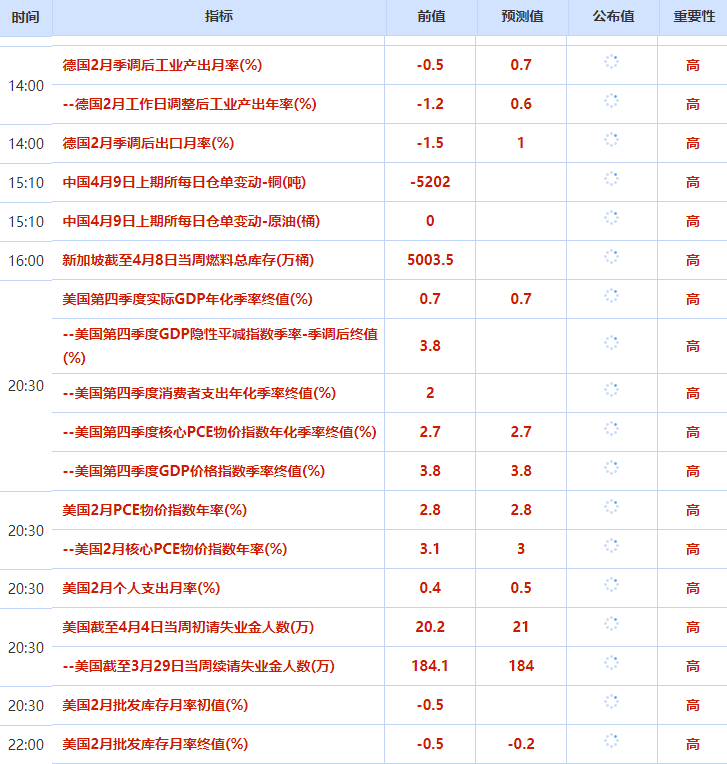
U.S. stocks closed sharply higher on Wednesday, boosted by positive news that the U.S. and Iran had reached a two-week ceasefire agreement and that the Strait of Hormuz was likely to reopen. The Dow Jones Industrial Average jumped 2.85%, the S&P 500 rose 2.51%, and the Nasdaq Composite jumped 2.80%. The S&P 500 broke through its 200-day moving average for the first time since mid-March, and the Dow Jones Industrial Average recorded its biggest one-day gain since April 9, 2025.
Investor sentiment improved significantly, with the CBOE Volatility Index, a measure of anxiety, falling to its lowest level since the outbreak of the conflict, and the economically sensitive transportation index hitting a record high. Chip stocks surged 6.3%, and the previously war-torn aviation, travel and leisure, and residential construction sectors rebounded strongly. However, energy stocks plunged 3.7% as crude oil futures fell below $100 a barrel.
The minutes of the Federal Reserve’s March meeting, released on the same day, showed that policymakers raised their 2026 inflation forecast due to the oil shock caused by the war and were open to raising interest rates.
Gold prices climbed to a near three-week high on Wednesday following news of a two-week ceasefire agreement between the US and Iran. Spot gold rose 0.8% to $4,740.42 per ounce, having earlier surged more than 3% to its highest level since March 19. US gold futures settled up 2% at $4,777.20.
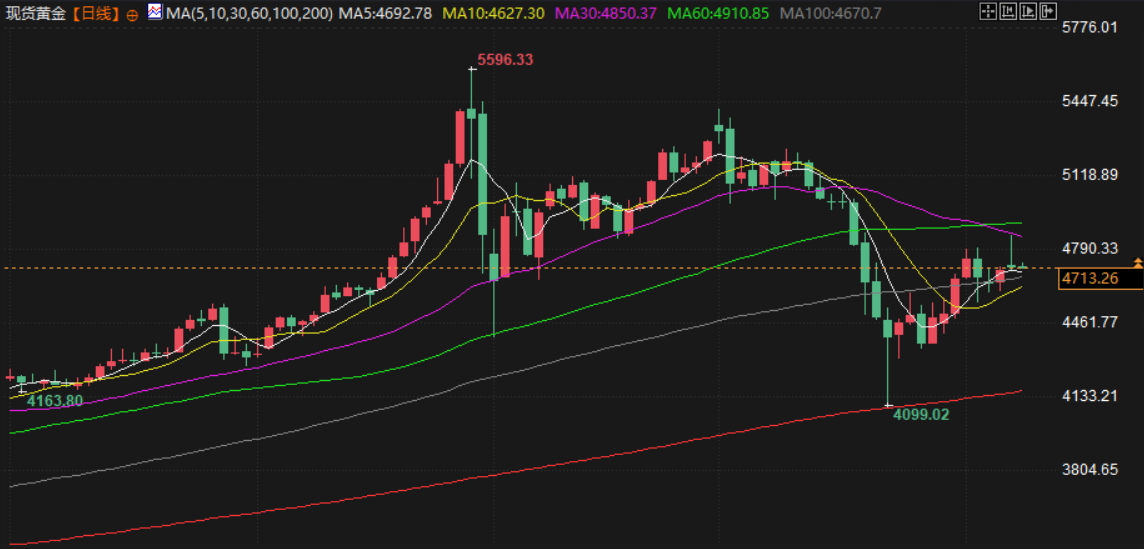
Analysts point out that the ceasefire helps alleviate inflationary pressures and may open the door for the Federal Reserve to cut interest rates, which is beneficial for gold. However, the situation remains fragile, and the recovery may be temporary. The ceasefire has caused the dollar to fall against a basket of currencies, further supporting gold prices. Since the start of the US-Israel war in Iraq on February 28, spot gold has fallen by 10%, as rising energy prices have exacerbated inflation concerns and weakened expectations of interest rate cuts.
The minutes of the Federal Reserve's March meeting, released on the same day, showed that a growing number of policymakers believe interest rate hikes may be necessary to address inflation that continues to exceed the 2% target. The U.S. Personal Consumption Expenditures Price Index and the Consumer Price Index will be released later this week.
In other precious metals, spot silver rose 3.3% to $75.35, platinum rose 5.3% to $2060.45, and palladium rose 7.6% to $1581.33.
International oil prices plummeted on Wednesday, with both WTI and Brent crude falling below the $100 per barrel mark: Brent crude futures plunged 13.29% to $94.75 per barrel, while WTI crude futures plunged 16.41% to $94.41 per barrel, influenced by the two-week ceasefire agreement reached between the US and Iran and expectations that the Strait of Hormuz might reopen.
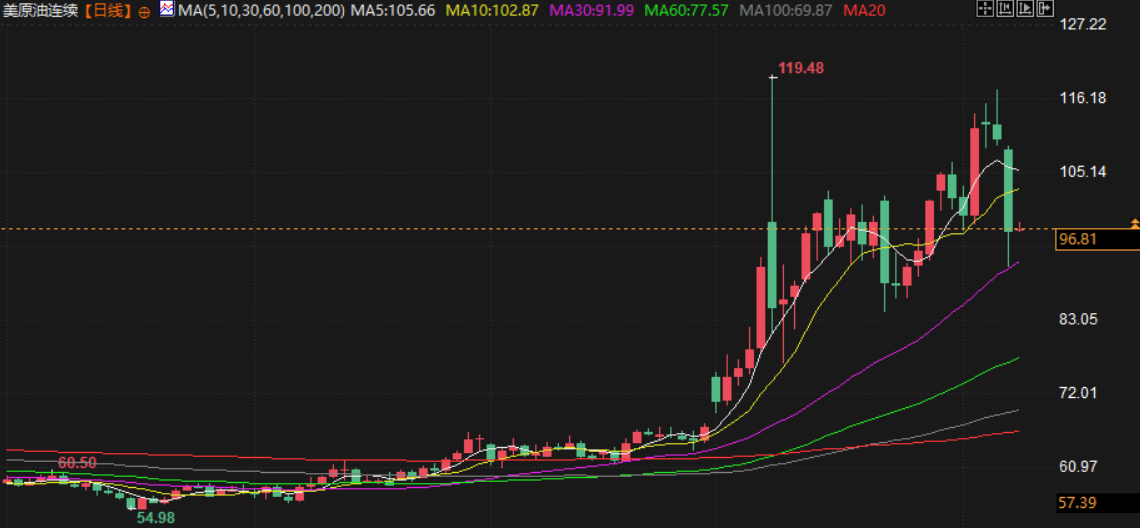
The market is hoping that the reopening of the Straits will allow pent-up energy supplies to flow through this narrow waterway, which carries approximately 20% of the world's daily oil supply. This comes after US President Trump changed his stance and agreed to a ceasefire before the deadline set by Iran. Iran stated it would open the Straits for two weeks if attacks ceased, and reportedly has proposed a ten-point peace plan.
However, the ceasefire agreement has been deemed very fragile, with the Iranian navy threatening on Wednesday that ships attempting to pass through the strait without permission would be destroyed, and the strait passage remains closed.
In addition, data from the U.S. Energy Information Administration showed that crude oil inventories increased by 3.1 million barrels to 464.7 million barrels last week, far exceeding the expected increase of 701,000 barrels.
The dollar touched a one-month low against a basket of major currencies on Wednesday, boosted by a relief rally in risk assets following a two-week ceasefire agreement between the US and Iran. However, it recovered some of its losses due to the fragility of the ceasefire, Iranian attacks on oil facilities in neighboring Gulf countries, and Israel's escalation of attacks on Lebanon. The dollar index closed at 99.077, up 0.16%.
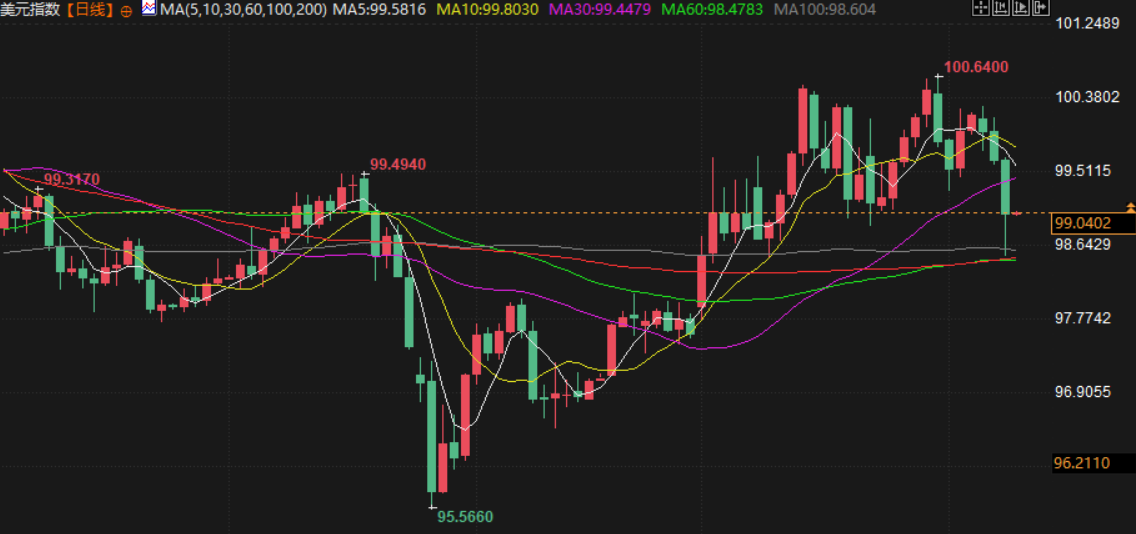
The euro rose 0.54% to $1.1696, the pound rose 0.78% to $1.3395, and the dollar fell 0.6% to 158.675 yen.
Analysts point out that the US dollar was one of the main beneficiaries of the Iran war because the US, as a net energy exporter, was less affected by oil; with the sharp drop in oil prices, traders now believe there is a 50% chance that the Federal Reserve will cut interest rates before the end of the year, whereas previously it was expected that no rate cut would be made.
Trump withdrew his threat to "destroy civilization" before the deadline. The ceasefire agreement was contingent on Iran agreeing to suspend its blockade of the Strait of Hormuz. Iran indicated it might open the strait before negotiations, but the Iranian parliament speaker stated that three key clauses had already been violated.
Israeli warplanes bombed Lebanon, and the Strait of Hormuz was closed again, escalating the situation on the first day of the ceasefire.
On April 8, local time, the first day of the temporary ceasefire between the US and Iran, the Israeli military launched its largest airstrike against Hezbollah in Lebanon since the start of the conflict. Iran claimed that Hezbollah had violated the ceasefire agreement, reopened the Strait of Hormuz, and threatened to take deterrent action against Israeli military targets. The White House announced on the 8th that the first round of US-Iran talks would be held in Pakistan on the 11th, but Iran stated that three key clauses of its 10 ceasefire terms had been violated, undermining the "foundation for negotiations." Currently, the US and Iran disagree on the ten-point plan that forms the "foundation for negotiations," and whether the US's "15-point plan" can be aligned with Iran's ceasefire terms, and whether Israel can make changes on the Lebanese side, are all important factors affecting the US-Iran negotiations and the peace process. Whether the first round of US-Iran talks in Islamabad, Pakistan, will proceed as scheduled remains to be seen. (CCTV)
Iranian Parliament Speaker: Three key clauses in the 10-point proposal were violated before negotiations began.
Iranian Parliament Speaker Qassem Ghalibaf issued a statement saying that three key clauses of the 10-point proposal had been violated before negotiations even began. These include: 1. Failure to comply with the ceasefire clause in the 10-point proposal regarding Lebanon—which the Pakistani Prime Minister explicitly mentioned and declared to be a "comprehensive ceasefire effective immediately in all places, including Lebanon and other regions"; 2. The intrusion of a drone into Iranian airspace, which was destroyed in Lar, Fars province, clearly violating the clause prohibiting any further violations of Iranian airspace; and 3. Denial of Iran's right to enrich uranium, as included in Article 6 of the framework. Now, the "workable conditions" that should have formed the basis for negotiations have been blatantly and explicitly violated, even before negotiations began. Under these circumstances, implementing a bilateral ceasefire or conducting negotiations is unreasonable.
Iranian media reports Strait of Hormuz to be closed again
Iranian media reported on the evening of April 8th local time that the Strait of Hormuz had been "completely closed," forcing oil tankers to turn back. The report stated that Iran suspended oil tanker passage through the Strait of Hormuz following Israel's attack on Lebanon.
Iran releases map of safe shipping routes in the Strait of Hormuz
Iran's Ports and Maritime Organization released a safety route map for the Strait of Hormuz on April 8, advising ships to adhere to navigational safety principles and avoid triggering mines. In a statement, the organization said that ongoing fighting in the Persian Gulf and the Strait of Hormuz from February 28 to April 8 means that various anti-ship mines may be present in the main shipping lanes of the Strait of Hormuz. To ensure maritime safety and avoid mines, ships should follow the safety route map published by Iran until further notice. (Xinhua)
Vance stated that the US never committed to a ceasefire agreement that included Lebanon.
U.S. Vice President Vance stated in Budapest, Hungary, on the 8th that Iran believed the ceasefire agreement included Lebanon, but this was not the case, and the United States "never made such a commitment." Vance made these remarks to reporters at the airport upon concluding his visit to Hungary, stating that Israel had expressed its willingness to "exercise restraint" in Lebanon to ensure the success of "current negotiations." (Xinhua)
Top Democrats in the U.S. House of Representatives signal their willingness to push for the 25th Amendment to remove Trump from office.
House Democrats took a notable step on Wednesday, beginning to support a slim chance of removing President Trump from office through the 25th Amendment to the Constitution. House Minority Leader Hakim Jeffries (a Democrat from New York) said in a letter to colleagues Wednesday that Jamie Raskin (a Democrat from Maryland), the ranking Democrat on the House Judiciary Committee, would host a virtual briefing Friday afternoon on “Accountability in the Trump Administration and the 25th Amendment.” Referring to Trump’s social media posts, Jeffries wrote: “It is appalling that Trump made such vulgar remarks on Easter Sunday, threatening to escalate the war he has chosen and to destroy civilization.” “We will continue to exert maximum pressure on Republicans to put their patriotic responsibilities above partisan loyalty and join Democrats in stopping this madness.”
Trump considers punishing some NATO countries that did not provide support in the war with Iran.
According to US government officials, the Trump administration is considering a plan to punish some NATO members for their lack of assistance to the US and Israel during the war with Iran. The plan proposes withdrawing US troops from NATO countries deemed ineffective in the war against Iran and redeploying them to countries more supportive of US military action. This plan falls far short of Trump's recent threats of a "complete withdrawal from NATO," which, under the law, cannot be withdrawn by the president without congressional approval. The plan has circulated and gained support among senior government officials in recent weeks and is currently in its early stages, being one of several punitive measures against NATO being discussed by the White House. This highlights the widening rift between the Trump administration and its European allies following the president's decision to wage war against Iran.
Federal Reserve meeting minutes: Policymakers focus on the dual risks of war with Iran
Following the outbreak of war with Iran, Federal Reserve officials weighed different scenarios facing the U.S. economy, including those requiring interest rate cuts and those potentially requiring rate hikes. The minutes of the March FOMC meeting, released Wednesday, showed that most officials were concerned that the war could impact the labor market, necessitating lower interest rates. At the same time, many officials also emphasized the risks of inflation, which could ultimately require a rate hike. The minutes indicated that a growing number of officials recommended including wording in the post-meeting statement that a rate hike was possible under certain conditions. The minutes stated, "Some participants considered there were good grounds to include a two-way description of future interest rate decisions in the post-meeting statement to reflect the possibility that raising the target range for the interest rate might be appropriate if inflation persists above target." Following the March meeting, several Fed policymakers have indicated a preference for keeping interest rates unchanged while assessing the impact of the war. Overall, policymakers' response to the war reflects their concern about the risks associated with their dual mandate. The minutes stated, "The vast majority of participants believed that both upside risks to inflation and downside risks to employment remained at high levels, and most participants noted that these risks had increased as the situation in the Middle East developed." At the March meeting, Federal Reserve officials maintained the benchmark policy rate in the range of 3.5% to 3.75%.
The probability of the Federal Reserve keeping interest rates unchanged in April is 98.4%, while the probability of a rate cut this year has decreased to 22.3%.
According to CME's "FedWatch": The probability of the Fed raising interest rates by 25 basis points in April is 1.6%, and the probability of keeping rates unchanged is 98.4%. The probability of the Fed cutting rates by a cumulative 25 basis points by June is 1.7%, the probability of keeping rates unchanged is 96.8%, and the probability of a cumulative 25 basis point rate hike is 1.5%. The probability of the Fed cutting rates by a cumulative 25 basis points by December has decreased to 22.3% (from 40.8% the previous day), the probability of keeping rates unchanged is 74% (from 42.4% the previous day), and the probability of a cumulative 25 basis point rate hike has decreased to 3.7% (from 16.8% the previous day).
The State-owned Assets Supervision and Administration Commission of the State Council established the Bureau of Overseas State-owned Assets.
The State-owned Assets Supervision and Administration Commission of the State Council (SASAC) has announced the establishment of a new Bureau for Overseas State-owned Assets. (Xinhua)
Liao Min attends ASEAN Plus Three (China, Japan and South Korea) Finance and Central Bank Deputy Chairmen Video Conference
On April 8, 2026, the first annual meeting of the ASEAN Plus Three (China, Japan, and South Korea) Financial Cooperation Mechanism's Deputy Finance and Central Bank Representatives was held via video conference. The meeting discussed the global and regional macroeconomic situation and key issues of ASEAN Plus Three financial cooperation. Vice Minister of Finance Liao Min attended the meeting and delivered a speech. Liao Min stated that the regional economy is currently facing multiple challenges, and ASEAN Plus Three should uphold multilateralism, strengthen macroeconomic policy communication and coordination, continuously deepen regional financial cooperation, and maintain regional economic and financial stability. Liao Min pointed out that the National People's Congress and the Chinese People's Political Consultative Conference (NPC and CPPCC) sessions, which concluded in March, reviewed and approved the 15th Five-Year Plan. During the 15th Five-Year Plan period, China will continue to promote high-quality development and high-level opening-up, sharing "Chinese opportunities" with countries around the world and promoting regional development and prosperity. China's economy has had a good start this year, and China will continue to implement a more proactive fiscal policy, focusing on expanding domestic demand and investment, and striving to achieve the expected growth targets. (Ministry of Finance)
Key Focus Today
stock market
U.S. stocks closed sharply higher on Wednesday, boosted by positive news that the U.S. and Iran had reached a two-week ceasefire agreement and that the Strait of Hormuz was likely to reopen. The Dow Jones Industrial Average jumped 2.85%, the S&P 500 rose 2.51%, and the Nasdaq Composite jumped 2.80%. The S&P 500 broke through its 200-day moving average for the first time since mid-March, and the Dow Jones Industrial Average recorded its biggest one-day gain since April 9, 2025.
Investor sentiment improved significantly, with the CBOE Volatility Index, a measure of anxiety, falling to its lowest level since the outbreak of the conflict, and the economically sensitive transportation index hitting a record high. Chip stocks surged 6.3%, and the previously war-torn aviation, travel and leisure, and residential construction sectors rebounded strongly. However, energy stocks plunged 3.7% as crude oil futures fell below $100 a barrel.
The minutes of the Federal Reserve’s March meeting, released on the same day, showed that policymakers raised their 2026 inflation forecast due to the oil shock caused by the war and were open to raising interest rates.
Gold Market
Gold prices climbed to a near three-week high on Wednesday following news of a two-week ceasefire agreement between the US and Iran. Spot gold rose 0.8% to $4,740.42 per ounce, having earlier surged more than 3% to its highest level since March 19. US gold futures settled up 2% at $4,777.20.
Analysts point out that the ceasefire helps alleviate inflationary pressures and may open the door for the Federal Reserve to cut interest rates, which is beneficial for gold. However, the situation remains fragile, and the recovery may be temporary. The ceasefire has caused the dollar to fall against a basket of currencies, further supporting gold prices. Since the start of the US-Israel war in Iraq on February 28, spot gold has fallen by 10%, as rising energy prices have exacerbated inflation concerns and weakened expectations of interest rate cuts.
The minutes of the Federal Reserve's March meeting, released on the same day, showed that a growing number of policymakers believe interest rate hikes may be necessary to address inflation that continues to exceed the 2% target. The U.S. Personal Consumption Expenditures Price Index and the Consumer Price Index will be released later this week.
In other precious metals, spot silver rose 3.3% to $75.35, platinum rose 5.3% to $2060.45, and palladium rose 7.6% to $1581.33.
oil market
International oil prices plummeted on Wednesday, with both WTI and Brent crude falling below the $100 per barrel mark: Brent crude futures plunged 13.29% to $94.75 per barrel, while WTI crude futures plunged 16.41% to $94.41 per barrel, influenced by the two-week ceasefire agreement reached between the US and Iran and expectations that the Strait of Hormuz might reopen.
The market is hoping that the reopening of the Straits will allow pent-up energy supplies to flow through this narrow waterway, which carries approximately 20% of the world's daily oil supply. This comes after US President Trump changed his stance and agreed to a ceasefire before the deadline set by Iran. Iran stated it would open the Straits for two weeks if attacks ceased, and reportedly has proposed a ten-point peace plan.
However, the ceasefire agreement has been deemed very fragile, with the Iranian navy threatening on Wednesday that ships attempting to pass through the strait without permission would be destroyed, and the strait passage remains closed.
In addition, data from the U.S. Energy Information Administration showed that crude oil inventories increased by 3.1 million barrels to 464.7 million barrels last week, far exceeding the expected increase of 701,000 barrels.
Foreign exchange market
The dollar touched a one-month low against a basket of major currencies on Wednesday, boosted by a relief rally in risk assets following a two-week ceasefire agreement between the US and Iran. However, it recovered some of its losses due to the fragility of the ceasefire, Iranian attacks on oil facilities in neighboring Gulf countries, and Israel's escalation of attacks on Lebanon. The dollar index closed at 99.077, up 0.16%.
The euro rose 0.54% to $1.1696, the pound rose 0.78% to $1.3395, and the dollar fell 0.6% to 158.675 yen.
Analysts point out that the US dollar was one of the main beneficiaries of the Iran war because the US, as a net energy exporter, was less affected by oil; with the sharp drop in oil prices, traders now believe there is a 50% chance that the Federal Reserve will cut interest rates before the end of the year, whereas previously it was expected that no rate cut would be made.
Trump withdrew his threat to "destroy civilization" before the deadline. The ceasefire agreement was contingent on Iran agreeing to suspend its blockade of the Strait of Hormuz. Iran indicated it might open the strait before negotiations, but the Iranian parliament speaker stated that three key clauses had already been violated.
International News
Israeli warplanes bombed Lebanon, and the Strait of Hormuz was closed again, escalating the situation on the first day of the ceasefire.
On April 8, local time, the first day of the temporary ceasefire between the US and Iran, the Israeli military launched its largest airstrike against Hezbollah in Lebanon since the start of the conflict. Iran claimed that Hezbollah had violated the ceasefire agreement, reopened the Strait of Hormuz, and threatened to take deterrent action against Israeli military targets. The White House announced on the 8th that the first round of US-Iran talks would be held in Pakistan on the 11th, but Iran stated that three key clauses of its 10 ceasefire terms had been violated, undermining the "foundation for negotiations." Currently, the US and Iran disagree on the ten-point plan that forms the "foundation for negotiations," and whether the US's "15-point plan" can be aligned with Iran's ceasefire terms, and whether Israel can make changes on the Lebanese side, are all important factors affecting the US-Iran negotiations and the peace process. Whether the first round of US-Iran talks in Islamabad, Pakistan, will proceed as scheduled remains to be seen. (CCTV)
Iranian Parliament Speaker: Three key clauses in the 10-point proposal were violated before negotiations began.
Iranian Parliament Speaker Qassem Ghalibaf issued a statement saying that three key clauses of the 10-point proposal had been violated before negotiations even began. These include: 1. Failure to comply with the ceasefire clause in the 10-point proposal regarding Lebanon—which the Pakistani Prime Minister explicitly mentioned and declared to be a "comprehensive ceasefire effective immediately in all places, including Lebanon and other regions"; 2. The intrusion of a drone into Iranian airspace, which was destroyed in Lar, Fars province, clearly violating the clause prohibiting any further violations of Iranian airspace; and 3. Denial of Iran's right to enrich uranium, as included in Article 6 of the framework. Now, the "workable conditions" that should have formed the basis for negotiations have been blatantly and explicitly violated, even before negotiations began. Under these circumstances, implementing a bilateral ceasefire or conducting negotiations is unreasonable.
Iranian media reports Strait of Hormuz to be closed again
Iranian media reported on the evening of April 8th local time that the Strait of Hormuz had been "completely closed," forcing oil tankers to turn back. The report stated that Iran suspended oil tanker passage through the Strait of Hormuz following Israel's attack on Lebanon.
Iran releases map of safe shipping routes in the Strait of Hormuz
Iran's Ports and Maritime Organization released a safety route map for the Strait of Hormuz on April 8, advising ships to adhere to navigational safety principles and avoid triggering mines. In a statement, the organization said that ongoing fighting in the Persian Gulf and the Strait of Hormuz from February 28 to April 8 means that various anti-ship mines may be present in the main shipping lanes of the Strait of Hormuz. To ensure maritime safety and avoid mines, ships should follow the safety route map published by Iran until further notice. (Xinhua)
Vance stated that the US never committed to a ceasefire agreement that included Lebanon.
U.S. Vice President Vance stated in Budapest, Hungary, on the 8th that Iran believed the ceasefire agreement included Lebanon, but this was not the case, and the United States "never made such a commitment." Vance made these remarks to reporters at the airport upon concluding his visit to Hungary, stating that Israel had expressed its willingness to "exercise restraint" in Lebanon to ensure the success of "current negotiations." (Xinhua)
Top Democrats in the U.S. House of Representatives signal their willingness to push for the 25th Amendment to remove Trump from office.
House Democrats took a notable step on Wednesday, beginning to support a slim chance of removing President Trump from office through the 25th Amendment to the Constitution. House Minority Leader Hakim Jeffries (a Democrat from New York) said in a letter to colleagues Wednesday that Jamie Raskin (a Democrat from Maryland), the ranking Democrat on the House Judiciary Committee, would host a virtual briefing Friday afternoon on “Accountability in the Trump Administration and the 25th Amendment.” Referring to Trump’s social media posts, Jeffries wrote: “It is appalling that Trump made such vulgar remarks on Easter Sunday, threatening to escalate the war he has chosen and to destroy civilization.” “We will continue to exert maximum pressure on Republicans to put their patriotic responsibilities above partisan loyalty and join Democrats in stopping this madness.”
Trump considers punishing some NATO countries that did not provide support in the war with Iran.
According to US government officials, the Trump administration is considering a plan to punish some NATO members for their lack of assistance to the US and Israel during the war with Iran. The plan proposes withdrawing US troops from NATO countries deemed ineffective in the war against Iran and redeploying them to countries more supportive of US military action. This plan falls far short of Trump's recent threats of a "complete withdrawal from NATO," which, under the law, cannot be withdrawn by the president without congressional approval. The plan has circulated and gained support among senior government officials in recent weeks and is currently in its early stages, being one of several punitive measures against NATO being discussed by the White House. This highlights the widening rift between the Trump administration and its European allies following the president's decision to wage war against Iran.
Federal Reserve meeting minutes: Policymakers focus on the dual risks of war with Iran
Following the outbreak of war with Iran, Federal Reserve officials weighed different scenarios facing the U.S. economy, including those requiring interest rate cuts and those potentially requiring rate hikes. The minutes of the March FOMC meeting, released Wednesday, showed that most officials were concerned that the war could impact the labor market, necessitating lower interest rates. At the same time, many officials also emphasized the risks of inflation, which could ultimately require a rate hike. The minutes indicated that a growing number of officials recommended including wording in the post-meeting statement that a rate hike was possible under certain conditions. The minutes stated, "Some participants considered there were good grounds to include a two-way description of future interest rate decisions in the post-meeting statement to reflect the possibility that raising the target range for the interest rate might be appropriate if inflation persists above target." Following the March meeting, several Fed policymakers have indicated a preference for keeping interest rates unchanged while assessing the impact of the war. Overall, policymakers' response to the war reflects their concern about the risks associated with their dual mandate. The minutes stated, "The vast majority of participants believed that both upside risks to inflation and downside risks to employment remained at high levels, and most participants noted that these risks had increased as the situation in the Middle East developed." At the March meeting, Federal Reserve officials maintained the benchmark policy rate in the range of 3.5% to 3.75%.
The probability of the Federal Reserve keeping interest rates unchanged in April is 98.4%, while the probability of a rate cut this year has decreased to 22.3%.
According to CME's "FedWatch": The probability of the Fed raising interest rates by 25 basis points in April is 1.6%, and the probability of keeping rates unchanged is 98.4%. The probability of the Fed cutting rates by a cumulative 25 basis points by June is 1.7%, the probability of keeping rates unchanged is 96.8%, and the probability of a cumulative 25 basis point rate hike is 1.5%. The probability of the Fed cutting rates by a cumulative 25 basis points by December has decreased to 22.3% (from 40.8% the previous day), the probability of keeping rates unchanged is 74% (from 42.4% the previous day), and the probability of a cumulative 25 basis point rate hike has decreased to 3.7% (from 16.8% the previous day).
Domestic News
The State-owned Assets Supervision and Administration Commission of the State Council established the Bureau of Overseas State-owned Assets.
The State-owned Assets Supervision and Administration Commission of the State Council (SASAC) has announced the establishment of a new Bureau for Overseas State-owned Assets. (Xinhua)
Liao Min attends ASEAN Plus Three (China, Japan and South Korea) Finance and Central Bank Deputy Chairmen Video Conference
On April 8, 2026, the first annual meeting of the ASEAN Plus Three (China, Japan, and South Korea) Financial Cooperation Mechanism's Deputy Finance and Central Bank Representatives was held via video conference. The meeting discussed the global and regional macroeconomic situation and key issues of ASEAN Plus Three financial cooperation. Vice Minister of Finance Liao Min attended the meeting and delivered a speech. Liao Min stated that the regional economy is currently facing multiple challenges, and ASEAN Plus Three should uphold multilateralism, strengthen macroeconomic policy communication and coordination, continuously deepen regional financial cooperation, and maintain regional economic and financial stability. Liao Min pointed out that the National People's Congress and the Chinese People's Political Consultative Conference (NPC and CPPCC) sessions, which concluded in March, reviewed and approved the 15th Five-Year Plan. During the 15th Five-Year Plan period, China will continue to promote high-quality development and high-level opening-up, sharing "Chinese opportunities" with countries around the world and promoting regional development and prosperity. China's economy has had a good start this year, and China will continue to implement a more proactive fiscal policy, focusing on expanding domestic demand and investment, and striving to achieve the expected growth targets. (Ministry of Finance)
- Risk Warning and Disclaimer
- The market involves risk, and trading may not be suitable for all investors. This article is for reference only and does not constitute personal investment advice, nor does it take into account certain users’ specific investment objectives, financial situation, or other needs. Any investment decisions made based on this information are at your own risk.