The US dollar strengthened against the Japanese yen for the third consecutive day as geopolitical tensions fueled risk aversion.
2026-04-13 10:58:51
The US dollar continued its upward trend against the Japanese yen, recording gains for the third consecutive trading day.
During Monday's Asian trading session, the currency pair fluctuated around 159.80, showing strong buying support. This movement was mainly driven by the latest developments in the Middle East, with the breakdown of peace talks between the US and Iran leading to a significant increase in market demand for safe-haven assets, giving the US dollar a strong boost as a traditional safe-haven currency.
US Vice President Vance confirmed that the US and Iran failed to reach an agreement after 21 hours of intensive negotiations in Islamabad, Pakistan. This news quickly triggered a significant drop in market risk appetite, with investors turning to safe-haven assets such as the US dollar.

US President Trump subsequently announced that the US would begin imposing a "blockade" on all ships entering and leaving the Strait of Hormuz. US Central Command further clarified that the blockade would officially begin at 10:00 AM Eastern Time on Monday (2:00 PM GMT), imposing comprehensive control on all maritime traffic entering and leaving Iranian ports.
This hardline stance marks a renewed escalation of tensions in the Middle East.
The Strait of Hormuz is one of the world's most important oil shipping routes, with large quantities of crude oil transported daily from the Middle East to markets in Asia, Europe, and North America. If a blockade is implemented, it will not only directly impact the global energy supply chain but could also trigger a significant increase in international shipping costs and exacerbate energy price volatility.
Iran reacted swiftly to the US threat of a blockade. Iranian Parliament Speaker Mohammad Bagher Ghalibaf stated that while the US offered some "constructive initiatives," it failed to win the trust of the Iranian delegation, and the final decision rested with Washington. He emphasized that Iran would not easily succumb to external pressure.
The Iranian Revolutionary Guard Corps (IRGC) issued a more direct warning, stating that any military vessel approaching the Strait of Hormuz would be considered a violation of the ceasefire agreement and would face a "decisive response" from Iran. This statement further highlights the differences between the two sides on key issues, particularly the Iranian nuclear issue and core points of contention such as the right of passage through the strait.
The fragile ceasefire agreement is currently facing a severe test. Analysts believe that if the blockade is actually implemented, the risk of regional conflict escalation will increase significantly. This would not only directly impact Middle Eastern oil-producing countries but could also be transmitted to the global economy through energy prices, pushing up inflationary pressures and suppressing economic growth.
Amid a strengthening dollar, traders are closely watching the Bank of Japan's upcoming policy meeting on April 27-28, which will focus on assessing whether the continued rise in global energy and commodity prices is sufficient to prompt the Bank of Japan to raise interest rates.
According to the "Sakura Report," following the branch governors' meeting on April 6, members of the Bank of Japan's board of directors are carefully weighing the balance between upside risks to inflation and downside risks to economic growth. The report indicates that all nine regions in Japan consider their economies to be in a state of "moderate recovery," "improving," or "moderate improvement," indicating that overall economic resilience remains, but external uncertainties have become a major constraint.
With tensions in the Middle East potentially leading to further increases in international oil prices, Japan, a major energy importer, will face significant pressure on its import costs. This could exacerbate domestic price increases, providing the Bank of Japan with a reason to raise interest rates. However, if lockdowns trigger a global economic slowdown, Japan's export-oriented economy will also be negatively impacted, requiring policymakers to strike a delicate balance between the two.
In summary, the recent continuous rise in the USD/JPY exchange rate reflects that investor concerns about Middle East geopolitical risks are dominating short-term market sentiment. The safe-haven status of the US dollar is fully manifested in the current environment, while the yen, as another traditional safe-haven currency, is relatively influenced by both domestic policy expectations in Japan and global risk appetite.
In the coming days, the market will continue to focus on the actual developments in the Strait of Hormuz, further responses from Iran, and whether the US will escalate its blockade. Meanwhile, signals from the Bank of Japan's meeting will also provide new guidance for the yen's trajectory. If energy prices surge due to the blockade, global inflation expectations may rise again, further supporting the dollar and testing the yen's defensive capabilities.
Overall , given the uncertainty surrounding the Middle East peace process, short-term volatility in the USD/JPY exchange rate is expected to remain high. Investors should closely monitor the latest geopolitical developments and prepare for potential energy price shocks.
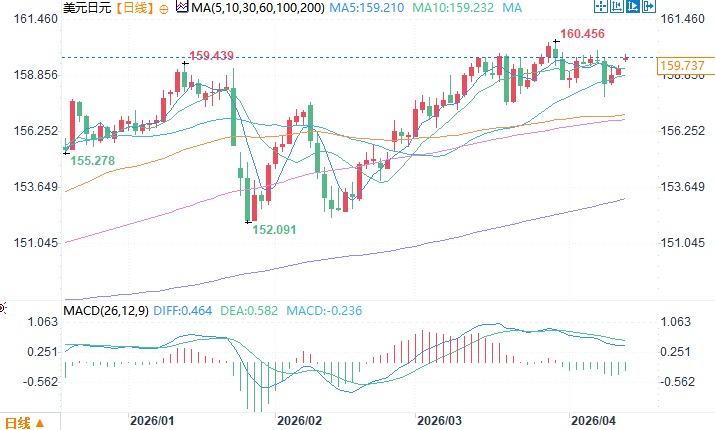
USD/JPY Daily Chart Source: EasyForex
At 10:58 AM Beijing time on April 13, the USD/JPY exchange rate was 159.72/73.
During Monday's Asian trading session, the currency pair fluctuated around 159.80, showing strong buying support. This movement was mainly driven by the latest developments in the Middle East, with the breakdown of peace talks between the US and Iran leading to a significant increase in market demand for safe-haven assets, giving the US dollar a strong boost as a traditional safe-haven currency.
US-Iran negotiations break down; Trump announces closure of Strait of Hormuz
US Vice President Vance confirmed that the US and Iran failed to reach an agreement after 21 hours of intensive negotiations in Islamabad, Pakistan. This news quickly triggered a significant drop in market risk appetite, with investors turning to safe-haven assets such as the US dollar.
US President Trump subsequently announced that the US would begin imposing a "blockade" on all ships entering and leaving the Strait of Hormuz. US Central Command further clarified that the blockade would officially begin at 10:00 AM Eastern Time on Monday (2:00 PM GMT), imposing comprehensive control on all maritime traffic entering and leaving Iranian ports.
This hardline stance marks a renewed escalation of tensions in the Middle East.
The Strait of Hormuz is one of the world's most important oil shipping routes, with large quantities of crude oil transported daily from the Middle East to markets in Asia, Europe, and North America. If a blockade is implemented, it will not only directly impact the global energy supply chain but could also trigger a significant increase in international shipping costs and exacerbate energy price volatility.
Iran responds strongly to warning issued by the Revolutionary Guard
Iran reacted swiftly to the US threat of a blockade. Iranian Parliament Speaker Mohammad Bagher Ghalibaf stated that while the US offered some "constructive initiatives," it failed to win the trust of the Iranian delegation, and the final decision rested with Washington. He emphasized that Iran would not easily succumb to external pressure.
The Iranian Revolutionary Guard Corps (IRGC) issued a more direct warning, stating that any military vessel approaching the Strait of Hormuz would be considered a violation of the ceasefire agreement and would face a "decisive response" from Iran. This statement further highlights the differences between the two sides on key issues, particularly the Iranian nuclear issue and core points of contention such as the right of passage through the strait.
The fragile ceasefire agreement is currently facing a severe test. Analysts believe that if the blockade is actually implemented, the risk of regional conflict escalation will increase significantly. This would not only directly impact Middle Eastern oil-producing countries but could also be transmitted to the global economy through energy prices, pushing up inflationary pressures and suppressing economic growth.
Market focus shifts to Bank of Japan meeting, with energy prices becoming a key variable.
Amid a strengthening dollar, traders are closely watching the Bank of Japan's upcoming policy meeting on April 27-28, which will focus on assessing whether the continued rise in global energy and commodity prices is sufficient to prompt the Bank of Japan to raise interest rates.
According to the "Sakura Report," following the branch governors' meeting on April 6, members of the Bank of Japan's board of directors are carefully weighing the balance between upside risks to inflation and downside risks to economic growth. The report indicates that all nine regions in Japan consider their economies to be in a state of "moderate recovery," "improving," or "moderate improvement," indicating that overall economic resilience remains, but external uncertainties have become a major constraint.
With tensions in the Middle East potentially leading to further increases in international oil prices, Japan, a major energy importer, will face significant pressure on its import costs. This could exacerbate domestic price increases, providing the Bank of Japan with a reason to raise interest rates. However, if lockdowns trigger a global economic slowdown, Japan's export-oriented economy will also be negatively impacted, requiring policymakers to strike a delicate balance between the two.
Geopolitical risks dominate the market; the strong dollar may continue.
In summary, the recent continuous rise in the USD/JPY exchange rate reflects that investor concerns about Middle East geopolitical risks are dominating short-term market sentiment. The safe-haven status of the US dollar is fully manifested in the current environment, while the yen, as another traditional safe-haven currency, is relatively influenced by both domestic policy expectations in Japan and global risk appetite.
In the coming days, the market will continue to focus on the actual developments in the Strait of Hormuz, further responses from Iran, and whether the US will escalate its blockade. Meanwhile, signals from the Bank of Japan's meeting will also provide new guidance for the yen's trajectory. If energy prices surge due to the blockade, global inflation expectations may rise again, further supporting the dollar and testing the yen's defensive capabilities.
Overall , given the uncertainty surrounding the Middle East peace process, short-term volatility in the USD/JPY exchange rate is expected to remain high. Investors should closely monitor the latest geopolitical developments and prepare for potential energy price shocks.
USD/JPY Daily Chart Source: EasyForex
At 10:58 AM Beijing time on April 13, the USD/JPY exchange rate was 159.72/73.
- Risk Warning and Disclaimer
- The market involves risk, and trading may not be suitable for all investors. This article is for reference only and does not constitute personal investment advice, nor does it take into account certain users’ specific investment objectives, financial situation, or other needs. Any investment decisions made based on this information are at your own risk.