Australia's March employment data faces downside risks; RBA still expects a rate hike in May.
2026-04-15 17:10:25
According to APP, ING analyst Francesco Pesole believes there are downside risks to Australia's March employment data, with the unemployment rate potentially rising slightly, but he does not expect this to prevent the RBA from raising interest rates in May. He noted, "We see some downside risks to Australia's March employment data; the consensus estimate of 20,000 new jobs seems somewhat optimistic, as positive growth over the past year has often been followed by negative readings." Pesole further stated, "We might see the unemployment rate rise slightly from 4.3% to 4.4%, which doesn't yet reflect the war-related impact, but could indicate a slight slowdown in labor market momentum." He emphasized, "Will this be enough to prevent the RBA from raising rates in May? We are currently skeptical." "We feel a certain urgency; the baseline scenario remains a May rate hike, not a delay to August." Furthermore, he believes that "AUD/USD retains solid upside potential after removing the risk of a renewed escalation. A peace agreement does not necessarily mean energy prices will return to pre-war levels, and the Australian dollar will benefit from both stronger export prices and improved risk sentiment."

As of April 15, 2026, the RBA cash rate was 4.10%, having been raised by 25 basis points on March 17. The market estimates a 64% probability of a rate hike to 4.35% in May, reflecting policymakers' continued focus on inflation expectations. Australia's unemployment rate rose to 4.3% in February, with employment increasing by 48,900, exceeding expectations but partly driven by part-time job growth. March employment data will be released on April 16 at 02:30 BST, with consensus expecting an increase of approximately 20,000 jobs. The unemployment rate is likely to remain stable or rise slightly to 4.4%, while the participation rate is expected to remain unchanged. This reading does not yet fully reflect the lagged effects of the Middle East conflict on the labor market, but it already shows early signs of a slight slowdown in labor market momentum.
Francesco Pesole 's analysis emphasizes that the RBA's current policy focus is on curbing inflation expectations rather than relying solely on employment data. Even with weak employment figures in March, the central bank is likely to maintain its tightening pace based on the overall inflation path to prevent a softening labor market from turning into insufficient demand. In the baseline scenario, a rate hike in May is highly probable, which would further tighten financial conditions and provide support for the Australian dollar.
In terms of exchange rates, AUD/USD is currently trading around 0.7133, having rebounded from recent lows. Francesco Pesole believes it still has upside potential, with ING's quarterly target at 0.720. If a peace agreement is reached, improved export prices (especially for commodities) and global risk appetite will jointly boost the Australian dollar, but the risk of renewed geopolitical escalation should be noted.
To provide a clear comparison between current employment and policy scenarios, the following table displays the latest data and potential impact of key indicators:
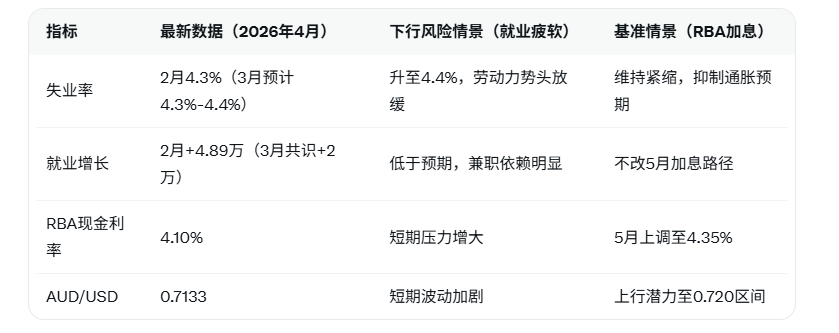
The above scenario shows that while softening employment data poses a short-term risk, it is insufficient to change the RBA's tightening tone, and the upward momentum of AUD/USD remains dominant.
Editor's Summary
Francesco Pesole's latest assessment provides a pragmatic framework for Australian monetary policy and exchange rate trends: Given the downside risks to March employment data and the potential slight increase in the unemployment rate, the probability of an RBA rate hike in May remains high, with the policy focus on managing inflation expectations. This analysis aligns with the latest data of a 4.10% cash rate, a 4.3% unemployment rate, and an AUD/USD exchange rate of 0.7133. It also highlights the potential boost to exports and risk sentiment from the peace agreement, providing an important reference for global investors allocating Australian dollar assets.
As of April 15, 2026, the RBA cash rate was 4.10%, having been raised by 25 basis points on March 17. The market estimates a 64% probability of a rate hike to 4.35% in May, reflecting policymakers' continued focus on inflation expectations. Australia's unemployment rate rose to 4.3% in February, with employment increasing by 48,900, exceeding expectations but partly driven by part-time job growth. March employment data will be released on April 16 at 02:30 BST, with consensus expecting an increase of approximately 20,000 jobs. The unemployment rate is likely to remain stable or rise slightly to 4.4%, while the participation rate is expected to remain unchanged. This reading does not yet fully reflect the lagged effects of the Middle East conflict on the labor market, but it already shows early signs of a slight slowdown in labor market momentum.
Francesco Pesole 's analysis emphasizes that the RBA's current policy focus is on curbing inflation expectations rather than relying solely on employment data. Even with weak employment figures in March, the central bank is likely to maintain its tightening pace based on the overall inflation path to prevent a softening labor market from turning into insufficient demand. In the baseline scenario, a rate hike in May is highly probable, which would further tighten financial conditions and provide support for the Australian dollar.
In terms of exchange rates, AUD/USD is currently trading around 0.7133, having rebounded from recent lows. Francesco Pesole believes it still has upside potential, with ING's quarterly target at 0.720. If a peace agreement is reached, improved export prices (especially for commodities) and global risk appetite will jointly boost the Australian dollar, but the risk of renewed geopolitical escalation should be noted.
To provide a clear comparison between current employment and policy scenarios, the following table displays the latest data and potential impact of key indicators:
The above scenario shows that while softening employment data poses a short-term risk, it is insufficient to change the RBA's tightening tone, and the upward momentum of AUD/USD remains dominant.
Editor's Summary
Francesco Pesole's latest assessment provides a pragmatic framework for Australian monetary policy and exchange rate trends: Given the downside risks to March employment data and the potential slight increase in the unemployment rate, the probability of an RBA rate hike in May remains high, with the policy focus on managing inflation expectations. This analysis aligns with the latest data of a 4.10% cash rate, a 4.3% unemployment rate, and an AUD/USD exchange rate of 0.7133. It also highlights the potential boost to exports and risk sentiment from the peace agreement, providing an important reference for global investors allocating Australian dollar assets.
- Risk Warning and Disclaimer
- The market involves risk, and trading may not be suitable for all investors. This article is for reference only and does not constitute personal investment advice, nor does it take into account certain users’ specific investment objectives, financial situation, or other needs. Any investment decisions made based on this information are at your own risk.