Risk assets need to adjust; crude oil's safe-haven appeal may trigger a rebound.
2026-04-15 18:15:53
On Wednesday (April 15), during the Asian and European sessions, international crude oil prices rebounded slightly after hitting a low, currently trading around 96.15, up 1.4%. Prices had briefly fallen to 94 during the session. Recent positive news regarding the US-Iran peace talks has significantly eased geopolitical concerns. However, from the perspective of the opening of the Strait of Hormuz, there is still no clear marginal improvement. Meanwhile, with the release of strategic reserves by various countries and the reduction of chemical plant inventories, the central value of oil prices is expected to continue to rise.
Meanwhile, Rabobank's global economics and markets research team pointed out that although the IMF has clearly warned that the continued blockade of the Strait of Hormuz could trigger a global economic recession, international oil prices are still declining.
The report specifically mentions Spain's response – the country has released four days' worth of supplies from its 90-day strategic oil reserve, and will release another eight days' worth, still maintaining a 78-day reserve.
However, it is worth noting that the International Energy Agency (IEA) assessment shows that even if the Strait of Hormuz resumes navigation the next day, it will take at least 60 days and at most 150 days for the normal transportation of crude oil to fully recover. Furthermore, demand-side control measures by various countries, including the release of strategic reserves, can only temporarily offset the impact on the energy market and have not substantially increased crude oil supply capacity.
From the core logic of crude oil trading, the recovery of shipping capacity in the Strait of Hormuz faces insurmountable physical constraints and institutional obstacles.
As a vital waterway for transporting one-fifth of the world's oil and liquefied natural gas, the strait has been severely disrupted in shipping since Iran announced its closure on February 28, 2026. Approximately 10 ships have been attacked in the strait and surrounding waters, and major global shipping companies such as Maersk and COSCO Shipping have suspended bookings on related routes.
More importantly, Iranian government spokesperson Fatima Mohajrani explicitly stated that there are plans to establish a special system for the Strait of Hormuz, regarding it as a "special property" of the country and a lever for external interactions. The Iranian parliament is also pushing forward relevant legislation to charge fees for passing vessels in order to demonstrate sovereignty and increase revenue.
Although the Strait of Hormuz is an international waterway, Iran controls the key nodes on the northern shore. This "special system" may essentially form a disguised barrier to passage. Unless the fees and additional conditions are completely eliminated, shipping companies will avoid the route due to rising costs and uncertainty, and the recovery of shipping capacity will inevitably be difficult.
The complex dynamics of the current geopolitical situation have further exacerbated the uncertainty surrounding the recovery of transport capacity.
US President Trump has declared the war with Iran "very close to ending" and has repeatedly proclaimed a US victory, but the situation on the ground is far more complex than the statements suggest, implying that the US ship blockade plan will provide leverage in negotiations.
Although the U.S. Central Command stated that it had achieved "maritime superiority" and completely blockaded Iranian ports within 36 hours, Iran still firmly controls the core waters of the Strait of Hormuz and "still has a large number of weapons." Domestic socio-political groups are becoming more united in the context of external interference.
Although the mediators have made progress in extending the ceasefire agreement, planning to extend the ceasefire, which expires on April 22, for at least two weeks to restart negotiations, US Vice President Vance also acknowledged that the differences between the US and Iran, accumulated over decades, cannot be resolved overnight.
The Russian Federation Security Council further warned that the Pentagon's continued troop buildup in the Middle East suggests that the US and Israel may be using the negotiations to prepare for ground military operations. If the negotiations fail to reach an agreement in two weeks, a more intense confrontation could erupt.
For crude oil traders, the current market structure has formed a clear trading logic: the continued progress of US-Iran negotiations and the release of strategic reserves by various countries have temporarily eliminated expectations of a sharp rise in oil prices. However, the reality is that spot prices remain high and the Strait of Hormuz remains closed. Thus, there is a contradiction between excessive market optimism and actual shortages in the oil market.
The 60-150 day physical recovery period of the Strait of Hormuz, concerns about tolls under Iran's "special regime," and the high uncertainty of geopolitical conflicts have collectively provided strong support for oil prices. The current continuous pullback in oil prices may be a good entry point for investment.
Conversely, risk assets, after their recent rapid rebound, are in need of adjustment and are prone to exhibiting a seesaw effect with oil prices.
Overall, the recovery of shipping capacity in the Strait of Hormuz is constrained by a triple set of factors: physical damage, institutional barriers, and geopolitical competition. Unless there are unexpected positive developments such as the complete elimination of tolls or a thorough resolution of the conflict, the structural gap in global crude oil supply will persist for a long time.
With the IMF warning of recession risks and the irreversible depletion of national reserves, crude oil assets have become defensive assets compared to equity assets. Risk assets should be wary of adjustment pressure after the rebound, so oil prices may start to move upward.
From a technical perspective, the Brent crude oil June contract has formed a double top pattern, and the current price is near the neckline of the pattern, where there is strong support. In addition, the oil price has previously broken below and then recovered the neckline, which confirms the support. The oil price is expected to rebound from the low price area.
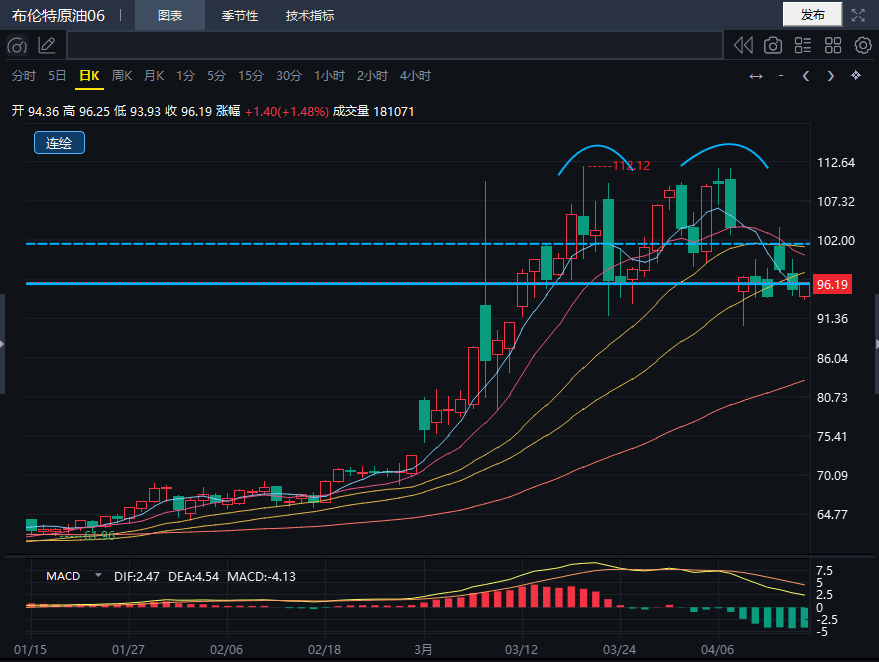
(Brent crude oil June futures contract daily chart, source: EasyForex)
At 18:12 Beijing time, the Brent crude oil June futures contract was trading at $96.21 per barrel.
Meanwhile, Rabobank's global economics and markets research team pointed out that although the IMF has clearly warned that the continued blockade of the Strait of Hormuz could trigger a global economic recession, international oil prices are still declining.
The report specifically mentions Spain's response – the country has released four days' worth of supplies from its 90-day strategic oil reserve, and will release another eight days' worth, still maintaining a 78-day reserve.
However, it is worth noting that the International Energy Agency (IEA) assessment shows that even if the Strait of Hormuz resumes navigation the next day, it will take at least 60 days and at most 150 days for the normal transportation of crude oil to fully recover. Furthermore, demand-side control measures by various countries, including the release of strategic reserves, can only temporarily offset the impact on the energy market and have not substantially increased crude oil supply capacity.
Physical constraints + institutional barriers: Hormuz faces numerous obstacles to capacity recovery
From the core logic of crude oil trading, the recovery of shipping capacity in the Strait of Hormuz faces insurmountable physical constraints and institutional obstacles.
As a vital waterway for transporting one-fifth of the world's oil and liquefied natural gas, the strait has been severely disrupted in shipping since Iran announced its closure on February 28, 2026. Approximately 10 ships have been attacked in the strait and surrounding waters, and major global shipping companies such as Maersk and COSCO Shipping have suspended bookings on related routes.
More importantly, Iranian government spokesperson Fatima Mohajrani explicitly stated that there are plans to establish a special system for the Strait of Hormuz, regarding it as a "special property" of the country and a lever for external interactions. The Iranian parliament is also pushing forward relevant legislation to charge fees for passing vessels in order to demonstrate sovereignty and increase revenue.
Although the Strait of Hormuz is an international waterway, Iran controls the key nodes on the northern shore. This "special system" may essentially form a disguised barrier to passage. Unless the fees and additional conditions are completely eliminated, shipping companies will avoid the route due to rising costs and uncertainty, and the recovery of shipping capacity will inevitably be difficult.
Geopolitical tensions are fluctuating, but overall the situation is moving in a positive direction.
The complex dynamics of the current geopolitical situation have further exacerbated the uncertainty surrounding the recovery of transport capacity.
US President Trump has declared the war with Iran "very close to ending" and has repeatedly proclaimed a US victory, but the situation on the ground is far more complex than the statements suggest, implying that the US ship blockade plan will provide leverage in negotiations.
Although the U.S. Central Command stated that it had achieved "maritime superiority" and completely blockaded Iranian ports within 36 hours, Iran still firmly controls the core waters of the Strait of Hormuz and "still has a large number of weapons." Domestic socio-political groups are becoming more united in the context of external interference.
Although the mediators have made progress in extending the ceasefire agreement, planning to extend the ceasefire, which expires on April 22, for at least two weeks to restart negotiations, US Vice President Vance also acknowledged that the differences between the US and Iran, accumulated over decades, cannot be resolved overnight.
The Russian Federation Security Council further warned that the Pentagon's continued troop buildup in the Middle East suggests that the US and Israel may be using the negotiations to prepare for ground military operations. If the negotiations fail to reach an agreement in two weeks, a more intense confrontation could erupt.
Summary and Technical Analysis:
For crude oil traders, the current market structure has formed a clear trading logic: the continued progress of US-Iran negotiations and the release of strategic reserves by various countries have temporarily eliminated expectations of a sharp rise in oil prices. However, the reality is that spot prices remain high and the Strait of Hormuz remains closed. Thus, there is a contradiction between excessive market optimism and actual shortages in the oil market.
The 60-150 day physical recovery period of the Strait of Hormuz, concerns about tolls under Iran's "special regime," and the high uncertainty of geopolitical conflicts have collectively provided strong support for oil prices. The current continuous pullback in oil prices may be a good entry point for investment.
Conversely, risk assets, after their recent rapid rebound, are in need of adjustment and are prone to exhibiting a seesaw effect with oil prices.
Overall, the recovery of shipping capacity in the Strait of Hormuz is constrained by a triple set of factors: physical damage, institutional barriers, and geopolitical competition. Unless there are unexpected positive developments such as the complete elimination of tolls or a thorough resolution of the conflict, the structural gap in global crude oil supply will persist for a long time.
With the IMF warning of recession risks and the irreversible depletion of national reserves, crude oil assets have become defensive assets compared to equity assets. Risk assets should be wary of adjustment pressure after the rebound, so oil prices may start to move upward.
From a technical perspective, the Brent crude oil June contract has formed a double top pattern, and the current price is near the neckline of the pattern, where there is strong support. In addition, the oil price has previously broken below and then recovered the neckline, which confirms the support. The oil price is expected to rebound from the low price area.
(Brent crude oil June futures contract daily chart, source: EasyForex)
At 18:12 Beijing time, the Brent crude oil June futures contract was trading at $96.21 per barrel.
- Risk Warning and Disclaimer
- The market involves risk, and trading may not be suitable for all investors. This article is for reference only and does not constitute personal investment advice, nor does it take into account certain users’ specific investment objectives, financial situation, or other needs. Any investment decisions made based on this information are at your own risk.