Trump makes tough statement: Close to defeating Iran, but wants to back down? Allies refuse to help with blockade.
2026-04-16 10:31:54
During a small private dinner at the White House on Monday evening (April 13), US President Donald Trump told the King and Queen of the Netherlands that he wanted a swift end to the war with Iran. Trump explained that the only effective way to get Tehran back to the negotiating table was to continue increasing pressure.
During the dinner, Trump enjoyed spinach soup, scallops, and Coke, emphasizing that the United States was close to victory. In a subsequent interview, he stated, "I think the war is very close to ending. If I back down now, it will take them 20 years to rebuild the country. We'll wait and see what happens. I think they really want to make a deal."
With the Strait of Hormuz remaining blocked, US crude oil prices fluctuated at high levels during Thursday's Asian trading session, currently trading in a narrow range around $88.20 per barrel.
Dutch Prime Minister Rob Jeten took advantage of the royal family's visit to the United States to speak with Trump, but explicitly refused to assist in the blockade of Iranian ports, calling it an "escalation of tensions." Jeten stated that European allies are willing to form an international coalition to help secure the Strait of Hormuz after the conflict ends, but will not participate at present .
Despite rejections from multiple countries, the Trump administration declared the blockade was proceeding smoothly. White House Press Secretary Carolyn Levitt emphasized that the United States possesses the world's most powerful navy, while the Iranian navy has lost its combat capability, and the blockade can be perfectly executed without external assistance. Currently, the U.S. Central Command has deployed over 10,000 sailors, Marines, and Air Force personnel, along with more than a dozen warships and aircraft involved in the operation.
Trump wants Iran to hand over all its enriched uranium and has pledged to freeze uranium enrichment activities for at least 20 years (he hopes to negotiate for longer). Iran, on the other hand, has offered a five-year freeze but wants to keep its enriched uranium within its borders. The two sides failed to overcome these differences during talks in Islamabad last weekend .
Vice President JD Vance is ready to lead special envoys Steve Witkoff and Jared Kushner to Pakistan again this week to continue talks, but no final decision has been made. Iranian President Peshizian stated that the US approach based on threats and military action will only worsen the situation, and negotiations will only continue if the rights of the Iranian people are guaranteed.
The blockade aims to cut off Iran's oil export revenue. The Strait of Hormuz typically handles about 20% of global oil shipments, and as a major oil producer, a continued blockade would significantly impact the Iranian economy. However, experts estimate that it may take several months for the Iranian regime to feel enough pain and make substantial concessions in negotiations .
Trump doesn't mind maintaining the lockdown indefinitely, but there are concerns within the Pentagon that a prolonged operation would divert U.S. naval power from the Pacific and other regions.
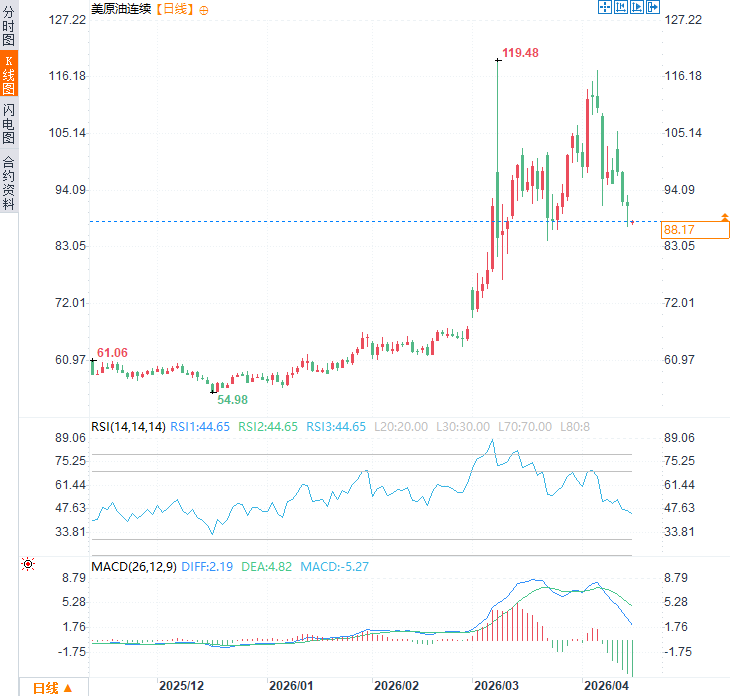
(US crude oil daily chart, source: FX678)
Trump faces multiple pressures: some factions within the Republican Party oppose involvement in another costly war in the Middle East; congressional allies worry that high oil prices and inflation could impact the midterm elections; and key allies such as Saudi Arabia are also pressuring the US to lift the blockade to prevent Iran from attacking Red Sea shipping lanes through Yemeni proxies, threatening another global energy artery.
Speaking at an event in Georgia, Vance acknowledged that deep-seated distrust between the U.S. and Iran is a major obstacle, stating, "You can't solve this overnight." Nevertheless, Trump administration officials believe that major external powers are urging Iran to reach an agreement to ease pressure on global energy markets .
Trump has intensified economic pressure on Iran through measures such as the continued blockade of the Strait of Hormuz, aiming to force Tehran to make concessions and reach an agreement on the nuclear issue as soon as possible. Despite widespread refusal from allies to participate, the United States has relied on its powerful navy to maintain operations. Significant differences exist between the two sides regarding the freeze period and the handling of enriched uranium, and a lack of mutual trust has led to slow progress in negotiations.
While a prolonged blockade would exacerbate Iran's economic woes, it also diverts US military resources and creates domestic political pressure. The progress of negotiations and the effectiveness of the blockade in the coming weeks will jointly determine the trajectory of the Middle East and the stability of global energy markets.
At 10:31 Beijing time, US crude oil futures were trading at $88.17 per barrel.
During the dinner, Trump enjoyed spinach soup, scallops, and Coke, emphasizing that the United States was close to victory. In a subsequent interview, he stated, "I think the war is very close to ending. If I back down now, it will take them 20 years to rebuild the country. We'll wait and see what happens. I think they really want to make a deal."
With the Strait of Hormuz remaining blocked, US crude oil prices fluctuated at high levels during Thursday's Asian trading session, currently trading in a narrow range around $88.20 per barrel.
Blockade Implementation and Allies' Attitudes
Dutch Prime Minister Rob Jeten took advantage of the royal family's visit to the United States to speak with Trump, but explicitly refused to assist in the blockade of Iranian ports, calling it an "escalation of tensions." Jeten stated that European allies are willing to form an international coalition to help secure the Strait of Hormuz after the conflict ends, but will not participate at present .
Despite rejections from multiple countries, the Trump administration declared the blockade was proceeding smoothly. White House Press Secretary Carolyn Levitt emphasized that the United States possesses the world's most powerful navy, while the Iranian navy has lost its combat capability, and the blockade can be perfectly executed without external assistance. Currently, the U.S. Central Command has deployed over 10,000 sailors, Marines, and Air Force personnel, along with more than a dozen warships and aircraft involved in the operation.
Core red lines and differences in negotiations
Trump wants Iran to hand over all its enriched uranium and has pledged to freeze uranium enrichment activities for at least 20 years (he hopes to negotiate for longer). Iran, on the other hand, has offered a five-year freeze but wants to keep its enriched uranium within its borders. The two sides failed to overcome these differences during talks in Islamabad last weekend .
Vice President JD Vance is ready to lead special envoys Steve Witkoff and Jared Kushner to Pakistan again this week to continue talks, but no final decision has been made. Iranian President Peshizian stated that the US approach based on threats and military action will only worsen the situation, and negotiations will only continue if the rights of the Iranian people are guaranteed.
The impact of pressure on the Iranian economy
The blockade aims to cut off Iran's oil export revenue. The Strait of Hormuz typically handles about 20% of global oil shipments, and as a major oil producer, a continued blockade would significantly impact the Iranian economy. However, experts estimate that it may take several months for the Iranian regime to feel enough pain and make substantial concessions in negotiations .
Trump doesn't mind maintaining the lockdown indefinitely, but there are concerns within the Pentagon that a prolonged operation would divert U.S. naval power from the Pacific and other regions.
(US crude oil daily chart, source: FX678)
Trump faces domestic and international pressure
Trump faces multiple pressures: some factions within the Republican Party oppose involvement in another costly war in the Middle East; congressional allies worry that high oil prices and inflation could impact the midterm elections; and key allies such as Saudi Arabia are also pressuring the US to lift the blockade to prevent Iran from attacking Red Sea shipping lanes through Yemeni proxies, threatening another global energy artery.
Speaking at an event in Georgia, Vance acknowledged that deep-seated distrust between the U.S. and Iran is a major obstacle, stating, "You can't solve this overnight." Nevertheless, Trump administration officials believe that major external powers are urging Iran to reach an agreement to ease pressure on global energy markets .
Editor's Summary
Trump has intensified economic pressure on Iran through measures such as the continued blockade of the Strait of Hormuz, aiming to force Tehran to make concessions and reach an agreement on the nuclear issue as soon as possible. Despite widespread refusal from allies to participate, the United States has relied on its powerful navy to maintain operations. Significant differences exist between the two sides regarding the freeze period and the handling of enriched uranium, and a lack of mutual trust has led to slow progress in negotiations.
While a prolonged blockade would exacerbate Iran's economic woes, it also diverts US military resources and creates domestic political pressure. The progress of negotiations and the effectiveness of the blockade in the coming weeks will jointly determine the trajectory of the Middle East and the stability of global energy markets.
At 10:31 Beijing time, US crude oil futures were trading at $88.17 per barrel.
- Risk Warning and Disclaimer
- The market involves risk, and trading may not be suitable for all investors. This article is for reference only and does not constitute personal investment advice, nor does it take into account certain users’ specific investment objectives, financial situation, or other needs. Any investment decisions made based on this information are at your own risk.