With geopolitical tensions easing, Eurozone interest rate expectations may shift entirely towards a dovish stance.
2026-04-16 14:38:48
According to an APP report, Macquarie Bank strategists Thierry Wiesmann and Gareth Berry stated in a report that the most hawkish central banks in the face of rising oil prices will likely revert to pre-war policy stances if a peace agreement is reached and oil prices remain low. In their view, the Bank of England (and perhaps the European Central Bank ) has the most room to maneuver and return to its pre-war position, as they have become exceptionally hawkish since the start of the US-Iran conflict. Therefore, these policy rate expectations may become less "hawkish."

Thierry Wiesmann and Gareth Berry further argue that the current high oil prices are primarily due to supply shocks caused by geopolitical conflicts, rather than overheated endogenous demand. Once the conflict eases, a peace agreement is reached, and oil prices fall back to a reasonable range, central banks will no longer need to maintain a wartime tightening stance, and can instead focus on balancing domestic growth and inflation. The Bank of England and the European Central Bank, by quickly adopting a hawkish stance and postponing their planned easing programs at the beginning of the conflict, have accumulated significant policy buffer space.
Latest market data shows that as of April 16, 2026, Brent crude oil prices were approximately $94.8 per barrel, a significant drop from the March peak but still higher than pre-war averages. The Bank of England's policy rate remained at 3.75%, and the European Central Bank's deposit facility rate was 2.00%. Both were on a gradual easing path before the conflict, but were forced to pause rate cuts or even strengthen tightening signals due to soaring energy prices during the war. If external shocks subside, both central banks are expected to be among the first to resume their pre-war pace, avoiding unnecessary drag on economic growth from prolonged high interest rates.
The table below compares current policy interest rates with potential room for maneuver, helping investors intuitively grasp the logic behind policy shifts:
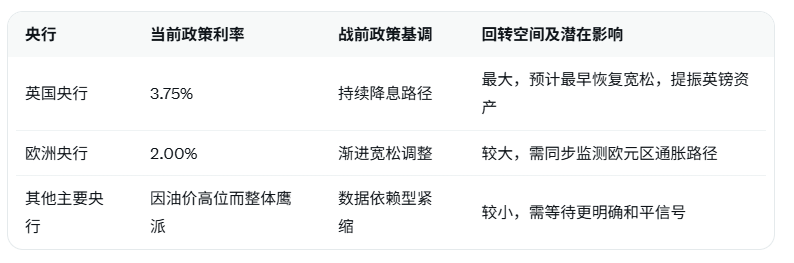
At a deeper level, this policy reversal is not a simple "U-shaped reversal," but rather a rational adjustment based on the re-anchoring of inflation expectations. The energy price increases during the conflict have partially translated into core inflation. If oil prices continue to fall, corporate cost pressures will ease, the risk of a wage-price spiral will decrease, and central banks will have ample room to implement easing measures. Meanwhile, as net energy importers, the Bank of England and the European Central Bank are more sensitive to oil prices; once external pressures ease, their policy flexibility will be significantly better than that of central banks in energy-exporting countries.
Editor's Summary : While current geopolitical tensions and oil price volatility have briefly boosted the hawkish stance of major central banks, Macquarie strategists' analysis clearly indicates that once a peace agreement is reached and oil prices return to low levels, the Bank of England and the European Central Bank will have the greatest policy flexibility. The latest interest rate levels of 3.75% and 2.00% provide ample buffer for subsequent easing. Investors should closely monitor oil price trends, the progress of peace negotiations, and communication between the two central banks at their next meeting to anticipate potential opportunities in the bond, currency, and stock markets.
Thierry Wiesmann and Gareth Berry further argue that the current high oil prices are primarily due to supply shocks caused by geopolitical conflicts, rather than overheated endogenous demand. Once the conflict eases, a peace agreement is reached, and oil prices fall back to a reasonable range, central banks will no longer need to maintain a wartime tightening stance, and can instead focus on balancing domestic growth and inflation. The Bank of England and the European Central Bank, by quickly adopting a hawkish stance and postponing their planned easing programs at the beginning of the conflict, have accumulated significant policy buffer space.
Latest market data shows that as of April 16, 2026, Brent crude oil prices were approximately $94.8 per barrel, a significant drop from the March peak but still higher than pre-war averages. The Bank of England's policy rate remained at 3.75%, and the European Central Bank's deposit facility rate was 2.00%. Both were on a gradual easing path before the conflict, but were forced to pause rate cuts or even strengthen tightening signals due to soaring energy prices during the war. If external shocks subside, both central banks are expected to be among the first to resume their pre-war pace, avoiding unnecessary drag on economic growth from prolonged high interest rates.
The table below compares current policy interest rates with potential room for maneuver, helping investors intuitively grasp the logic behind policy shifts:
At a deeper level, this policy reversal is not a simple "U-shaped reversal," but rather a rational adjustment based on the re-anchoring of inflation expectations. The energy price increases during the conflict have partially translated into core inflation. If oil prices continue to fall, corporate cost pressures will ease, the risk of a wage-price spiral will decrease, and central banks will have ample room to implement easing measures. Meanwhile, as net energy importers, the Bank of England and the European Central Bank are more sensitive to oil prices; once external pressures ease, their policy flexibility will be significantly better than that of central banks in energy-exporting countries.
Editor's Summary : While current geopolitical tensions and oil price volatility have briefly boosted the hawkish stance of major central banks, Macquarie strategists' analysis clearly indicates that once a peace agreement is reached and oil prices return to low levels, the Bank of England and the European Central Bank will have the greatest policy flexibility. The latest interest rate levels of 3.75% and 2.00% provide ample buffer for subsequent easing. Investors should closely monitor oil price trends, the progress of peace negotiations, and communication between the two central banks at their next meeting to anticipate potential opportunities in the bond, currency, and stock markets.
- Risk Warning and Disclaimer
- The market involves risk, and trading may not be suitable for all investors. This article is for reference only and does not constitute personal investment advice, nor does it take into account certain users’ specific investment objectives, financial situation, or other needs. Any investment decisions made based on this information are at your own risk.