Australia's unemployment rate in March was 4.3%, showing greater resilience than expected; the Reserve Bank of Australia may raise interest rates twice more this year.
2026-04-16 10:59:39
According to APP, Krishna Bimwalap, Asia-Pacific economist at Stick Investment Management, pointed out that the Australian labor market continued to perform strongly in March, but its unexpected resilience is worrying, further demonstrating the need for further interest rate hikes. The latest Australian Bureau of Statistics data shows that the trend unemployment rate remained stable at 4.3% in March 2026, employment continued to grow, and the participation rate remained high. These indicators collectively reflect that the labor supply and demand situation remains relatively tight, rather than rapidly cooling.

Krishna Bimwalap emphasized that the Reserve Bank of Australia ( RBA) may not be overly concerned if the unemployment rate gradually rises from the current 4.3% to 5.0%, meaning the institution still has considerable flexibility in adjusting monetary policy. Considering the data just released in March and the RBA's March meeting which raised the cash rate to 4.10%, he believes there is room for at least two more rate hikes this year to effectively curb potential upward pressure from the wage-price spiral.
This assessment stems from observations of the deeper structure of the labor market. While employment growth in some sectors is driven by part-time jobs, the relative stability of full-time employment and changes in job seeker behavior indicate that economic demand remains resilient. If this trend continues, it could push up overall inflation expectations, thereby impacting the Fed's 2%-3% medium-term inflation target. In the current environment, the Fed needs to balance economic growth with price stability, avoiding premature policy easing that could lead to a rebound in inflation.
The table below compares key labor market indicators with policy thresholds to help provide a clearer understanding of the scope for interest rate hikes:
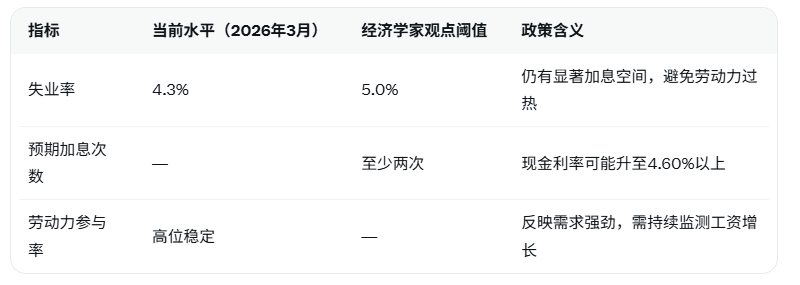
From a broader perspective, while labor market resilience may support consumption and economic growth in the short term, without proper guidance in the long term, it could amplify the risk of imported inflation from global supply chain fluctuations or geopolitical factors. The Reserve Bank of Australia's recent policy decisions have already demonstrated a data-dependent approach, with future meetings focusing on employment data, wage indices, and inflation readings.
Editor's Summary : The continued strength of Australia's labor market sends a clear signal to monetary policymakers: the current unemployment rate of 4.3% remains low and sufficient to support further tightening measures to anchor inflation expectations. Economists' predictions of at least two rate hikes this year reflect a cautious balance between the dual mandates of employment and prices. Investors should closely monitor subsequent employment reports and communications with the Reserve Bank to assess the potential transmission effect of the interest rate path on asset prices.
Krishna Bimwalap emphasized that the Reserve Bank of Australia ( RBA) may not be overly concerned if the unemployment rate gradually rises from the current 4.3% to 5.0%, meaning the institution still has considerable flexibility in adjusting monetary policy. Considering the data just released in March and the RBA's March meeting which raised the cash rate to 4.10%, he believes there is room for at least two more rate hikes this year to effectively curb potential upward pressure from the wage-price spiral.
This assessment stems from observations of the deeper structure of the labor market. While employment growth in some sectors is driven by part-time jobs, the relative stability of full-time employment and changes in job seeker behavior indicate that economic demand remains resilient. If this trend continues, it could push up overall inflation expectations, thereby impacting the Fed's 2%-3% medium-term inflation target. In the current environment, the Fed needs to balance economic growth with price stability, avoiding premature policy easing that could lead to a rebound in inflation.
The table below compares key labor market indicators with policy thresholds to help provide a clearer understanding of the scope for interest rate hikes:
From a broader perspective, while labor market resilience may support consumption and economic growth in the short term, without proper guidance in the long term, it could amplify the risk of imported inflation from global supply chain fluctuations or geopolitical factors. The Reserve Bank of Australia's recent policy decisions have already demonstrated a data-dependent approach, with future meetings focusing on employment data, wage indices, and inflation readings.
Editor's Summary : The continued strength of Australia's labor market sends a clear signal to monetary policymakers: the current unemployment rate of 4.3% remains low and sufficient to support further tightening measures to anchor inflation expectations. Economists' predictions of at least two rate hikes this year reflect a cautious balance between the dual mandates of employment and prices. Investors should closely monitor subsequent employment reports and communications with the Reserve Bank to assess the potential transmission effect of the interest rate path on asset prices.
- Risk Warning and Disclaimer
- The market involves risk, and trading may not be suitable for all investors. This article is for reference only and does not constitute personal investment advice, nor does it take into account certain users’ specific investment objectives, financial situation, or other needs. Any investment decisions made based on this information are at your own risk.