Uncertainty in the Middle East fueled risk aversion, causing the USD/JPY pair to rebound to a key resistance level.
2026-04-17 11:00:56
The US dollar continued its upward trend against the Japanese yen during Friday's Asian trading session, rising to around 159.35, marking its third consecutive day of gains. The market is currently driven primarily by both geopolitical risks and policy expectations.

From a fundamental perspective, the situation in the Middle East has once again become the focus of the market. US President Donald Trump stated that Israel and Lebanon have reached a 10-day ceasefire agreement, but the situation is not entirely stable. The Lebanese military indicated that multiple violations have been recorded since the ceasefire took effect, and signs of continued conflict persist in some areas. This uncertainty has intensified market risk aversion, driving the US dollar higher.
Meanwhile, the US and Iran are expected to hold a new round of talks this weekend. Trump expressed optimism about reaching a long-term agreement, but markets generally remain cautious. With the outcome of the negotiations still uncertain, safe-haven funds flowed into the US dollar, putting downward pressure on the yen, with USD/JPY rising to around 159.35 .
However, the upside potential of the exchange rate was also limited by policy signals from Japan. Japanese Finance Minister Satsuki Katayama stated that Japan had been in close communication with US Treasury officials regarding the exchange rate issue and emphasized that "decisive action" would be taken if necessary. This statement was interpreted by the market as a signal of potential intervention, providing support for the yen.
Furthermore, Bank of Japan Governor Kazuo Ueda pointed out that Japan's current real interest rates remain at a low level, requiring careful consideration when deciding on the pace of interest rate hikes. He also noted that inflation is primarily driven by supply shocks rather than demand expansion, which presents greater challenges for monetary policy adjustments.
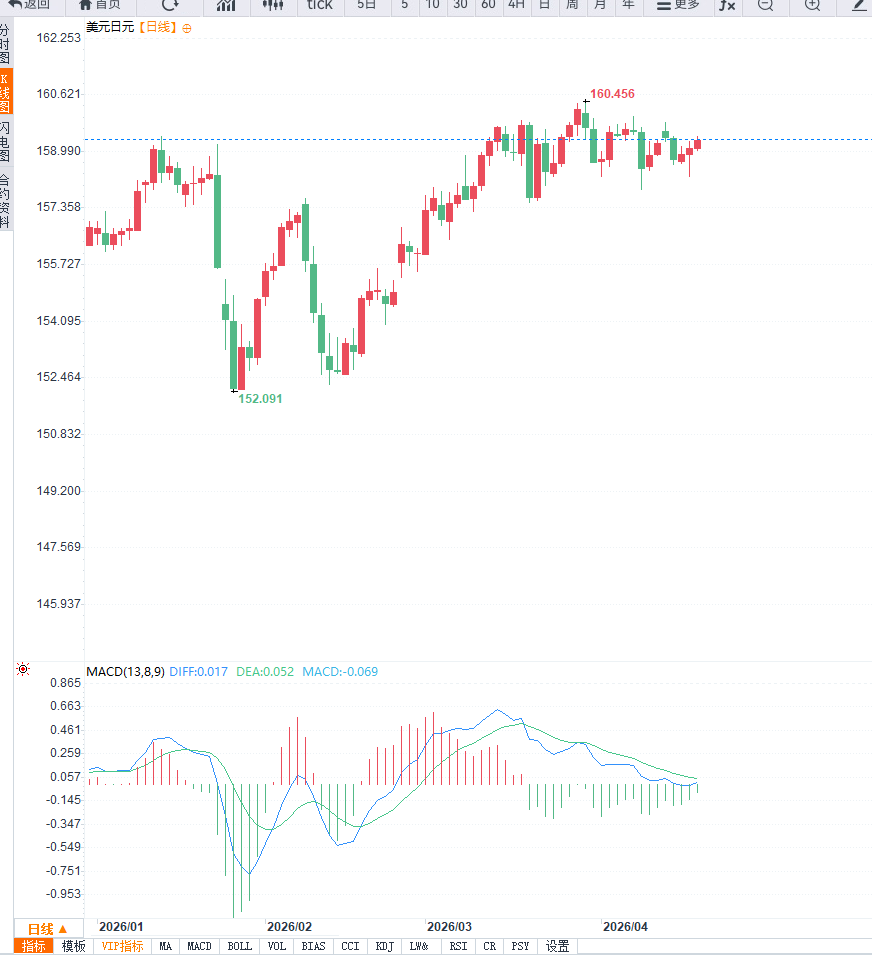
From a market structure perspective, the USD/JPY pair is currently caught in a tug-of-war between multiple factors: on the one hand, geopolitical risks are driving demand for the US dollar; on the other hand, expectations of Japanese policy intervention and a potential interest rate hike path are providing support for the Japanese yen. The exchange rate is currently consolidating at a high level around the 159 mark .
At the global market level, both the US dollar and the Japanese yen are considered safe-haven assets. However, in the current environment, the US dollar benefits from higher interest rates and liquidity advantages, resulting in relatively stronger performance. The Japanese yen, on the other hand, is under pressure due to long-term easing policies, but expectations of intervention are a significant supporting factor.
Investor sentiment is clearly cautious in the market. In the short term, trading will primarily revolve around geopolitical risks and policy signals. In the absence of a clear directional catalyst, the exchange rate is more likely to remain volatile at high levels .
From a technical perspective, on the daily chart, USD/JPY maintains a strong upward structure, with higher highs and the overall trend remaining intact. The current price is approaching previous highs, and while momentum indicators are still bullish, they show signs of weakening. Key resistance levels to watch are 160.00 and 161.20; a break above 160 could open up further upside potential. Support levels are at 158.20 and 157.50; a break below these levels could lead to a correction. On the 4-hour chart, the pair is exhibiting a volatile upward trend, with short-term moving averages maintaining a bullish alignment. However, the RSI is approaching overbought territory, and the MACD momentum has weakened, indicating a slowdown in short-term upward momentum and a potential pullback, but the overall trend remains bullish.
Editor's Summary : Overall, the current USD/JPY exchange rate movement is driven by both geopolitical risks and policy expectations. The US dollar remains strong due to safe-haven demand, while the Japanese yen is supported by intervention expectations and signals of policy adjustments. In the short term, the exchange rate may continue to fluctuate at high levels, with limited upside potential but also support on the downside. The future trend hinges on changes in the Middle East situation and whether the Japanese authorities take actual intervention action; investors need to closely monitor relevant signals.
From a fundamental perspective, the situation in the Middle East has once again become the focus of the market. US President Donald Trump stated that Israel and Lebanon have reached a 10-day ceasefire agreement, but the situation is not entirely stable. The Lebanese military indicated that multiple violations have been recorded since the ceasefire took effect, and signs of continued conflict persist in some areas. This uncertainty has intensified market risk aversion, driving the US dollar higher.
Meanwhile, the US and Iran are expected to hold a new round of talks this weekend. Trump expressed optimism about reaching a long-term agreement, but markets generally remain cautious. With the outcome of the negotiations still uncertain, safe-haven funds flowed into the US dollar, putting downward pressure on the yen, with USD/JPY rising to around 159.35 .
However, the upside potential of the exchange rate was also limited by policy signals from Japan. Japanese Finance Minister Satsuki Katayama stated that Japan had been in close communication with US Treasury officials regarding the exchange rate issue and emphasized that "decisive action" would be taken if necessary. This statement was interpreted by the market as a signal of potential intervention, providing support for the yen.
Furthermore, Bank of Japan Governor Kazuo Ueda pointed out that Japan's current real interest rates remain at a low level, requiring careful consideration when deciding on the pace of interest rate hikes. He also noted that inflation is primarily driven by supply shocks rather than demand expansion, which presents greater challenges for monetary policy adjustments.
From a market structure perspective, the USD/JPY pair is currently caught in a tug-of-war between multiple factors: on the one hand, geopolitical risks are driving demand for the US dollar; on the other hand, expectations of Japanese policy intervention and a potential interest rate hike path are providing support for the Japanese yen. The exchange rate is currently consolidating at a high level around the 159 mark .
At the global market level, both the US dollar and the Japanese yen are considered safe-haven assets. However, in the current environment, the US dollar benefits from higher interest rates and liquidity advantages, resulting in relatively stronger performance. The Japanese yen, on the other hand, is under pressure due to long-term easing policies, but expectations of intervention are a significant supporting factor.
Investor sentiment is clearly cautious in the market. In the short term, trading will primarily revolve around geopolitical risks and policy signals. In the absence of a clear directional catalyst, the exchange rate is more likely to remain volatile at high levels .
From a technical perspective, on the daily chart, USD/JPY maintains a strong upward structure, with higher highs and the overall trend remaining intact. The current price is approaching previous highs, and while momentum indicators are still bullish, they show signs of weakening. Key resistance levels to watch are 160.00 and 161.20; a break above 160 could open up further upside potential. Support levels are at 158.20 and 157.50; a break below these levels could lead to a correction. On the 4-hour chart, the pair is exhibiting a volatile upward trend, with short-term moving averages maintaining a bullish alignment. However, the RSI is approaching overbought territory, and the MACD momentum has weakened, indicating a slowdown in short-term upward momentum and a potential pullback, but the overall trend remains bullish.
Editor's Summary : Overall, the current USD/JPY exchange rate movement is driven by both geopolitical risks and policy expectations. The US dollar remains strong due to safe-haven demand, while the Japanese yen is supported by intervention expectations and signals of policy adjustments. In the short term, the exchange rate may continue to fluctuate at high levels, with limited upside potential but also support on the downside. The future trend hinges on changes in the Middle East situation and whether the Japanese authorities take actual intervention action; investors need to closely monitor relevant signals.
- Risk Warning and Disclaimer
- The market involves risk, and trading may not be suitable for all investors. This article is for reference only and does not constitute personal investment advice, nor does it take into account certain users’ specific investment objectives, financial situation, or other needs. Any investment decisions made based on this information are at your own risk.